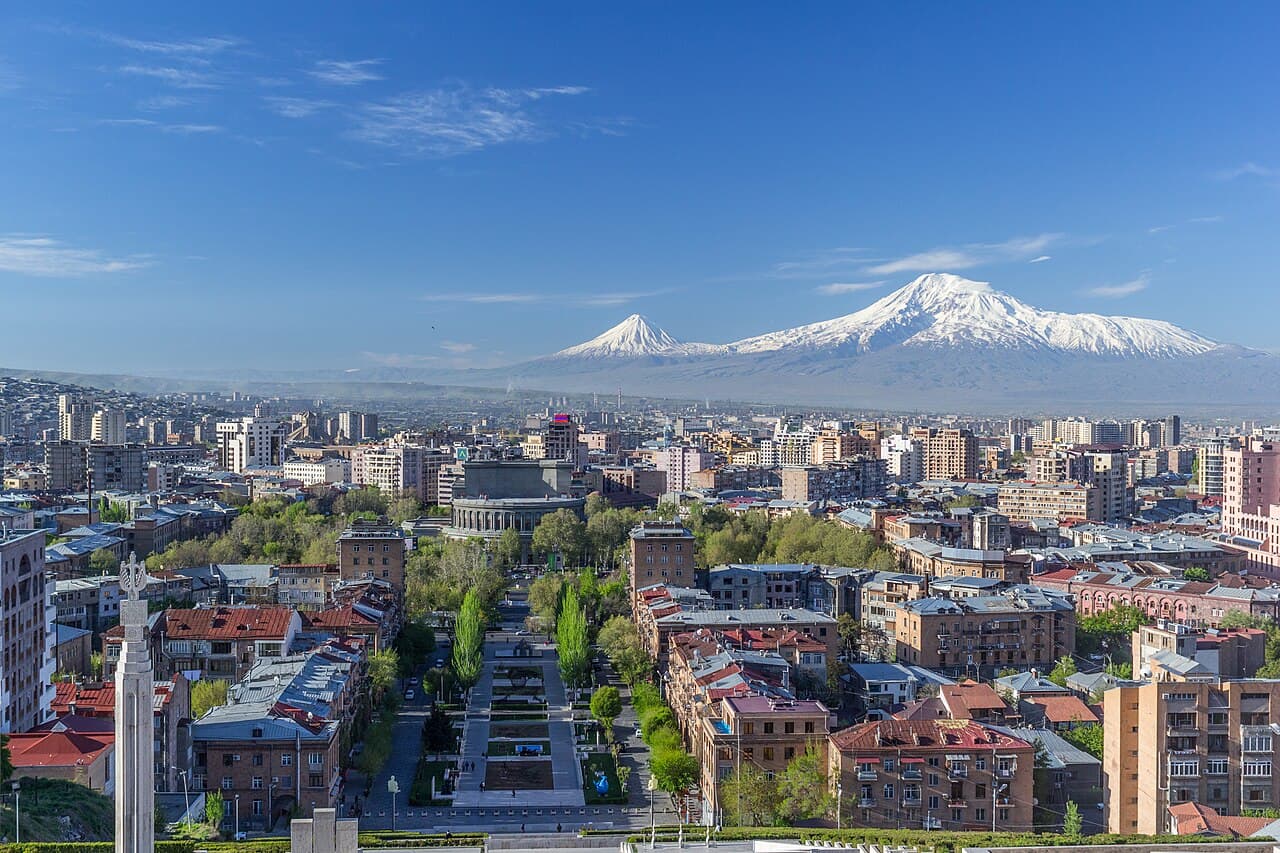
ArmeniaPhoto: Սէրուժ Ուրիշեան (Serouj Ourishian) / Wikimedia Commons (CC BY 4.0)

Armenia

Country · AM · AMD · Asia/Yerevan

This information may change. Always check the official source.Last verified: August 2026 by

A hundred and eighty visa-free days a year, and only two of the four borders you can actually use.

  • Most Western passports enter Armenia without a visa for up to 180 days in a year, for tourism or business.
  • The border with Turkey has been closed since 1993. You cannot cross from Kars or Dogubayazit.
  • The FCDO advises against all travel within 5 km of the entire eastern border between Armenia and Azerbaijan, because of tensions between the two countries.
  • Read the Azerbaijani side before you plan. Azerbaijan can refuse entry to anyone who has visited certain areas without its permission, and the two countries' stamps interact badly. See the Azerbaijan guide.
More details

The allowance is generous and oddly counted

  • Most Western passports enter Armenia without a visa for up to 180 days in a year, for tourism or business.
  • It is 180 days in a year, not per entry and not 90 in 180. That is one of the most generous visa-free allowances anywhere and it is counted across the calendar, so leaving and coming back does not reset it.
  • Your passport must be valid for the duration of your stay - Armenia does not demand the usual six months beyond departure, which is unusually relaxed. Airlines may still apply a stricter test.
  • There is no arrival form and no fee.

Two of the four borders are closed

This is the fact that reshapes itineraries, and it is not a visa matter.

  • The border with Turkey has been closed since 1993. You cannot cross from Kars or Dogubayazit.
  • The border with Azerbaijan is closed and remains so. There is no crossing to Baku or to Nakhchivan.
  • That leaves Georgia to the north and Iran to the south, plus flights.
  • Georgia is the practical land route. Yerevan to Tbilisi is a standard bus or shared-taxi run and the border works normally.
  • The FCDO warns that entering from Iran carries significant personal safety risks for British passport holders, which is a separate matter from whether the crossing is open.

The border strip to stay out of

  • The FCDO advises against all travel within 5 km of the entire eastern border between Armenia and Azerbaijan, because of tensions between the two countries.
  • It also advises against all travel along the M16/H26 road between Ijevan and Noyemberyan. That matters because it is in the north, near the Georgian route, and a satnav may offer it.
  • Check your driving route against that advice before setting off north or east. This is the one piece of Armenian geography that a map app will not warn you about.

If you are also visiting Azerbaijan

  • Read the Azerbaijani side before you plan. Azerbaijan can refuse entry to anyone who has visited certain areas without its permission, and the two countries' stamps interact badly. See the Azerbaijan guide.
Sources (2)

Armenia is in the Eurasian Economic Union, so its customs rules are the union's rather than its own.

  • Armenia is an EAEU member alongside Russia, Belarus, Kazakhstan and Kyrgyzstan, and the union's common customs code sets the allowances and the thresholds.
  • Cash of USD 10,000 or more must be declared, the EAEU-wide figure, on entry and on exit.
  • The allowance for goods depends on how you arrive - the air limit is higher than the land one, which matters on the road in from Georgia.
  • The Turkish and Azerbaijani borders are closed. The only land routes in are from Georgia and Iran, and every itinerary has to be built around that.
  • Antiquities, old carpets and religious objects need an export certificate from the Ministry of Culture, obtained before you fly rather than at the airport.
More details
  • Armenia is an EAEU member alongside Russia, Belarus, Kazakhstan and Kyrgyzstan, and the union's common customs code sets the allowances and the thresholds.
  • Cash of USD 10,000 or more must be declared, the EAEU-wide figure, on entry and on exit.
  • The allowance for goods depends on how you arrive - the air limit is higher than the land one, which matters on the road in from Georgia.
  • The Turkish and Azerbaijani borders are closed. The only land routes in are from Georgia and Iran, and every itinerary has to be built around that.
  • Antiquities, old carpets and religious objects need an export certificate from the Ministry of Culture, obtained before you fly rather than at the airport.
Sources (1)

Yerevan handles the straightforward, private hospitals handle the rest expensively, and outside the capital care is basic.

  • Public facilities in Yerevan are generally sufficient for minor or straightforward problems.
  • Mount Aragats is 4,090 m and the lakes below it about 3,000 m. Altitude sickness is a real risk there and people drive up from Yerevan at 1,000 m in an afternoon.
  • Bring what you need. Pharmacies in Yerevan are good; in villages they are not.
  • Tap water in Yerevan is famously good and the city has public drinking fountains everywhere, which are a genuine Armenian institution. Elsewhere, ask locally.
More details

Care

  • Public facilities in Yerevan are generally sufficient for minor or straightforward problems.
  • Outside Yerevan, care tends to be basic. This is the practical constraint on a trip into the mountains or the south.
  • Private hospitals in Yerevan are good and can be expensive.
  • Take insurance covering treatment and repatriation, and have accessible funds.

Altitude

  • Mount Aragats is 4,090 m and the lakes below it about 3,000 m. Altitude sickness is a real risk there and people drive up from Yerevan at 1,000 m in an afternoon.
  • Ascend slowly and turn back if you get a headache that will not shift.

Medicines

  • Bring what you need. Pharmacies in Yerevan are good; in villages they are not.
  • CBD is a controlled drug here and a prescription is not a defence - see the safety section. This is the most likely medicine mistake at this border.

Everyday

  • Tap water in Yerevan is famously good and the city has public drinking fountains everywhere, which are a genuine Armenian institution. Elsewhere, ask locally.
  • Food is excellent and hygiene standards are good in the cities.
  • Winters are cold and dry, summers very hot in the Ararat plain.

Numbers

  • 112 or 911 for an ambulance - 112 has been the unified number since February 2026 and 103 reaches the ambulance service directly. The FCDO notes an English-speaking operator is available on 911, which is not something you can count on in the region.
Sources (1)

Yerevan

Long-term averages for Yerevan: the mean daily high, the mean overnight low and the mean monthly rainfall across 30 years of ERA5 reanalysis data (1995–2024).

DayNight
-100102030°C0100mmJanFebMarAprMayJunJulAugSepOctNovDecJanuary: Day 3 °C, Night -6 °C, Rain 26 mm. February: Day 5 °C, Night -5 °C, Rain 28 mm. March: Day 10 °C, Night -1 °C, Rain 53 mm. April: Day 16 °C, Night 4 °C, Rain 58 mm. May: Day 21 °C, Night 9 °C, Rain 50 mm. June: Day 28 °C, Night 14 °C, Rain 17 mm. July: Day 31 °C, Night 18 °C, Rain 11 mm. August: Day 32 °C, Night 18 °C, Rain 6 mm. September: Day 26 °C, Night 14 °C, Rain 11 mm. October: Day 19 °C, Night 7 °C, Rain 22 mm. November: Day 11 °C, Night 0 °C, Rain 24 mm. December: Day 5 °C, Night -4 °C, Rain 30 mm
Show the monthly table
Yerevan
MonthDay (°C)Night (°C)Rain (mm)
January3-626
February5-528
March10-153
April16458
May21950
June281417
July311811
August32186
September261411
October19722
November11024
December5-430

Dilijan

Long-term averages for Dilijan: the mean daily high, the mean overnight low and the mean monthly rainfall across 30 years of ERA5 reanalysis data (1995–2024).

DayNight
-1001020°C0200mmJanFebMarAprMayJunJulAugSepOctNovDecJanuary: Day 2 °C, Night -6 °C, Rain 33 mm. February: Day 3 °C, Night -5 °C, Rain 41 mm. March: Day 7 °C, Night -2 °C, Rain 91 mm. April: Day 13 °C, Night 3 °C, Rain 129 mm. May: Day 18 °C, Night 8 °C, Rain 168 mm. June: Day 22 °C, Night 12 °C, Rain 141 mm. July: Day 23 °C, Night 15 °C, Rain 101 mm. August: Day 24 °C, Night 16 °C, Rain 70 mm. September: Day 21 °C, Night 12 °C, Rain 75 mm. October: Day 16 °C, Night 7 °C, Rain 77 mm. November: Day 10 °C, Night 2 °C, Rain 40 mm. December: Day 5 °C, Night -3 °C, Rain 33 mm
Show the monthly table
Dilijan
MonthDay (°C)Night (°C)Rain (mm)
January2-633
February3-541
March7-291
April133129
May188168
June2212141
July2315101
August241670
September211275
October16777
November10240
December5-333

Gyumri

Long-term averages for Gyumri: the mean daily high, the mean overnight low and the mean monthly rainfall across 30 years of ERA5 reanalysis data (1995–2024).

DayNight
-15-551525°C0200mmJanFebMarAprMayJunJulAugSepOctNovDecJanuary: Day -1 °C, Night -11 °C, Rain 31 mm. February: Day 1 °C, Night -10 °C, Rain 31 mm. March: Day 6 °C, Night -5 °C, Rain 71 mm. April: Day 12 °C, Night 0 °C, Rain 100 mm. May: Day 17 °C, Night 5 °C, Rain 111 mm. June: Day 22 °C, Night 9 °C, Rain 72 mm. July: Day 25 °C, Night 12 °C, Rain 51 mm. August: Day 26 °C, Night 13 °C, Rain 36 mm. September: Day 22 °C, Night 9 °C, Rain 28 mm. October: Day 15 °C, Night 4 °C, Rain 47 mm. November: Day 7 °C, Night -2 °C, Rain 30 mm. December: Day 1 °C, Night -8 °C, Rain 31 mm
Show the monthly table
Gyumri
MonthDay (°C)Night (°C)Rain (mm)
January-1-1131
February1-1031
March6-571
April120100
May175111
June22972
July251251
August261336
September22928
October15447
November7-230
December1-831
Sources (1)

Where to stay

Yerevan for almost everything, Dilijan or Goris if you want a second base.

  • Almost everything in Armenia is a day trip from Yerevan, and most visitors never move.
  • The Kentron district - the centre, around Republic Square and the Cascade - is where to stay. Walkable, full of cafes, and the whole city's social life happens on those streets in the evening.
  • Dilijan - forested, cool, called the Armenian Switzerland, and a good base for the north and Lake Sevan. Check the route in avoids the M16/H26 road the FCDO advises against.
  • Anywhere within 5 km of the eastern border with Azerbaijan. The FCDO advises against all travel there, which rules out a strip running the length of the country's eastern side.
  • Winter is cold and Yerevan sits at 1,000 m. Heating in older apartments is uneven.
More details

Yerevan is the base

  • Almost everything in Armenia is a day trip from Yerevan, and most visitors never move.
  • The Kentron district - the centre, around Republic Square and the Cascade - is where to stay. Walkable, full of cafes, and the whole city's social life happens on those streets in the evening.
  • Accommodation is cheap and there is a good supply of apartments as well as hotels.

A second base

  • Dilijan - forested, cool, called the Armenian Switzerland, and a good base for the north and Lake Sevan. Check the route in avoids the M16/H26 road the FCDO advises against.
  • Goris - in the far south, for Tatev and the Karahunj stones, and on the road to Iran.
  • Lake Sevan - guesthouses on the shore, busy in July and August with Armenians rather than foreigners.

What to avoid

  • Anywhere within 5 km of the eastern border with Azerbaijan. The FCDO advises against all travel there, which rules out a strip running the length of the country's eastern side.
  • Check where a rural guesthouse actually is against that advice before booking - the villages on that side are not always obviously close to a frontier on a booking site's map.

Practical

  • Winter is cold and Yerevan sits at 1,000 m. Heating in older apartments is uneven.
  • Summer in Yerevan is very hot - it is a dry basin and it holds heat.
  • Petty theft happens - pickpocketing, bag-snatching, theft from cars and burglary involving foreigners. Ordinary precautions.
Sources (2)

Getting online in Armenia

Three networks, very cheap data, and good coverage everywhere except the mountains.

  • Three networks cover Armenia: Viva, Team and Ucom. Both of the first two changed name recently and the old ones are still on every sign - Viva was VivaCell-MTS, Team was Beeline. Prepaid tourist SIMs are sold at Zvartnots airport and in every Yerevan mall.
  • Data is genuinely cheap - among the cheapest in the region - and packages are generous.
  • Works well and is easy. Armenia's networks are well supported.
  • A local SIM is worth it if you are driving, because the mountain roads are where you would need to call someone and where a local number is what a hotel or a recovery service will call back on.
  • Download offline maps before leaving Yerevan. The monastery roads - Tatev, Noravank, Haghpat - run through valleys with no signal.
More details

The local SIM

  • Three networks cover Armenia: Viva, Team and Ucom. Both of the first two changed name recently and the old ones are still on every sign - Viva was VivaCell-MTS, Team was Beeline. Prepaid tourist SIMs are sold at Zvartnots airport and in every Yerevan mall.
  • Data is genuinely cheap - among the cheapest in the region - and packages are generous.
  • Registration needs the passport.
  • Coverage is good in Yerevan, the towns and along the main roads, and drops in the mountains, which is much of the country.

An eSIM instead

  • Works well and is easy. Armenia's networks are well supported.
  • A local SIM is worth it if you are driving, because the mountain roads are where you would need to call someone and where a local number is what a hotel or a recovery service will call back on.

Practical

  • Download offline maps before leaving Yerevan. The monastery roads - Tatev, Noravank, Haghpat - run through valleys with no signal.
  • Check your route against the FCDO's border advice while you still have data. The 5 km strip along the eastern border and the M16/H26 road are not marked on any map app.
  • Wi-fi is everywhere in Yerevan - cafes, restaurants, hotels - and Armenia has a substantial tech sector, so it is fast.
Sources (1)

Armenian sockets are Type and at 230 V, the European round-pin pattern.

  • A Europlug fits every socket in the country, and Schuko plugs fit the earthed ones.
  • British, American and Australian plugs need an adapter.
  • Soviet-era sockets are unearthed and slightly narrower, so a heavy European plug occasionally needs a firm push.
  • Georgia and Iran, the two open land borders, use the same round pins, so the plug is one thing that does not change in the region.
  • 230 V, so American 120 V-only appliances need a converter, not just a shape adapter.
More details

Sockets in Armenia are Type and at 230 V, 50 Hz - two round pins, the same shape as continental Europe.

  • A Europlug fits every socket in the country, and Schuko plugs fit the earthed ones.
  • British, American and Australian plugs need an adapter.
  • Soviet-era sockets are unearthed and slightly narrower, so a heavy European plug occasionally needs a firm push.
  • Georgia and Iran, the two open land borders, use the same round pins, so the plug is one thing that does not change in the region.
  • 230 V, so American 120 V-only appliances need a converter, not just a shape adapter.
Sources (1)

European plugs, an alphabet you cannot guess at, and Russian as the second language.

  • Plugs are the European two-pin type and , 230 V. Standard continental European kit works.
  • Yerevan is at 1,000 m and has a continental climate: very hot dry summers, cold winters.
  • Armenia was the first country to adopt Christianity as a state religion, in 301, and the monasteries are the point of the country. Most are working churches: cover shoulders, women often cover their heads, and services are worth standing quietly through.
  • Yerevan's drinking fountains (pulpulaks) are safe and everywhere - fill a bottle rather than buying water.
More details

The basics

  • Plugs are the European two-pin type and , 230 V. Standard continental European kit works.
  • Armenian has its own alphabet, invented in 405 AD and related to nothing else. You cannot sound out a word or guess a street name - a camera translation app is genuinely useful here in a way it is not in a Latin or Cyrillic country.
  • Russian is very widely spoken and often signposted. English is common among younger people in Yerevan and rare in villages.
  • UTC+4 all year, no daylight saving.
  • Dialling code +374.

Climate

  • Yerevan is at 1,000 m and has a continental climate: very hot dry summers, cold winters.
  • The mountains are another matter entirely and passes close from November to February.
  • Spring and autumn are the best times to visit.

Culture

  • Armenia was the first country to adopt Christianity as a state religion, in 301, and the monasteries are the point of the country. Most are working churches: cover shoulders, women often cover their heads, and services are worth standing quietly through.
  • The genocide memorial at Tsitsernakaberd is central to Armenian identity and is visited seriously rather than as a sight.
  • Hospitality is intense and sincere. An invitation to a table is not a formality.
  • Coffee and cognac are the two things Armenians will insist you try, and both are good.

Small things

  • Yerevan's drinking fountains (pulpulaks) are safe and everywhere - fill a bottle rather than buying water.
  • The Cascade is where the city goes in the evening.
  • Sunday is quiet and rural bus services thin out.
Sources (2)

Money, cards and the dram

Cheap, card-friendly in Yerevan and cash-only outside it.

  • The Armenian dram (AMD) is the currency and the numbers are large - a coffee is several hundred, a meal several thousand.
  • Cards work well in Yerevan - restaurants, shops, hotels, supermarkets - and contactless is normal.
  • Private hospitals are good and can be expensive. Take insurance covering treatment and repatriation, and have accessible funds - see the health section.
  • 10% is normal in restaurants and often already added in Yerevan.
  • Prices are quoted with the thousands separator and a menu at 3,500 is three and a half thousand dram, not thirty-five.
More details

The dram

  • The Armenian dram (AMD) is the currency and the numbers are large - a coffee is several hundred, a meal several thousand.
  • Armenia is inexpensive by European standards, and among the better-value countries in the region.
  • Exchange offices are everywhere in Yerevan and give better rates than banks or the airport. US dollars, euros and Russian roubles are all readily exchanged.

Cards

  • Cards work well in Yerevan - restaurants, shops, hotels, supermarkets - and contactless is normal.
  • Cash is needed outside the capital, in villages, at monasteries, for marshrutkas and shared taxis, and at most guesthouses.
  • Take cash before a day trip. The monastery towns do not reliably have working machines.
  • Cash machines are common in Yerevan and thin out fast. Decline the offer to be billed in your own currency.

Medical costs

  • Private hospitals are good and can be expensive. Take insurance covering treatment and repatriation, and have accessible funds - see the health section.

Tipping

  • 10% is normal in restaurants and often already added in Yerevan.
  • Drivers and guides are tipped modestly.

Small things

  • Prices are quoted with the thousands separator and a menu at 3,500 is three and a half thousand dram, not thirty-five.
  • Keep small notes for marshrutkas and church donations.
Sources (2)

Everyday prices

Typical prices in dram (AMD), averaged across the country by Numbeo and read on 19 August 2026. Tick Convert prices above the table to see every amount in your own currency.

Everyday prices
ItemTypical price
Inexpensive restaurant meal4,000 AMD
Dinner for two, mid-range, three courses15,500 AMD
Cappuccino1,160 AMD
Local draught beer, 0.5 l800 AMD
Bottled water, 0.33 l216 AMD
Public transport, one-way ticket150 AMD
Taxi, starting fare400 AMD
Petrol, 1 litre542 AMD
Cigarettes, pack of 20 (Marlboro)1,000 AMD
Average net monthly salary278,000 AMD

These are country-wide averages, not a price list: tourist districts, airports and islands sit well above them, and small towns below. The salary line is there for proportion - it is what people living here actually earn.

Sources (1)

Airport guides for Armenia2

One page per airport: the routes into town, what they cost and the trap particular to that arrival.

See all 2 airports

From Zvartnots into Yerevan

Twelve kilometres and about twenty minutes, with ride-hailing that costs almost nothing.

  • Zvartnots International (EVN) is about 12 km west of Yerevan - 20 minutes in normal traffic.
  • It is small, modern and easy. Immigration is quick for visa-free nationalities.
  • Yandex Go and GG are the ride-hailing apps and both work from the airport. A ride into Yerevan costs very little.
  • Airport taxis are fixed-price from the official desk. Agree the figure; there is no meter.
  • Yerevan is where everything starts. The country is small and most sights are day trips: Garni and Geghard, Khor Virap, Noravank, Tatev, Lake Sevan, Dilijan.
More details
The airport
  • Zvartnots International (EVN) is about 12 km west of Yerevan - 20 minutes in normal traffic.
  • It is small, modern and easy. Immigration is quick for visa-free nationalities.
  • Flights arrive at unsociable hours. A great many Yerevan arrivals land between 03:00 and 05:00, which is worth knowing when you book accommodation.
Into town
  • Yandex Go and GG are the ride-hailing apps and both work from the airport. A ride into Yerevan costs very little.
  • Airport taxis are fixed-price from the official desk. Agree the figure; there is no meter.
  • Bus 201 runs to Republic Square for 300 dram, cash, and it runs all night - every 30 minutes from 07:00 to 22:00 and hourly after that, which is exactly when those 03:00 arrivals land.
  • Take cash for the taxi if you have not set up an app - the drivers prefer it.
Onward
  • Yerevan is where everything starts. The country is small and most sights are day trips: Garni and Geghard, Khor Virap, Noravank, Tatev, Lake Sevan, Dilijan.
  • Marshrutkas (minibuses) and shared taxis cover the country from the Kilikia and Sasuntsi David terminals.
  • To Georgia: buses and shared taxis run Yerevan to Tbilisi daily, about six hours. Check the route avoids the M16/H26 road the FCDO advises against.
  • The train to Tbilisi runs overnight in summer and is slow and pleasant.
Sources (2)

Getting around Armenia

Marshrutkas, shared taxis and a hire car - on roads that are worse than the distances suggest.

  • Yandex Go and GG are the ride-hailing apps and are absurdly cheap. This is how visitors move around.
  • The metro is a single Soviet line, clean and fast, and covers less of the city than you would want.
  • Marshrutkas - minibuses - run everywhere from the Yerevan terminals. Cheap, crowded, and departing when full rather than on a timetable.
  • Shared taxis cover the same routes faster for a little more.
  • You need an International Driving Permit as well as your own licence.
More details

In Yerevan

  • Yandex Go and GG are the ride-hailing apps and are absurdly cheap. This is how visitors move around.
  • The metro is a single Soviet line, clean and fast, and covers less of the city than you would want.
  • Yerevan is walkable in the centre, which is where almost everything is.

Around the country

  • Marshrutkas - minibuses - run everywhere from the Yerevan terminals. Cheap, crowded, and departing when full rather than on a timetable.
  • Shared taxis cover the same routes faster for a little more.
  • Hiring a driver for a day is a normal and affordable way to see three monasteries in one go, and is what most visitors end up doing.
  • The Tatev cable car - the longest reversible aerial tramway in the world - is the way to reach Tatev monastery, and is worth planning a day around.

Driving yourself

  • You need an International Driving Permit as well as your own licence.
  • The FCDO describes the standard of driving as poor, with drivers ignoring traffic laws. That is accurate.
  • Roads deteriorate significantly from November to February, and mountain passes close.
  • Do not drive at night outside towns - poor road surfaces, inadequate lighting, and livestock.
  • Check your route against the border advice. Stay 5 km clear of the eastern border with Azerbaijan and avoid the M16/H26 between Ijevan and Noyemberyan. A satnav will not know this.

Apps and platforms

Two ride-hailing apps, offline maps, and a translation tool for the alphabet.

  • Yandex Go and GG - the two ride-hailing apps. Both work in Yerevan and both are cheap enough that taking a car everywhere is affordable.
  • Offline maps. The monastery valleys have no signal.
  • No Uber, no Bolt.
  • Few things book online outside Yerevan hotels. Tours, drivers and guesthouses are arranged by phone or WhatsApp.
  • Carry a copy of your passport rather than the original, which is the FCDO's advice, and keep the original somewhere secure.
More details

Worth having

  • Yandex Go and GG - the two ride-hailing apps. Both work in Yerevan and both are cheap enough that taking a car everywhere is affordable.
  • Offline maps. The monastery valleys have no signal.
  • A translation app with camera input. The Armenian alphabet is unique - it shares nothing with Latin or Cyrillic - so a menu or a road sign is genuinely unreadable without help. Russian is widely understood and often signposted alongside.

What does not exist

  • No Uber, no Bolt.
  • Few things book online outside Yerevan hotels. Tours, drivers and guesthouses are arranged by phone or WhatsApp.

A practical habit

  • Carry a copy of your passport rather than the original, which is the FCDO's advice, and keep the original somewhere secure.
  • Armenian addresses often use the old Russian conventions, so a pin is more reliable than a written address.
Sources (3)

Armenian roads are free, the alcohol limit is effectively zero, and the mountain routes need care rather than a 4x4.

  • The alcohol limit is effectively zero and roadside checks are routine.
  • Roads are free; there are no tolls or vignettes anywhere in the country.
  • The main routes are paved and reasonable, and the side roads to Tatev, Noravank and the Vayots Dzor villages are narrow with steep drops and no barriers.
  • Winter closes the Vardenyats and Selim passes and snow reaches the main north-south route in January.
  • Speed cameras are widespread on the Yerevan approaches and the fines reach hire companies reliably.
More details

Free roads, near-zero alcohol tolerance, and mountain driving that is slow rather than technical.

  • The alcohol limit is effectively zero and roadside checks are routine.
  • Roads are free; there are no tolls or vignettes anywhere in the country.
  • The main routes are paved and reasonable, and the side roads to Tatev, Noravank and the Vayots Dzor villages are narrow with steep drops and no barriers.
  • Winter closes the Vardenyats and Selim passes and snow reaches the main north-south route in January.
  • Speed cameras are widespread on the Yerevan approaches and the fines reach hire companies reliably.
Sources (1)

Safety and the border areas

A low-crime country with two specific places the FCDO says not to go, and a drug law with no medical exemption.

  • Armenia has low crime rates and Yerevan is comfortable to walk at night.
  • Within 5 km of the entire eastern border with Azerbaijan - the FCDO advises against all travel there because of tensions between the two countries, and there is a ceasefire rather than a settlement.
  • Smuggling drugs carries 4 to 10 years, which is the sentence the FCDO names.
  • The standard of driving is poor and traffic laws are widely ignored.
  • Demonstrations occur in Yerevan and the larger cities, usually organised by political opposition, and tend to be peaceful. Avoid large gatherings anyway.
More details

Crime is low

  • Armenia has low crime rates and Yerevan is comfortable to walk at night.
  • Occasional pickpocketing, bag-snatching, theft from cars and burglary involving foreigners is the realistic risk.
  • Carry a copy of your passport rather than the original.

The two places not to go

  • Within 5 km of the entire eastern border with Azerbaijan - the FCDO advises against all travel there because of tensions between the two countries, and there is a ceasefire rather than a settlement.
  • The M16/H26 road between Ijevan and Noyemberyan - advised against for the same reason. This is in the north and can appear on a route to Georgia.
  • Neither is signposted as a restricted zone in a way a visitor would notice. Check the route, not the road signs.

Drugs

  • Smuggling drugs carries 4 to 10 years, which is the sentence the FCDO names.
  • Using, possessing or trading cannabis, CBD or THC products is illegal here in its own right - CBD included, which is the part that catches ordinary travellers rather than smugglers.
  • A medical prescription is not a defence. The FCDO says so directly, which is unusually blunt and worth taking at face value if you carry CBD for anything.

Driving

  • The standard of driving is poor and traffic laws are widely ignored.
  • Roads deteriorate from November to February.
  • Do not drive at night outside urban areas.

Protests

  • Demonstrations occur in Yerevan and the larger cities, usually organised by political opposition, and tend to be peaceful. Avoid large gatherings anyway.

The mountains

  • Altitude sickness is a genuine risk on Mount Aragats at 4,090 m and around the Aragats lakes at about 3,000 m.
  • Weather changes fast and mountain rescue is limited.
Sources (3)

Emergency numbers and what to do

112 has been the unified number since February 2026, and 911 still works with an English-speaking operator - which is not the norm in the region.

  • 112 has been the unified number since 15 February 2026, and it puts police and rescue on the same call. 911 still reaches all services and the FCDO notes an English-speaking operator is available, which is a real advantage over most of the region.
  • Contact your insurer immediately if you are referred for treatment - private hospitals are good and expensive, and accessible funds may be needed.
  • Mountain rescue is limited. Tell someone your route and your expected return before walking on Aragats or in the high south.
  • If you realise you are close to the eastern border with Azerbaijan, turn around. The FCDO's 5 km line exists because the situation is a ceasefire rather than a settlement.
More details

The numbers

Emergency numbers and what to do
ForCall
All emergencies112
All emergencies (also reaches every service)911
Fire101
Police102
Ambulance103
Gas leak104
  • 112 has been the unified number since 15 February 2026, and it puts police and rescue on the same call. 911 still reaches all services and the FCDO notes an English-speaking operator is available, which is a real advantage over most of the region.

If something goes wrong

  • Contact your insurer immediately if you are referred for treatment - private hospitals are good and expensive, and accessible funds may be needed.
  • Report a crime and get the report for the claim.
  • Outside Yerevan, the plan for anything serious is getting to Yerevan.

In the mountains

  • Mountain rescue is limited. Tell someone your route and your expected return before walking on Aragats or in the high south.
  • There is no signal in the valleys, so an offline map and a charged phone are the safety kit.

Near the border

  • If you realise you are close to the eastern border with Azerbaijan, turn around. The FCDO's 5 km line exists because the situation is a ceasefire rather than a settlement.
  • Do not photograph military positions or checkpoints anywhere near it.

Consular

  • Most countries have an embassy in Yerevan, which is a practical advantage in a small country - help is in the same city as almost everything else.
Sources (3)