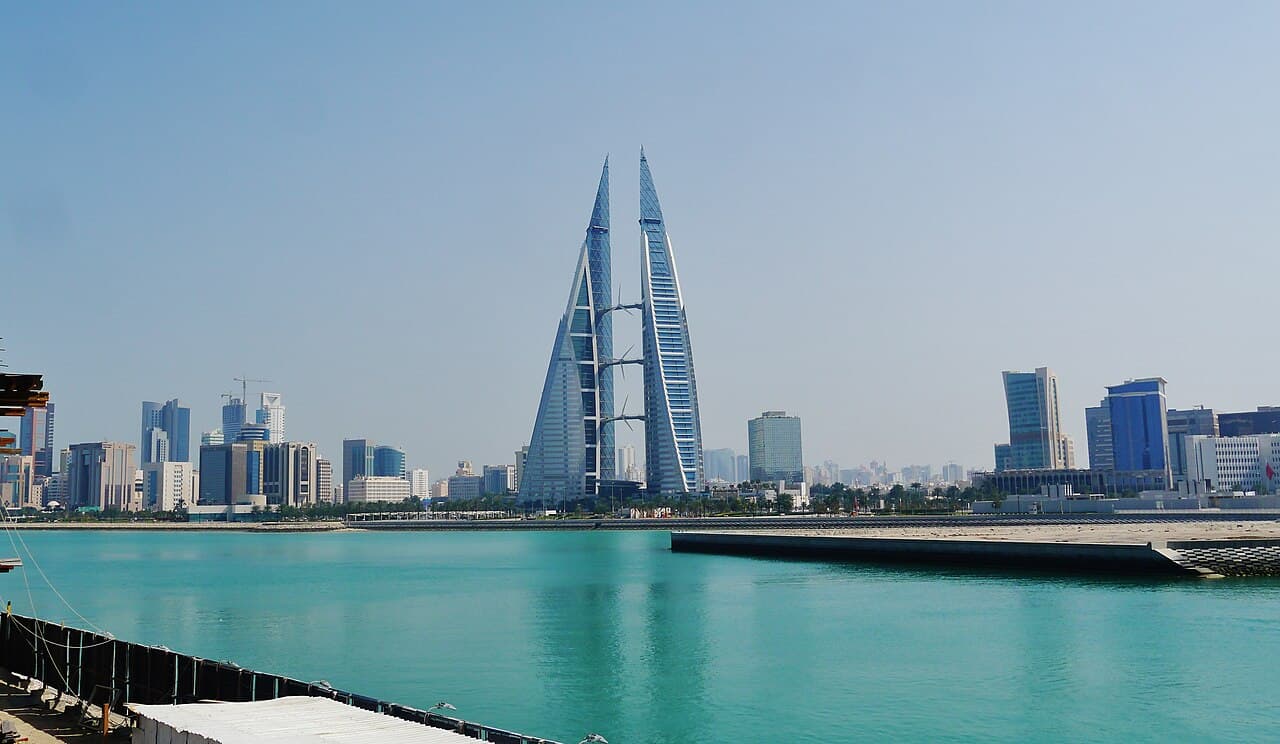
BahrainPhoto: Zairon / Wikimedia Commons (CC BY-SA 4.0)

Bahrain

Country · BH · BHD · Asia/Bahrain

This information may change. Always check the official source.Last verified: August 2026 by

Everyone needs a visa, most people can get one at the airport, and what you get by default is two weeks.

  • There is no visa-free entry to Bahrain except for GCC citizens. Every other passport needs a visa of some kind.
  • Most Western and East Asian passports can get one on arrival, at the airport or the causeway. Bahrain publishes the list: the UK, USA, Canada, Australia, the EU and Schengen states, Japan, South Korea, Singapore, Malaysia, China, Hong Kong, Macao, Russia and India are all on it.
  • A visa is issued automatically for 2 weeks. That is the default and it is what most arrivals leave the desk with.
  • Your passport must be valid at least 6 months after arrival.
  • The King Fahd Causeway runs 25 km to Saudi Arabia and is the busiest land crossing in the Gulf.
More details

Everyone needs a visa - but most can buy it at the desk

  • There is no visa-free entry to Bahrain except for GCC citizens. Every other passport needs a visa of some kind.
  • Most Western and East Asian passports can get one on arrival, at the airport or the causeway. Bahrain publishes the list: the UK, USA, Canada, Australia, the EU and Schengen states, Japan, South Korea, Singapore, Malaysia, China, Hong Kong, Macao, Russia and India are all on it.
  • Or apply online in advance at , which is faster on arrival and lets you fix a problem before you fly rather than at the border.
  • Use and nothing else. Bahrain's own site states that it is the only official channel and that no company operates on behalf of the government - the reseller industry around Gulf visas is large and charges several times the fee.

What you actually get

  • A visa is issued automatically for 2 weeks. That is the default and it is what most arrivals leave the desk with.
  • Visit visas of up to 6 months exist but are a different application, made in advance.
  • Two weeks is ample for Bahrain, which is a small island. It is not ample if you were planning to use it as a regional base.
  • Extensions are handled through the Bahrain.bh government portal rather than at the airport.

The rest

  • Your passport must be valid at least 6 months after arrival.
  • You may be asked for evidence of onward travel and accommodation.
  • Holding a visa does not guarantee entry - Bahrain states this explicitly - and a refused entry is not refunded.

The causeway is a real border

  • The King Fahd Causeway runs 25 km to Saudi Arabia and is the busiest land crossing in the Gulf.
  • It is a full international border. Going to Khobar for the day needs a Saudi visa, and coming back needs a fresh Bahraini visa unless you hold a multiple-entry one.
  • Thursday evenings and Ramadan the queue can run for hours in the Bahrain-bound direction.
Sources (3)

Bahrain is the relaxed one in the Gulf, and the trap is the causeway: what is legal here is not legal in Saudi Arabia.

  • Non-Muslim adults may bring in a limited quantity of alcohol, and it is sold legally in licensed shops and hotels - unusual for the region.
  • Carrying alcohol across the King Fahd Causeway into Saudi Arabia is a serious criminal offence. The Saudi side searches vehicles, and a bottle in the boot has ended in detention.
  • Pork is available in licensed sections of supermarkets and may be brought in in small personal quantities.
  • Bahrain publishes no fixed cash threshold, unlike its neighbours, but customs may require you to declare currency or gold on the spot and you should be able to account for a large sum. Do not assume the Gulf-standard figure applies here.
More details
  • Non-Muslim adults may bring in a limited quantity of alcohol, and it is sold legally in licensed shops and hotels - unusual for the region.
  • Carrying alcohol across the King Fahd Causeway into Saudi Arabia is a serious criminal offence. The Saudi side searches vehicles, and a bottle in the boot has ended in detention.
  • Pork is available in licensed sections of supermarkets and may be brought in in small personal quantities.
  • Bahrain publishes no fixed cash threshold, unlike its neighbours, but customs may require you to declare currency or gold on the spot and you should be able to account for a large sum. Do not assume the Gulf-standard figure applies here.
  • Medicines containing codeine or narcotics need a prescription in the original packaging.
  • Material considered offensive to Islam is prohibited, and printed matter is what customs looks at.
Sources (2)

Good hospitals, and you will be billed for emergency treatment as a visitor.

  • Bahrain has good private hospitals and clinics, several with English-speaking staff; the FCDO publishes a list.
  • This is the one to plan for. Some medicines that are ordinary at home are controlled in Bahrain.
  • Summer runs May to September and Bahrain is humid as well as hot - the combination is harder work than the dry heat of Riyadh.
  • Dust storms occur and air quality can be poor for days, which matters if you are asthmatic.
  • 999 for an ambulance, and it is the general emergency number.
More details

Care

  • Bahrain has good private hospitals and clinics, several with English-speaking staff; the FCDO publishes a list.
  • You will be charged for emergency treatment. Take insurance covering treatment and repatriation, and have accessible funds as well - payment may be wanted at the point of care.

Medicines - check before you fly

  • This is the one to plan for. Some medicines that are ordinary at home are controlled in Bahrain.
  • The FCDO advises seeking prior authority from the Bahrain Embassy before bringing certain prescription medicines, and carrying a doctor's letter.
  • Do not assume a pharmacy will replace something you could not bring.

Heat

  • Summer runs May to September and Bahrain is humid as well as hot - the combination is harder work than the dry heat of Riyadh.
  • Everything is air-conditioned and life moves indoors and after dark.
  • Drink more than you think, and take salt as well as water.

Air quality

  • Dust storms occur and air quality can be poor for days, which matters if you are asthmatic.

Numbers

  • 999 for an ambulance, and it is the general emergency number.
Sources (1)

Manama

Long-term averages for Manama: the mean daily high, the mean overnight low and the mean monthly rainfall across 30 years of ERA5 reanalysis data (1995–2024).

DayNight
152025303540°C020mmJanFebMarAprMayJunJulAugSepOctNovDecJanuary: Day 19 °C, Night 15 °C, Rain 17 mm. February: Day 20 °C, Night 16 °C, Rain 10 mm. March: Day 23 °C, Night 18 °C, Rain 10 mm. April: Day 28 °C, Night 22 °C, Rain 3 mm. May: Day 32 °C, Night 27 °C, Rain 2 mm. June: Day 35 °C, Night 30 °C, Rain 0 mm. July: Day 37 °C, Night 31 °C, Rain 0 mm. August: Day 37 °C, Night 31 °C, Rain 0 mm. September: Day 36 °C, Night 29 °C, Rain 0 mm. October: Day 32 °C, Night 26 °C, Rain 1 mm. November: Day 26 °C, Night 22 °C, Rain 12 mm. December: Day 21 °C, Night 17 °C, Rain 14 mm
Show the monthly table
Manama
MonthDay (°C)Night (°C)Rain (mm)
January191517
February201610
March231810
April28223
May32272
June35300
July37310
August37310
September36290
October32261
November262212
December211714

When to visit

Manama's summer is not really about the daytime 37 C - it is about nights that stay at 30-31 C from June to September. The season worth flying for is November to March.

Manama's daytime peak is 37 C in July and August, which is a number people arrive expecting.

More details

The night is the part that catches people out

Manama's daytime peak is 37 C in July and August, which is a number people arrive expecting. The figure that changes a trip is the overnight mean: 30 C in June, 31 C in July and August, 29 C in September. Four months of the year the city does not cool down after dark, so the evening is not the escape from the afternoon that it is in a Mediterranean summer - it is a slightly dimmer version of it.

Rain effectively stops for half the year. April through October total 6 mm between them, and June to September average zero. There is no wet season to plan around; the only thing the calendar decides is how hot it will be.

The season is winter, and it is a real one

From November to March the daytime mean runs 19-26 C with nights at 15-22 C, which is shirt weather rather than survival weather, and it is when the country's outdoor life actually happens. January, at 19 C by day, is the coolest month of the year and still warmer than a London August.

The shoulders are short and sharp. April already averages 28 C by day and 22 C at night; by May the daytime mean is 32 C. If a date is flexible by a fortnight in spring, moving it earlier is worth more here than almost anywhere.

Sources (1)

Where to stay

Manama, Adliya or Amwaj - and midweek costs a fraction of the weekend.

  • Manama city centre and the Diplomatic Area - business hotels, the World Trade Centre, walking distance to the Bab Al Bahrain souq.
  • Adliya - the restaurant and gallery district, low-rise, walkable, and where people actually go out in the evening.
  • Bahrain is where Saudi Arabia goes for the weekend, across the causeway.
  • Thursday and Friday nights cost far more than Sunday to Wednesday, and everything is busier.
  • The FCDO names Sitra, Bani Jamra, Diraz and the villages along Budaiya Highway as places where demonstrations occur.
More details

The areas

  • Manama city centre and the Diplomatic Area - business hotels, the World Trade Centre, walking distance to the Bab Al Bahrain souq.
  • Adliya - the restaurant and gallery district, low-rise, walkable, and where people actually go out in the evening.
  • Seef - the malls and the newer towers, functional and dull.
  • Amwaj Islands - reclaimed islands off Muharraq with beaches and apartments, quieter and further out.
  • Muharraq - the old town, the pearling trail, and the closest thing Bahrain has to genuine heritage streets. Underrated.

Timing is the price

  • Bahrain is where Saudi Arabia goes for the weekend, across the causeway.
  • Thursday and Friday nights cost far more than Sunday to Wednesday, and everything is busier.
  • The Formula One weekend in spring fills the island entirely and prices multiply.

Where not to bother going

  • The FCDO names Sitra, Bani Jamra, Diraz and the villages along Budaiya Highway as places where demonstrations occur.
  • These are residential villages with nothing for a visitor. Avoiding them is not a restriction on anything you would want to do.
  • Leave any area where a large gathering forms, which is the general advice everywhere.
Sources (1)

Getting online in Bahrain

Three networks on an island 50 km long. Coverage is not a problem here.

  • Batelco, stc Bahrain and Zain cover the country - that is three operators, not four: stc Bahrain is the former VIVA, and Batelco is still Batelco. All sell tourist prepaid SIMs at the airport and in the malls.
  • Registration needs the passport.
  • The obvious choice for a short trip, which most Bahrain trips are. All three networks are well supported.
  • If you are crossing the causeway to Saudi Arabia, note that a Bahraini plan does not cover you there and roaming charges apply. Buy a separate Saudi eSIM if you are spending real time across the water.
  • Data is cheap and fast by any standard.
More details

The local SIM

  • Batelco, stc Bahrain and Zain cover the country - that is three operators, not four: stc Bahrain is the former VIVA, and Batelco is still Batelco. All sell tourist prepaid SIMs at the airport and in the malls.
  • Registration needs the passport.
  • Coverage is total. Bahrain is an archipelago about 50 km long with a population concentrated in a small area - there is nowhere with no signal.

An eSIM instead

  • The obvious choice for a short trip, which most Bahrain trips are. All three networks are well supported.
  • If you are crossing the causeway to Saudi Arabia, note that a Bahraini plan does not cover you there and roaming charges apply. Buy a separate Saudi eSIM if you are spending real time across the water.

Practical

  • Data is cheap and fast by any standard.
  • Wi-fi is universal in hotels, malls and cafes.
  • Keeping an eye on local news is worth doing, since demonstrations happen and are geographically specific - see the safety section.
Sources (1)

Bahraini sockets are British Type at 230 V, as across most of the Gulf.

  • British plugs fit straight in. European, American and Australian ones need an adapter.
  • 230 V matches Europe, so only American 120 V-only equipment needs a converter.
  • Saudi Arabia, across the causeway, uses the same plug at 60 Hz rather than 50 - invisible to a charger, faster for a mains-timed motor.
  • Older buildings carry two-pin sockets left from before the standard settled, which take a Europlug.
  • Adapters are cheap in any Lulu or Carrefour and expensive at the airport.
More details

Sockets in Bahrain are Type at 230 V, 50 Hz - the British three-pin plug.

  • British plugs fit straight in. European, American and Australian ones need an adapter.
  • 230 V matches Europe, so only American 120 V-only equipment needs a converter.
  • Saudi Arabia, across the causeway, uses the same plug at 60 Hz rather than 50 - invisible to a charger, faster for a mains-timed motor.
  • Older buildings carry two-pin sockets left from before the standard settled, which take a Europlug.
  • Adapters are cheap in any Lulu or Carrefour and expensive at the airport.
  • A Europlug fits nothing in a Type room without an adapter, which is worth knowing before a connecting flight from Europe.
Sources (1)

British plugs, English almost everywhere, and a weekend that runs Friday to Saturday.

  • Plugs are the British three-pin type , 230 V. UK chargers work unmodified.
  • Arabic is the language and English is very widely spoken - Bahrain has one of the highest levels of English in the region, and every sign, menu and official form is bilingual.
  • Bahrain is the most socially relaxed of the Gulf states after the UAE - alcohol is legal, cinemas show more, and the dress code is more forgiving. It is still a Muslim country and the rules in the safety section are real.
  • Eating, drinking, smoking or loud music in public during daylight are criminal offences, not lapses of manners. This applies to visitors.
  • Adliya is where you eat. Block 338 is the restaurant district and it is genuinely good.
More details

The basics

  • Plugs are the British three-pin type , 230 V. UK chargers work unmodified.
  • Arabic is the language and English is very widely spoken - Bahrain has one of the highest levels of English in the region, and every sign, menu and official form is bilingual.
  • UTC+3 all year, no daylight saving - the same as Saudi Arabia and an hour behind the UAE.
  • The weekend is Friday and Saturday.

Getting a sense of the place

  • Bahrain is the most socially relaxed of the Gulf states after the UAE - alcohol is legal, cinemas show more, and the dress code is more forgiving. It is still a Muslim country and the rules in the safety section are real.
  • It is also the oldest. Dilmun was here 4,000 years ago, the Bahrain Fort sits on a tell of stacked civilisations, and the pearling trail in Muharraq is a UNESCO site about an industry that ended a century ago.
  • The Tree of Life is a 400-year-old acacia alone in the desert, which is either remarkable or a tree, depending on your mood.

Ramadan

  • Eating, drinking, smoking or loud music in public during daylight are criminal offences, not lapses of manners. This applies to visitors.
  • Hotels serve food discreetly to guests during the day.
  • Everything opens after sunset and stays open very late.

Small things

  • Adliya is where you eat. Block 338 is the restaurant district and it is genuinely good.
  • Cover shoulders and knees away from a hotel pool.
  • Friday midday is quiet everywhere until after prayers.
Sources (2)

The dinar, and the 1,000 fils

One of the strongest currencies in the world, divided into 1,000 fils - so prices carry three decimal places.

  • The Bahraini dinar is pegged to the US dollar and is worth well over two and a half of them - one of the highest-value currencies in the world.
  • Cards work everywhere. Contactless is standard, and Apple Pay and Google Pay are widely taken.
  • You will be charged for emergency treatment. The FCDO says so plainly and adds that you need accessible funds as well as insurance, because payment may be wanted at the point of care.
  • Bahrain is cheaper than the UAE and Qatar and more expensive than most of the region beyond the Gulf.
  • 10% is often already added as a service charge. Beyond that, rounding up is enough.
More details

The dinar

  • The Bahraini dinar is pegged to the US dollar and is worth well over two and a half of them - one of the highest-value currencies in the world.
  • It divides into 1,000 fils, not 100, so prices are written to three decimal places. A coffee at 1.500 BHD is one and a half dinars.
  • This catches people out on day one, exactly as the Omani rial does. A restaurant bill of 25.000 is twenty-five dinars, not twenty-five thousand of anything.
  • Saudi riyals are widely accepted in Bahrain, given the causeway traffic, but at a rate that is not in your favour. Pay in dinars.

Cards and cash

  • Cards work everywhere. Contactless is standard, and Apple Pay and Google Pay are widely taken.
  • Cash is useful in the souq, for taxis without an app, and for small shops.
  • Cash machines are everywhere. Decline the offer to be billed in your home currency.

Medical bills

  • You will be charged for emergency treatment. The FCDO says so plainly and adds that you need accessible funds as well as insurance, because payment may be wanted at the point of care.
  • Carry the insurance certificate and the assistance number.

Costs

  • Bahrain is cheaper than the UAE and Qatar and more expensive than most of the region beyond the Gulf.
  • It is a weekend destination for Saudis, so hotel prices rise sharply Thursday and Friday and fall the rest of the week. Arriving Sunday to Wednesday is markedly cheaper.

Tipping

  • 10% is often already added as a service charge. Beyond that, rounding up is enough.
Sources (2)

Everyday prices

Typical prices in Bahraini dinar (BHD), averaged across the country by Numbeo and read on 19 August 2026. Tick Convert prices above the table to see every amount in your own currency.

Everyday prices
ItemTypical price
Inexpensive restaurant meal2.65 BHD
Dinner for two, mid-range, three courses18 BHD
Cappuccino1.79 BHD
Local draught beer, 0.5 l2.50 BHD
Bottled water, 0.33 l0.12 BHD
Public transport, one-way ticket0.30 BHD
Taxi, starting fare2.00 BHD
Petrol, 1 litre0.22 BHD
Cigarettes, pack of 20 (Marlboro)2.20 BHD
Average net monthly salary842 BHD

These are country-wide averages, not a price list: tourist districts, airports and islands sit well above them, and small towns below. The salary line is there for proportion - it is what people living here actually earn.

Sources (1)

Airport guides for Bahrain1

One page per airport: the routes into town, what they cost and the trap particular to that arrival.

See all 1 airports

From Bahrain International into Manama

Fifteen minutes from the terminal to the city, on an island where nothing is far.

  • Bahrain International (BAH) is on Muharraq island, about 7 km from central Manama - 15 minutes, and the terminal was rebuilt in 2021 and is genuinely pleasant.
  • Visas on arrival are issued here for eligible nationalities, at desks before immigration.
  • Use established taxi services - that is the FCDO's phrasing and it means the official rank or an app, not someone offering a lift in the hall.
  • Buses run from the airport to the King Fahd Causeway and on to Saudi Arabia. Remember it is a full border in both directions.
  • Bahrain is about 50 km end to end. Nothing is more than 45 minutes away, including the Formula One circuit at Sakhir and the Bahrain Fort.
More details
The airport
  • Bahrain International (BAH) is on Muharraq island, about 7 km from central Manama - 15 minutes, and the terminal was rebuilt in 2021 and is genuinely pleasant.
  • Visas on arrival are issued here for eligible nationalities, at desks before immigration.
  • Have the fee ready; card is accepted but the queue moves faster if you are prepared.
Into town
  • Use established taxi services - that is the FCDO's phrasing and it means the official rank or an app, not someone offering a lift in the hall.
  • Careem and Uber both operate in Bahrain and are the normal way to move around.
  • Airport taxis are metered. Insist on the meter or agree the price before setting off.
  • There is no airport rail. The bus exists but is not a sensible first move with luggage.
The causeway
  • Buses run from the airport to the King Fahd Causeway and on to Saudi Arabia. Remember it is a full border in both directions.
Scale
  • Bahrain is about 50 km end to end. Nothing is more than 45 minutes away, including the Formula One circuit at Sakhir and the Bahrain Fort.
  • This makes a single base sensible, which is not true of most Gulf countries.
Sources (2)

Getting around Bahrain

Ride-hailing and a hire car. The island is small enough that neither costs much.

  • Careem and Uber both work and are cheap. This is what most visitors use for everything.
  • Taxis are metered and plentiful; use the official ranks or call one.
  • Driving to Saudi Arabia needs a Saudi visa, vehicle insurance valid there, and patience. Rental companies must give permission and most charge for it.
  • The bus across is simpler than driving if you just want to see Khobar.
  • Demonstrations can cause traffic disruption and temporary bans on gatherings in roads and squares.
More details

The practical options

  • Careem and Uber both work and are cheap. This is what most visitors use for everything.
  • Taxis are metered and plentiful; use the official ranks or call one.
  • Renting a car is easy and cheap, and driving in Bahrain is straightforward by Gulf standards - the roads are good and the distances are trivial.
  • Buses run a real network for very little, and are used mainly by residents rather than visitors.

The causeway, again

  • Driving to Saudi Arabia needs a Saudi visa, vehicle insurance valid there, and patience. Rental companies must give permission and most charge for it.
  • The bus across is simpler than driving if you just want to see Khobar.
  • Traffic peaks Thursday evening in the Bahrain-bound direction and Saturday evening going back.

Protests and roads

  • Demonstrations can cause traffic disruption and temporary bans on gatherings in roads and squares.
  • They happen in specific places - see the safety section - and avoiding those villages avoids the issue entirely.

Apps and platforms

Ride-hailing, the official visa portal, and the government services site.

  • Careem and Uber - both operate and both are cheap.
  • - the only official visa channel, for the application itself.
  • Bahrain says on its own portal that no website or company operates on its behalf. Anything that looks like an official visa service and is not is a middleman charging a markup, and some of them are worse than that.
  • Payment of the application fee does not guarantee approval, and an unapproved application is not refunded - which is Bahrain's own wording and worth reading before you pay anyone.
  • Talabat and Deliveroo cover food delivery.
More details

Worth having

  • Careem and Uber - both operate and both are cheap.
  • - the only official visa channel, for the application itself.
  • Bahrain.bh - the government services portal, which is where visa extensions and cancellations are handled rather than at an office.

A word on visa resellers

  • Bahrain says on its own portal that no website or company operates on its behalf. Anything that looks like an official visa service and is not is a middleman charging a markup, and some of them are worse than that.
  • Payment of the application fee does not guarantee approval, and an unapproved application is not refunded - which is Bahrain's own wording and worth reading before you pay anyone.

Everyday

  • Talabat and Deliveroo cover food delivery.
  • Bahrain has no metro, so no transport app is needed beyond the ride-hailing ones.
Sources (2)

Bahraini roads are free, the island is small, and the causeway to Saudi Arabia is the one queue that matters.

  • The King Fahd Causeway to Saudi Arabia is the only land link and queues for hours on Thursday evenings and Sunday mornings.
  • Roads are free with no tolls.
  • The alcohol limit is zero at the wheel, even though alcohol is legally sold in hotels.
  • Speed cameras cover the highways and fines are automatic.
  • The whole island is drivable in an hour, so a car is a convenience rather than a necessity from Manama.
More details

Free roads, an island 50 km long, and one border crossing worth planning around.

  • The King Fahd Causeway to Saudi Arabia is the only land link and queues for hours on Thursday evenings and Sunday mornings.
  • Roads are free with no tolls.
  • The alcohol limit is zero at the wheel, even though alcohol is legally sold in hotels.
  • Speed cameras cover the highways and fines are automatic.
  • The whole island is drivable in an hour, so a car is a convenience rather than a necessity from Manama.
  • An International Driving Permit is expected alongside your licence at the hire desk.
  • Friday mornings are the quiet window on the roads; the rest of the weekend the coastal road is busy.
Sources (1)

Safety, protests and the law

Crime is low, alcohol is legal, and the two things that get visitors arrested are drugs and photographing the wrong building.

  • Crime is low across most of Bahrain. Ordinary precautions with belongings, and established taxi services rather than an unofficial car.
  • Demonstrations and protests take place and can cause traffic disruption and localised confrontations between police and demonstrators.
  • Alcohol is legal in Bahrain in licensed hotels, bars and restaurants - which is a large part of why Saudis cross the causeway at weekends.
  • Even trace amounts mean prison and deportation. Trafficking carries a life sentence.
  • Filming, photographing, publishing or redistributing images of security and military sites is prohibited, and the FCDO notes arrest and prosecution follow.
More details

Crime

  • Crime is low across most of Bahrain. Ordinary precautions with belongings, and established taxi services rather than an unofficial car.

Protests

  • Demonstrations and protests take place and can cause traffic disruption and localised confrontations between police and demonstrators.
  • They happen in specific places: Sitra, Bani Jamra, Diraz and the villages along Budaiya Highway. Risk rises around significant political anniversaries.
  • Public gatherings in roads or squares face temporary bans.
  • Leave any area where a large gathering is forming. Do not stop to watch or film.

Alcohol

  • Alcohol is legal in Bahrain in licensed hotels, bars and restaurants - which is a large part of why Saudis cross the causeway at weekends.
  • Public intoxication risks fines, imprisonment or deportation. Airport staff will not let a drunk passenger board.
  • Drink-driving is treated very seriously.

Drugs

  • Even trace amounts mean prison and deportation. Trafficking carries a life sentence.
  • This applies to residue in a bag or on clothing. It is a genuine risk for anyone arriving from a country where cannabis is legal.

Photography

  • Filming, photographing, publishing or redistributing images of security and military sites is prohibited, and the FCDO notes arrest and prosecution follow.
  • The "redistributing" part is worth reading twice - sharing someone else's image can be the offence.

Dress and behaviour

  • Conservative dress in public. Women should avoid exposing shoulders or knees. Bahrain is more relaxed than Saudi Arabia and less so than Dubai.
  • Swimwear at pools and hotel beaches only.
  • Ramadan: eating, drinking, smoking or playing loud music in public during daylight are criminal offences, not discourtesies.

LGBT+

  • Same-sex activity between consenting adults over 21 is not itself prohibited, which makes Bahrain unusual in the region - but public displays of affection are illegal for anyone.
Sources (1)

Emergency numbers and what to do

999 reaches everything, and English is not a problem.

  • 999 works nationally and operators handle English readily - Bahrain is straightforward in this respect.
  • You will be billed for emergency treatment. Contact your insurer at the same time as the hospital, and expect to need accessible funds.
  • Report a crime and get the report for any claim.
  • Leave. Do not photograph or film it, and do not share footage of it - redistributing images of security sites and operations is itself an offence here.
  • Settle fines and bills. Traffic fines attach to a rental car and then to you.
More details

The numbers

Emergency numbers and what to do
ForCall
Police, fire, ambulance999
Directorate of Traffic199
  • 999 works nationally and operators handle English readily - Bahrain is straightforward in this respect.

If something goes wrong

  • You will be billed for emergency treatment. Contact your insurer at the same time as the hospital, and expect to need accessible funds.
  • Report a crime and get the report for any claim.
  • A road accident: call the traffic directorate and do not move the vehicles.

Around a demonstration

  • Leave. Do not photograph or film it, and do not share footage of it - redistributing images of security sites and operations is itself an offence here.
  • Anniversaries of political events are the days when this is most likely to matter.

Before you leave

  • Settle fines and bills. Traffic fines attach to a rental car and then to you.
  • If you drove the causeway, make sure the Saudi side has nothing outstanding either.
Sources (2)