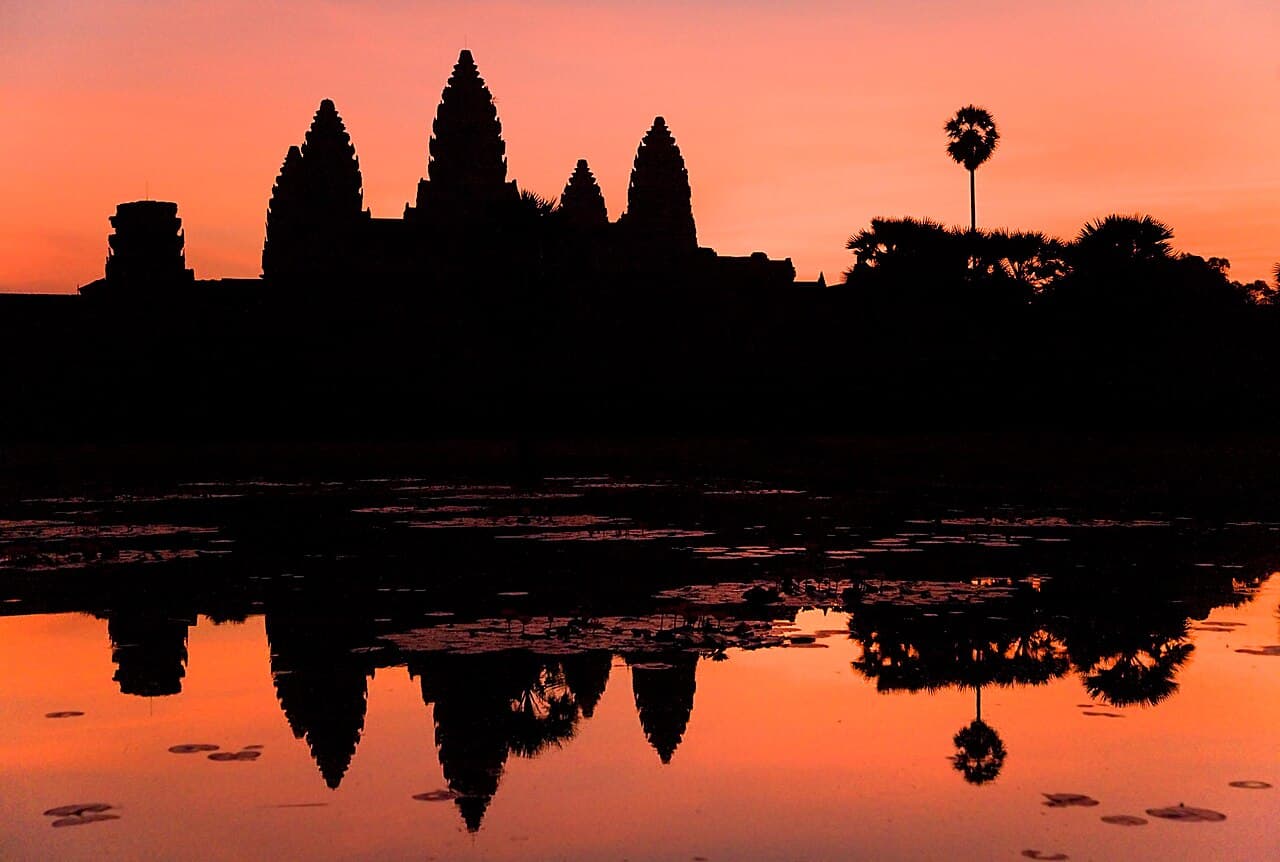
CambodiaPhoto: Chi King / Wikimedia Commons (CC BY 2.0)

Cambodia

Country · KH · KHR · Asia/Phnom_Penh

This information may change. Always check the official source.Last verified: August 2026 by

Nearly every nationality can buy a visa on arrival for USD 30 cash, so the visa is the easy part. The e-Arrival card is the part people get wrong: it is compulsory, it is free, and the sites charging for it are not the government.

  • The e-Arrival card is compulsory for every air arrival and it is free, submitted within 7 days before you land. The only official channels are arrival.gov.kh and the Cambodia e-Arrival app.
  • Any site charging a "service fee" for the arrival card is not the government. The giveaway is the domain: the real one ends in .gov.kh.
  • Visa on arrival is USD 30 in clean US cash plus one passport photo, at Techo International, Siem Reap Angkor, Sihanoukville and most land checkpoints. Allow 15 to 30 minutes.
  • The e-Visa costs USD 36 all in and takes about 3 working days, but is accepted at fewer crossings than the visa on arrival - it is less flexible, not more. Both give 30 days, extendable once.
  • Passport valid 6 months with a blank page, and an onward ticket that airlines do check. The land borders with Thailand are closed, so Bangkok to Siem Reap has to be flown.
More details

Two separate things, and only one of them is a visa

Almost everyone needs a visa, and almost everyone can buy one at the airport. Everyone flying in also needs the e-Arrival card, which is not a visa and costs nothing. Confusing the two is what costs people money.

The e-Arrival card

  • Compulsory for every air arrival, submitted within 7 days before you land. You get a QR code to show at immigration.
  • It is free. The only official channels are arrival.gov.kh and the Cambodia e-Arrival app.
  • The paid lookalikes are not the government. The General Department of Immigration has publicly named cambodia-e-arrival.online as fraudulent and warns that any site charging a "service fee" for the card is not theirs. The giveaway is the domain: the real one ends in .gov.kh.
  • Land crossings still use the paper card, filled in at the counter.

Getting the visa

  1. Visa on arrival - USD 30, tourist (T) class. Available at Techo International, Siem Reap Angkor International, Sihanoukville and most land checkpoints. Bring the fee in clean USD cash and one passport photo; without a photo you will be charged a small extra fee. Allow 15 to 30 minutes.
  2. e-Visa - USD 36 all in, being the USD 30 visa plus a USD 6 processing fee, at evisa.gov.kh. Takes about 3 working days, is valid 3 months from issue, single entry, 30 days. It is accepted at the three international airports and at selected land checkpoints from Vietnam and Laos, so it is less flexible than the visa on arrival, not more.
  3. Visa-free if you hold an ASEAN passport: Indonesia, Laos, Malaysia, the Philippines, Singapore and Vietnam get 30 days; Brunei and Myanmar get 14; Thailand gets 7, cut back during the border dispute.

Both routes give you 30 days, extendable once by another 30 at the immigration office in Phnom Penh.

Two nationality cases worth checking before you book

  • Chinese passports, including Hong Kong and Macao, are visa-free for 14 days on a pilot that runs 15 June to 15 October 2026, multiple entry. It is a trial with a published end date - after 15 October 2026 the normal visa rules return unless it is extended, so check before travelling in the autumn.
  • Ten nationalities cannot use the visa on arrival or the e-Visa at all: Afghanistan, Algeria, Bangladesh, Iran, Iraq, Nigeria, Pakistan, Saudi Arabia, Sri Lanka and Sudan. They must apply at a Cambodian embassy in advance, usually with a supporting letter from a travel agency.

At the desk

  • Passport valid at least 6 months from arrival, with a blank page.
  • Onward or return ticket is required and airlines do check it.
  • The land borders with Thailand are closed. If your plan was Bangkok to Siem Reap overland, it does not currently work - see the safety section.
Sources (3)

Cambodia has banned vapes since 2014, and the temples make the export side of customs the one to think about.

  • Electronic cigarettes and shisha are prohibited. The ban dates to 2014, it covers import and sale, and devices are confiscated at Phnom Penh and Siem Reap.
  • Angkorian artefacts may not leave the country. Any stone carving, bronze or old statue needs clearance, and the items offered near the temples are exactly what the airport scanner is looking for.
  • The allowance is 200 cigarettes and a litre or two of spirits per adult, with a value cap on other goods.
  • Cash above the declarable threshold must be reported, and US dollars are used as freely as riel here, which does not exempt them.
  • Drug penalties are severe and the tourist bars in Phnom Penh and Sihanoukville are watched.
More details
  • Electronic cigarettes and shisha are prohibited. The ban dates to 2014, it covers import and sale, and devices are confiscated at Phnom Penh and Siem Reap.
  • Angkorian artefacts may not leave the country. Any stone carving, bronze or old statue needs clearance, and the items offered near the temples are exactly what the airport scanner is looking for.
  • The allowance is 200 cigarettes and a litre or two of spirits per adult, with a value cap on other goods.
  • Cash above the declarable threshold must be reported, and US dollars are used as freely as riel here, which does not exempt them.
  • Drug penalties are severe and the tourist bars in Phnom Penh and Sihanoukville are watched.
Sources (1)

Dengue is running 58% above last year, the state hospitals cannot handle a serious emergency, and the realistic plan for anything major is evacuation to Bangkok. Insurance that covers it is not optional here.

  • Public hospitals cannot handle a serious emergency - the answer to a major injury is evacuation to Bangkok or Singapore, which costs tens of thousands of dollars. Insurance covering it is not optional here.
  • Check your policy covers a motorbike if you plan to ride one. Most exclude riding without the correct licence, and motorbike injuries are the commonest serious problem visitors have.
  • Dengue is the real risk and 2026 is a bad year: 28,074 cases and 38 deaths by mid-July, about 58% up on 2025. The mosquito bites in daylight, so use repellent by day too.
  • Malaria is a much smaller worry than people expect - no risk in Phnom Penh, very low around Siem Reap and the temples. Tablets are usually only for remote forested border areas.
  • The monkeys at Angkor bite and carry rabies. Wash any bite with soap and running water for 15 minutes and get to a clinic the same day; Institut Pasteur in Phnom Penh reliably has the vaccine.
More details

Insurance first

Public hospitals are not equipped for a serious emergency and the standard answer to a major injury or illness is evacuation to Bangkok or Singapore. That flight costs tens of thousands of dollars.

Travel insurance that explicitly covers medical evacuation and repatriation is the single most important thing you bring. Check it covers a motorbike if you intend to ride one - most policies exclude riding without the correct licence, and motorbike injuries are the commonest serious problem visitors have here.

Mosquitoes

  • Dengue is the real risk and 2026 is a bad year. Cambodia had recorded 28,074 cases and 38 deaths by mid-July 2026, about 58% up on the same point in 2025. It is worst in the rainy season, May to October, and it is an urban disease - Phnom Penh and Siem Reap included. There is no drug for it, so bite avoidance is the whole strategy: repellent with DEET or picaridin by day as well as at night, since the dengue mosquito bites in daylight.
  • Malaria is a much smaller worry than most people expect. No risk in Phnom Penh, and very low around Siem Reap, the Angkor temples and Tonle Sap. Risk elsewhere is low, and tablets are usually recommended only for remote forested areas near the borders. Mefloquine resistance is widespread in the western provinces, so it is the wrong drug here.
  • Japanese encephalitis is a rural, rainy-season risk and worth a vaccine for a long or rural trip.

Vaccines

  • For everyone: hepatitis A, typhoid, tetanus up to date, plus routine MMR and diphtheria-tetanus-polio.
  • Consider: rabies, hepatitis B and Japanese encephalitis for longer stays, rural travel or anything involving animals.
  • A yellow fever certificate is required if you arrive from a country where yellow fever is present. There is no yellow fever in Cambodia itself.

Rabies

Dogs and monkeys carry rabies here, and the monkeys around the Angkor temples bite. Do not feed them and do not hold food where they can see it.

If you are bitten or scratched, wash the wound with soap and running water for 15 minutes and get to a clinic the same day. The Institut Pasteur du Cambodge on Monivong Boulevard in Phnom Penh is the reliable place for post-exposure vaccine, and it is one of the few places in the country that reliably has it.

Where to go when ill

  • Phnom Penh: Royal Phnom Penh Hospital and Calmette Hospital are the usual choices, with Institut Pasteur for vaccines and bites.
  • Siem Reap: Royal Angkor International Hospital.
  • Serious cases go to Bangkok. Any of the above will arrange it, and this is where the insurance earns its keep.

Food and water

  • Do not drink the tap water. Bottled and filtered water is universal and cheap, and most guesthouses have a refill station.
  • Ice in restaurants and bars is factory made and safe. The cylindrical ice with a hole through it is the commercial kind.
  • Street food is good and busy stalls are the safe ones, for the ordinary reason that the turnover is high.
Sources (2)

Phnom Penh

Long-term averages for Phnom Penh: the mean daily high, the mean overnight low and the mean monthly rainfall across 30 years of ERA5 reanalysis data (1995–2024).

DayNight
20253035°C0500mmJanFebMarAprMayJunJulAugSepOctNovDecJanuary: Day 32 °C, Night 22 °C, Rain 15 mm. February: Day 33 °C, Night 24 °C, Rain 11 mm. March: Day 35 °C, Night 25 °C, Rain 39 mm. April: Day 35 °C, Night 26 °C, Rain 94 mm. May: Day 33 °C, Night 26 °C, Rain 165 mm. June: Day 33 °C, Night 25 °C, Rain 157 mm. July: Day 32 °C, Night 25 °C, Rain 168 mm. August: Day 32 °C, Night 25 °C, Rain 189 mm. September: Day 31 °C, Night 25 °C, Rain 265 mm. October: Day 30 °C, Night 24 °C, Rain 263 mm. November: Day 30 °C, Night 24 °C, Rain 104 mm. December: Day 30 °C, Night 23 °C, Rain 31 mm
Show the monthly table
Phnom Penh
MonthDay (°C)Night (°C)Rain (mm)
January322215
February332411
March352539
April352694
May3326165
June3325157
July3225168
August3225189
September3125265
October3024263
November3024104
December302331

Siem Reap

Long-term averages for Siem Reap: the mean daily high, the mean overnight low and the mean monthly rainfall across 30 years of ERA5 reanalysis data (1995–2024).

DayNight
20253035°C0500mmJanFebMarAprMayJunJulAugSepOctNovDecJanuary: Day 31 °C, Night 21 °C, Rain 11 mm. February: Day 33 °C, Night 23 °C, Rain 19 mm. March: Day 34 °C, Night 25 °C, Rain 55 mm. April: Day 34 °C, Night 26 °C, Rain 109 mm. May: Day 33 °C, Night 26 °C, Rain 173 mm. June: Day 32 °C, Night 26 °C, Rain 138 mm. July: Day 32 °C, Night 25 °C, Rain 164 mm. August: Day 31 °C, Night 25 °C, Rain 184 mm. September: Day 30 °C, Night 25 °C, Rain 277 mm. October: Day 30 °C, Night 24 °C, Rain 230 mm. November: Day 30 °C, Night 23 °C, Rain 77 mm. December: Day 30 °C, Night 21 °C, Rain 17 mm
Show the monthly table
Siem Reap
MonthDay (°C)Night (°C)Rain (mm)
January312111
February332319
March342555
April3426109
May3326173
June3226138
July3225164
August3125184
September3025277
October3024230
November302377
December302117

Sihanoukville

Long-term averages for Sihanoukville: the mean daily high, the mean overnight low and the mean monthly rainfall across 30 years of ERA5 reanalysis data (1995–2024).

DayNight
20253035°C01000mmJanFebMarAprMayJunJulAugSepOctNovDecJanuary: Day 29 °C, Night 24 °C, Rain 54 mm. February: Day 30 °C, Night 24 °C, Rain 50 mm. March: Day 31 °C, Night 25 °C, Rain 120 mm. April: Day 31 °C, Night 26 °C, Rain 186 mm. May: Day 30 °C, Night 26 °C, Rain 331 mm. June: Day 29 °C, Night 25 °C, Rain 412 mm. July: Day 28 °C, Night 25 °C, Rain 506 mm. August: Day 28 °C, Night 25 °C, Rain 472 mm. September: Day 28 °C, Night 25 °C, Rain 484 mm. October: Day 29 °C, Night 25 °C, Rain 393 mm. November: Day 29 °C, Night 25 °C, Rain 161 mm. December: Day 30 °C, Night 24 °C, Rain 61 mm
Show the monthly table
Sihanoukville
MonthDay (°C)Night (°C)Rain (mm)
January292454
February302450
March3125120
April3126186
May3026331
June2925412
July2825506
August2825472
September2825484
October2925393
November2925161
December302461
Sources (1)

Some of the best value in Southeast Asia: a dorm is USD 5 to USD 8 and a hotel room with a pool is USD 30 to USD 60. Do not let a guesthouse keep your passport, and think twice about Sihanoukville.

  • Cambodia is cheap even by regional standards: a dorm is USD 5 to USD 8, a guesthouse room USD 15 to USD 25, and a comfortable hotel with a pool USD 30 to USD 60.
  • Book the first two nights only. Walk-in rates are frequently below the online price outside the December to February peak.
  • Do not hand over your passport as a deposit. Offer a photocopy or a photo of the data page, which is normally accepted - you need the passport itself for SIM registration and domestic flights.
  • In Siem Reap stay around Wat Bo and the river, quieter and greener than Pub Street and still a ten minute tuk-tuk away; in Phnom Penh, BKK1 is the leafy, walkable district.
  • Sihanoukville is not the beach town it was - it was rebuilt as a casino city and much of it is a construction site. The islands offshore are unaffected and are where the beaches are.
More details

Cambodia is cheap even by regional standards, and the money buys more in Siem Reap than anywhere else in the country.

  • Hostel dorm - USD 5 to USD 8. In Siem Reap the competition pushes it lower still.
  • Private guesthouse room - USD 15 to USD 25, usually with air conditioning and often with a pool.
  • Comfortable hotel - USD 30 to USD 60, which in Siem Reap buys a garden, a pool and breakfast.
  • Book the first two nights only. Walk-in rates are frequently below the online price outside the December to February peak.

Where to stay

  • Siem Reap: the streets around Wat Bo and the river are quieter and greener than Pub Street, and still a ten minute tuk-tuk from it. Most places arrange temple transport.
  • Phnom Penh: Boeung Keng Kang (BKK1) is the leafy, walkable district with the restaurants and cafes. The riverside is livelier and noisier, and is also where bag snatching concentrates.
  • Kampot and Kep are the calm southern alternative, and Koh Rong and Koh Rong Sanloem are the islands most people actually want when they say Sihanoukville.

Two practical points

  • Do not hand over your passport as a deposit. Some guesthouses still ask. Offer a photocopy or a photo of the data page instead, which is normally accepted without argument. You need the passport itself for SIM registration and any domestic flight.
  • Sihanoukville is not the beach town it was. It was rebuilt as a casino city and much of it is a construction site with a poor safety record; the UK and other governments single it out in their advice. The islands offshore are unaffected and are where the beaches are - most visitors now transit the town and go straight to the ferry.
Sources (1)

Cambodia has some of the cheapest mobile data anywhere: USD 5 buys 30 GB, and USD 10 buys up to 100 GB. This is one of the few countries where buying at the airport is not a mistake.

  • Data here is close to free and the airport counters charge roughly city prices, so this is one of the few countries where buying on arrival is not a mistake.
  • The Smart Traveller SIM is USD 5 for 30 GB over 15 days, plus local minutes - the default for a two-week trip. Cellcard and Metfone sell 60 GB to 100 GB for USD 6 to USD 10.
  • Smart is fastest in Phnom Penh and Siem Reap; Metfone has the widest rural footprint, so pick it for Mondulkiri, Ratanakiri or the north.
  • Every SIM must be registered to a passport, scanned at the counter while you wait. There is no biometric step and it takes a couple of minutes.
  • An international eSIM costs several times the local price here - USD 14.99 for 5 GB against USD 5 for 30 GB - so buy locally unless you must land connected.
More details

Data here is close to free by regional standards, and the airport counters charge roughly what the city shops do. There is no reason to arrive without a SIM.

  • Smart Traveller SIM - USD 5 for 30 GB over 15 days, plus local and some international minutes. The default choice for a two-week trip.
  • Cellcard and Metfone sell 60 GB to 100 GB for USD 6 to USD 10 on their tourist bundles.
  • Smaller bundles start at USD 1 if you only need maps and messaging.

Which network

  • Smart is the fastest and most reliable in Phnom Penh, Siem Reap and the main towns.
  • Metfone, run by Vietnam's Viettel, has the widest rural footprint. Pick it if you are going to Mondulkiri, Ratanakiri or the north.
  • Cellcard is the third option and competitive on price, with solid coverage on the main routes.

Registration

Every SIM must be registered to a passport. Bring the physical passport to the counter; the shop scans it and activates the line while you wait. There is no biometric step and it takes a couple of minutes.

eSIM

  • Smart, Cellcard and Metfone all support eSIM, and buying the local eSIM keeps the local price.
  • An international eSIM such as Saily works on landing but costs several times what a local SIM does here: USD 5.99 for 1 GB over 7 days, USD 14.99 for 5 GB over 30 days. In most countries that premium buys convenience; in Cambodia it is the difference between USD 5 and USD 25 for the same trip.

Coverage on the Angkor circuit is good, including at the outlying temples, so offline maps are a backup rather than a necessity.

Sources (3)

Cambodian sockets take American, European and British plugs in the same room, usually without earthing any of them.

  • A universal adapter is the sensible answer here, more than almost anywhere else.
  • Most sockets are unearthed hybrids. A plug that fits is not a plug that is earthed, and that includes European ones with an earth contact.
  • American appliances fit and then meet 230 V. Anything not marked 100-240 V will burn out.
  • Guesthouses run on a supply that cuts, particularly outside Phnom Penh and Siem Reap, so a power bank earns its weight.
  • Thailand, Vietnam and Laos are all different again, which is why a single universal adapter beats a bag of country ones on a regional trip.
More details

Sockets in Cambodia are Type , and at 230 V, 50 Hz - flat American pins, round European ones and the British three-pin all turn up, sometimes in one wall.

  • A universal adapter is the sensible answer here, more than almost anywhere else.
  • Most sockets are unearthed hybrids. A plug that fits is not a plug that is earthed, and that includes European ones with an earth contact.
  • American appliances fit and then meet 230 V. Anything not marked 100-240 V will burn out.
  • Guesthouses run on a supply that cuts, particularly outside Phnom Penh and Siem Reap, so a power bank earns its weight.
  • Thailand, Vietnam and Laos are all different again, which is why a single universal adapter beats a bag of country ones on a regional trip.
Sources (1)

Type , and sockets at 230 V, shoulders and knees covered at the temples, and a calendar where the whole country stops for a week in April.

  • 230 V at 50 Hz, with type , and sockets turning up sometimes in the same room. A universal adapter is the sensible answer; a 120 V American appliance needs a converter, not just an adapter.
  • Shoulders and knees must be covered to enter Angkor, enforced at the entrance and strictly at Angkor Wat's upper level. Shoes stay on in the Angkor temples, unlike in an active pagoda.
  • The greeting is the sampeah - palms together, a slight bow. Do not touch anyone's head, do not point your feet at a person or a Buddha image, and keep your temper in public.
  • Tipping is not obligatory but wages are low: about 10% in a restaurant without a service charge, a dollar or two for a waiting tuk-tuk driver, USD 5 to USD 15 a day for a temple guide.
  • Khmer New Year in mid-April closes much of the country for a week and empties Phnom Penh. April is also the hottest month; November to February is dry, comfortable and peak season.
More details

Power

230 V at 50 Hz, with sockets of type , and - the flat American pins, the round European pins and the British three-pin all turn up, sometimes in the same room. A universal adapter is the sensible answer. Anything from the UK or Europe runs on the voltage directly; American 120 V appliances without a dual-voltage supply need a converter, not just an adapter.

Temples

  • Shoulders and knees must be covered to enter Angkor, for everyone. It is enforced at the entrance and strictly at Angkor Wat's upper level, the Bakan, which also has a minimum age and closes on Buddhist holy days.
  • Shoes stay on in the Angkor temples, unlike in an active pagoda.
  • Do not climb on the ruins or touch the carvings, and do not photograph monks without asking.

Manners

  • The greeting is the sampeah: palms together, a slight bow. Returning it is appreciated and never wrong.
  • Do not touch anyone's head, and do not point your feet at a person or a Buddha image.
  • Keep your temper. Public anger loses face for everyone present and will not get you what you want.

Tipping

Not obligatory, widely appreciated, and wages are low. Around 10% in a restaurant that has not already added a service charge, a dollar or two for a tuk-tuk driver who has waited, and USD 5 to USD 15 a day for a temple guide.

The calendar

  • Khmer New Year, mid-April, is the big one. Much of the country closes for the best part of a week and Phnom Penh empties as people travel home. Book transport well ahead or plan to stay put.
  • Pchum Ben, in September or October, is the other major holiday, with similar effects.
  • The Water Festival in November brings millions into Phnom Penh for the boat races. It is worth seeing and it is also when petty crime spikes.
  • April is the hottest month and the run-up to the rains, at 35 degrees and humid. November to February is dry and comfortable and is the peak season for that reason.

Odds and ends

  • The language is Khmer, with its own script; English is common in tourism and rarer outside it, and older people may speak French.
  • Dry season dust and rainy season downpours both argue for a small daypack with a cover.
  • Cambodia is UTC+7, with no daylight saving.
Sources (1)

Cambodia runs on US dollars with Cambodian riel as the small change, at a steady 4,000 KHR to the dollar. The catch that surprises everyone: a torn or grubby dollar note will simply be refused.

  • The US dollar is the everyday money and the riel is the change, at a flat 4,000 KHR to USD 1 that barely moves - you can do the arithmetic in your head.
  • Damaged US notes are refused, far more strictly than you are used to. A small tear, a scribble or a worn note gets handed straight back, so check what you are given at the moment you get it.
  • ATMs dispense dollars, mostly in 50s and 100s, which are awkward to spend. Fees run about USD 4 to USD 6, so take out more, less often - BRED and ACLEDA are the usual picks.
  • Keep a stock of USD 1 and USD 5 notes for tuk-tuks, markets and entrance fees.
  • The Angkor pass is USD 37 for one day, USD 62 for three and USD 72 for seven, and the multi-day passes need not be used on consecutive days.
More details

One country, two currencies, one exchange rate

The US dollar is the everyday money and the Cambodian riel is the change. ATMs give you dollars, prices are quoted in dollars, and anything under a dollar comes back in riel at a flat 4,000 KHR to USD 1. Buy a 3,500 KHR coffee with a five dollar note and you get a dollar note and 1,500 riel back. That rate barely moves, so you can do the arithmetic in your head.

The thing nobody warns you about

Damaged US notes are refused, and the standard is far stricter than you are used to. A small tear, a scribble, a soft worn note or an older series design is enough for a shop, a driver or a hotel to hand it straight back. Two consequences:

  • Check the notes you are given, in the exchange booth and as change, and hand back anything torn or taped at the moment you get it. Once you have walked away it is yours.
  • Bring clean, flat, recent dollars if you are bringing cash at all. The riel has no such problem - torn riel circulates freely.

Cash

  • ATMs dispense USD and mostly in 50s and 100s, which are awkward to spend. Withdrawing an odd amount such as USD 180 tends to force out smaller notes.
  • Withdrawal fees run about USD 4 to USD 6 on top of your own bank's charge, so take out more, less often. BRED and ACLEDA are the usual picks for the lower fee and the friendlier note mix.
  • Keep a stock of USD 1 and USD 5 notes. Tuk-tuks, markets and entrance fees all want them.

Paying by phone

KHQR is everywhere - it is on the counter of practically every shop, stall and restaurant. Until recently it was closed to visitors; now the Bakong Tourists app from the National Bank of Cambodia lets you register with an email, link a Visa or Mastercard, and scan those codes at some 3.3 million merchants. Alipay and WeChat Pay also work on KHQR. It is the clean way round the torn-note problem.

Cards and costs

  • Cards are fine in city hotels, mid-range restaurants and supermarkets. Everywhere else is cash.
  • The Angkor pass is USD 37 for one day, USD 62 for three days and USD 72 for seven from Angkor Enterprise. The 3-day pass is used on any 3 days within a week, the 7-day on any 7 within a month, and they need not be consecutive. Children under 12 are free but may be asked for a passport as proof.
Sources (2)

Everyday prices

Typical prices in Cambodian riel (KHR), averaged across the country by Numbeo and read on 12 August 2026. Tick Convert prices above the table to see every amount in your own currency.

Everyday prices
ItemTypical price
Inexpensive restaurant meal13,200 KHR
Dinner for two, mid-range, three courses114,000 KHR
Cappuccino9,510 KHR
Local draught beer, 0.5 l4,050 KHR
Bottled water, 0.33 l2,330 KHR
Public transport, one-way ticket4,050 KHR
Taxi, starting fare4,770 KHR
Petrol, 1 litre5,260 KHR
Cigarettes, pack of 20 (Marlboro)7,090 KHR
Average net monthly salary1,160,000 KHR

These are country-wide averages, not a price list: tourist districts, airports and islands sit well above them, and small towns below. The salary line is there for proportion - it is what people living here actually earn.

Sources (1)

Airport guides for Cambodia2

One page per airport: the routes into town, what they cost and the trap particular to that arrival.

See all 2 airports

Phnom Penh moved airports in September 2025: Techo International is 20 km south of the city, not the 10-minute hop the old one was. Siem Reap moved too, and its new airport is 50 km from the temples.

  • Phnom Penh changed airports on 9 September 2025. Techo International replaced the old one entirely, and it is 20 km south of the city - a 45 to 60 minute drive, not the ten-minute hop guidebooks describe.
  • Grab, PassApp or a counter taxi runs USD 10 to USD 20 into central Phnom Penh, and the airport's own advice is to use the official counters or an app.
  • The Airport Express Bus is 1,500 KHR but the driver handles no money - you drop the exact fare into a box that gives no change, so get small riel notes first. Allow 90 minutes to 2 hours.
  • Siem Reap's airport also moved and is now about 50 km east of town, a 45 to 60 minute drive. An official taxi is about USD 35, a negotiated taxi or tuk-tuk USD 20 to USD 25.
  • Ask your guesthouse in Siem Reap. Free or cheap airport pickup is a normal part of the offer and is usually the easiest way in.
More details
Phnom Penh: Techo International Airport (KTI)

The airport you have read about in an older guidebook no longer exists. Techo International opened on 9 September 2025 and replaced the old Phnom Penh International Airport entirely. Some booking sites still show the old PNH code and the old location. The new airport is 20 km south of the city and the drive takes 45 to 60 minutes.

  • Grab, PassApp or WowNow - USD 10 to USD 20 depending on where you are going. The airport's own advice is to use the official taxi counters or a ride-hailing app, and this is the sensible default.
  • Metered and counter taxis sit in the same USD 10 to USD 20 band to the centre. Agree the destination before you set off.
  • Airport Express Bus - 1,500 KHR. Cheap, slow and slightly awkward: the driver handles no money at all and you drop the exact fare into a box, which gives no change. Get small riel notes from the airport exchange counter first. Useful stops are Canadia Park for the riverside and the Royal University of Law and Economics for Boeung Keng Kang. Allow 90 minutes to 2 hours, and note the stop is a long walk out at the far end of the car park.
Siem Reap: Siem Reap Angkor International Airport (SAI)

This one also moved, in October 2023, and the new airport is about 50 km east of Siem Reap - a 45 to 60 minute drive, where the old airport was fifteen minutes out.

  • Official airport taxi - about USD 35 one way into town.
  • Negotiated taxi or tuk-tuk - USD 20 to USD 25, arranged outside the terminal.
  • Shuttle bus - from about 32,000 KHR, the budget option.
  • Ask your guesthouse. Free or cheap airport pickup is a normal part of the offer in Siem Reap and is usually the easiest way in.

Build the transfer into your temple plans. Sunrise at Angkor Wat means leaving town around 05:00, and arriving on a late flight now costs you an hour on the road before you even start.

Sources (2)

Getting around the city, and which apps to install

Grab and PassApp end the tuk-tuk haggle and cost USD 1 to USD 3 for a short hop. Intercity is by coach - Phnom Penh to Siem Reap is 5 to 6 hours - and the Thai land borders are closed, so that leg has to be flown.

  • Install a ride-hailing app before you leave the airport. Grab and PassApp both show the fare up front and remove the tourist price entirely.
  • A short city hop is USD 1 to USD 3 in a tuk-tuk. If you flag one down in the street instead, agree the price first - the unmetered tourist price runs to about triple.
  • Phnom Penh to Siem Reap is 5 to 6 hours on a good road, with Giant Ibis the operator most travellers pick and Capitol Tours and Virak Buntham also on the corridor.
  • Book coaches online through BookMeBus, CamboTicket or 12Go rather than through your guesthouse: you see the real departure times and vehicle, and it is usually cheaper.
  • The Thai land borders are closed to tourists, Poipet included, so that leg has to be flown. The Vietnamese and Lao crossings work normally.
More details

Install a ride-hailing app before you leave the airport. It replaces the entire negotiation and removes the tourist price.

  • Grab and PassApp both cover Phnom Penh and Siem Reap, showing the fare up front. PassApp is the local one and usually has more tuk-tuks on it; Grab takes foreign cards.
  • A short city hop is USD 1 to USD 3 in a tuk-tuk, a little more in a car.
  • If you do flag one down in the street, agree the price before you get in. The unmetered tourist price runs to about triple.
  • Two things are both called a tuk-tuk: the traditional remorque, a carriage towed behind a motorbike, and the smaller Indian-style auto-rickshaw that most app cars are. The rickshaw is quicker through traffic; the remorque is better with luggage.

Between cities

  • Phnom Penh to Siem Reap is the main route, 5 to 6 hours on a good road with a wide choice of departures.
  • Giant Ibis is the operator most travellers pick for the long runs, with Capitol Tours and Virak Buntham also on the main corridors.
  • Book online rather than through your guesthouse, on BookMeBus, CamboTicket or 12Go. You will see the actual departure times and the vehicle, and it is usually cheaper.
  • Night buses exist and are best avoided on safety grounds where a daytime coach will do.

The land borders with Thailand are closed. Poipet, Chong Chom and the other Thai crossings have been shut to tourists since the 2025 fighting, so Bangkok to Siem Reap has to be flown. The Vietnamese and Lao crossings are operating normally.

Traffic ignores lane markings and right of way. Cross roads slowly and predictably and let the traffic flow around you; stopping suddenly is what causes accidents.

Apps and platforms

PassApp and Grab for rides, BookMeBus and CamboTicket for coaches, and the Bakong Tourists app if you would rather pay by QR than carry dollars.

  • PassApp is the local ride-hailing app, strongest for tuk-tuks in Phnom Penh and Siem Reap; Grab adds food delivery and foreign card payment.
  • BookMeBus and CamboTicket cover domestic coaches, minivans and ferries, with live seat maps and operator reviews; 12Go handles cross-border and multi-leg journeys.
  • Bakong Tourists is the National Bank's app, which lets a foreign card pay Cambodian KHQR codes instead of carrying dollars.
  • Download the offline Google Maps area for Siem Reap and the Angkor park before you go temple-hopping.
  • Download the Khmer pack in Google Translate. English is widely spoken in tourism and much less so outside it.
More details
  • PassApp - https://passapp.com/ - The local ride-hailing app, strongest for tuk-tuks in Phnom Penh and Siem Reap.
  • Grab - https://www.grab.com/kh/ - Rides, food delivery and foreign card payment.
  • BookMeBus - https://www.bookmebus.com/ - Domestic coaches, minivans and ferries with live seat maps.
  • CamboTicket - https://www.camboticket.com/ - The other domestic booking site, with operator reviews.
  • 12Go - https://12go.asia/ - Useful for cross-border and multi-leg journeys.
  • Giant Ibis - https://www.giantibis.com/ - Books direct on the main tourist routes.
  • Bakong Tourists - The National Bank's app, which lets a foreign card pay Cambodian KHQR codes.
  • Google Maps - Reliable for driving and walking; download the offline area for Siem Reap and the Angkor park.
  • Google Translate - Download the Khmer pack. English is widely spoken in tourism and much less so outside it.
Sources (3)

Cambodia recognises an International Driving Permit, but a car with a driver is the normal arrangement and motorbike hire is where insurance fails.

  • A car with a driver is standard and inexpensive - the way most visitors cover Phnom Penh to Siem Reap or the coast.
  • Motorbike hire without the correct licence class voids travel insurance, and Cambodia has one of the highest road fatality rates in the region.
  • The alcohol limit is 0.05 % with roadside checks in Phnom Penh at night.
  • Traffic drives on the right, and right of way is negotiated rather than given, including at roundabouts.
  • Rural roads are unlit and shared with everything - livestock, unlit motorbikes, ox carts - so intercity driving after dark is avoided.
More details

A permit is recognised; a driver is the usual arrangement, and the scooter question decides your insurance.

  • A car with a driver is standard and inexpensive - the way most visitors cover Phnom Penh to Siem Reap or the coast.
  • Motorbike hire without the correct licence class voids travel insurance, and Cambodia has one of the highest road fatality rates in the region.
  • The alcohol limit is 0.05 % with roadside checks in Phnom Penh at night.
  • Traffic drives on the right, and right of way is negotiated rather than given, including at roundabouts.
  • Rural roads are unlit and shared with everything - livestock, unlit motorbikes, ox carts - so intercity driving after dark is avoided.
Sources (1)

Cambodia is broadly safe for visitors, with two hard exceptions: bag snatching from passing motorbikes, which injures people, and the Thai border zone, where there is an armed conflict and land mines.

  • Bag snatching by a passing motorbike is the most common crime against visitors and it hurts people - the injuries come from being pulled off your feet. Phnom Penh's riverside is the hotspot.
  • Walk on the inside of the pavement, keep bags on the tuk-tuk floor between your feet, and if a strap is grabbed, let it go.
  • The strip within 50 km of the Thai border is rated do-not-travel because of rocket and artillery fire and mines, while Cambodia as a whole is only "exercise increased caution".
  • Cambodia remains one of the most heavily mined countries in the world. The Angkor park, the towns and main roads are cleared - never leave marked paths in open countryside.
  • Never take a job offer made to you as a tourist. Organised crime runs scam compounds in Sihanoukville, Bavet and Kandal, and people who go have their passports taken and are held.
More details

The one that actually happens

Bag snatching by a passing motorbike is the most common crime against visitors, and it hurts people. Riders grab a bag or a phone at speed, and the injuries come from being pulled off your feet or out of a tuk-tuk. Phnom Penh's riverside is the hotspot, the Sihanoukville beachfront next.

  • Walk on the inside of the pavement, away from the road.
  • Cross-body straps go across the body, not over one shoulder - and if the strap is grabbed, let it go.
  • Do not stand at the kerb using your phone. That is the setup.
  • In a tuk-tuk, keep bags on the floor between your feet, not on the outside seat.

The Thai border

There is an armed conflict along the Thai border and it is not a background risk. Fighting broke out in 2025, a ceasefire followed in December 2025, and it has not held cleanly. The US State Department rates Cambodia as a whole Level 2, exercise increased caution - but the strip within 50 km of the Thai border is Level 4, do not travel, on account of rocket and artillery fire, civilian casualties and mines.

  • All the Thai land crossings are closed to tourists, Poipet included. Fly.
  • Preah Vihear temple sits in the disputed zone. Do not plan a trip there.
  • The Vietnamese and Lao borders are unaffected and working normally.

Land mines

Cambodia remains one of the most heavily mined countries in the world, and much of the contamination is unmarked. The worst-affected provinces are Battambang, Banteay Meanchey, Pursat, Pailin, Kampong Thom and rural Siem Reap.

  • The Angkor park itself is cleared and safe, as are the towns and the main roads. This is a risk of open countryside, not of ordinary sightseeing.
  • Never leave marked paths and established tracks in rural areas, at outlying temples, or in any field.
  • If a route looks like a shortcut across open ground, it is not one.

Scams and the things to say no to

  • Job offers. Organised crime runs scam compounds in Sihanoukville, Bavet and Kandal, recruiting through advertisements for easy, well-paid work. People who take them have their passports taken and are held. No legitimate employer recruits a tourist this way.
  • Counterfeit notes given as change, in shops and bars. Another reason to look at what you are handed.
  • Drink spiking has been reported in bars used by foreigners. Watch your drink being poured.
  • The tuk-tuk wrong change trick: a large note handed over, a smaller one produced as proof you underpaid. Say the amount aloud as you hand it over.
  • Orphanage visits and "milk for the baby". Orphanage tourism is actively harmful and the milk scam ends with the tin being returned to the shop for cash. Give to a registered charity instead if you want to help.

Cambodia is not a dangerous country to travel in. Violent crime against tourists outside the snatch-theft category is uncommon, and ordinary care is enough.

Sources (2)

The numbers are 117, 118 and 119, but English on those lines is limited and the ambulance service is thin. For anything serious the faster plan is a Grab to a private hospital.

  • Police 117, fire 118, ambulance 119 - but expect little or no English on those lines.
  • If you are at a hotel or restaurant, have a member of staff make the call. It will be faster and more accurate than trying to do it yourself.
  • For a serious but transportable emergency, a Grab straight to a private hospital usually beats waiting for an ambulance. That is the opposite of the advice you would follow at home, and it is what residents do.
  • Royal Phnom Penh Hospital and Calmette are the Phnom Penh choices, Royal Angkor International Hospital in Siem Reap, with Institut Pasteur for rabies and vaccines.
  • Report a crime to the tourist police rather than a local station - they handle foreign visitors and are more likely to have English. A lost passport needs the report first, then your embassy in Phnom Penh.
More details

The numbers

Emergency information in Cambodia
ServiceNumber
Police117
Fire118
Ambulance119
Tourist police, Phnom Penh012 942 484
Tourist police, Siem Reap012 402 424
Human trafficking hotline1288

The country code is +855, and a Cambodian mobile number written 012 xxx xxx is dialled +855 12 xxx xxx from abroad, dropping the leading zero.

How this really works

  • Expect little or no English on 117, 118 and 119. If you are at a hotel, guesthouse or restaurant, get a member of staff to make the call - it will be faster and more accurate than trying to do it yourself.
  • The public ambulance service is limited and slow, and in traffic it is slower still. For a serious but transportable emergency, a taxi or Grab straight to a private hospital is usually the quicker choice than waiting for 119. This is the opposite of the advice you would follow at home, and it is what residents actually do.
  • Call your insurer's assistance line early, not after the fact. They authorise treatment, they know which hospitals they will pay, and they run the evacuation if it comes to that.

Where to go

  • Phnom Penh: Royal Phnom Penh Hospital and Calmette Hospital; Institut Pasteur du Cambodge on Monivong Boulevard for rabies and vaccines.
  • Siem Reap: Royal Angkor International Hospital.

If things go wrong

  • Lost or stolen passport: get a police report first - your embassy and your insurer will both want it - then contact your embassy in Phnom Penh. Most are there; Siem Reap has almost none.
  • Keep a photo of your passport data page and your visa in your phone and in your email. It turns a week-long problem into a two-day one.
  • Report a crime to the tourist police rather than a local station where you can. They handle foreign visitors and are more likely to have English.
  • Trouble with the police is best handled calmly and politely. Fines are sometimes negotiated on the spot; arguing about the principle does not go well.
Sources (2)