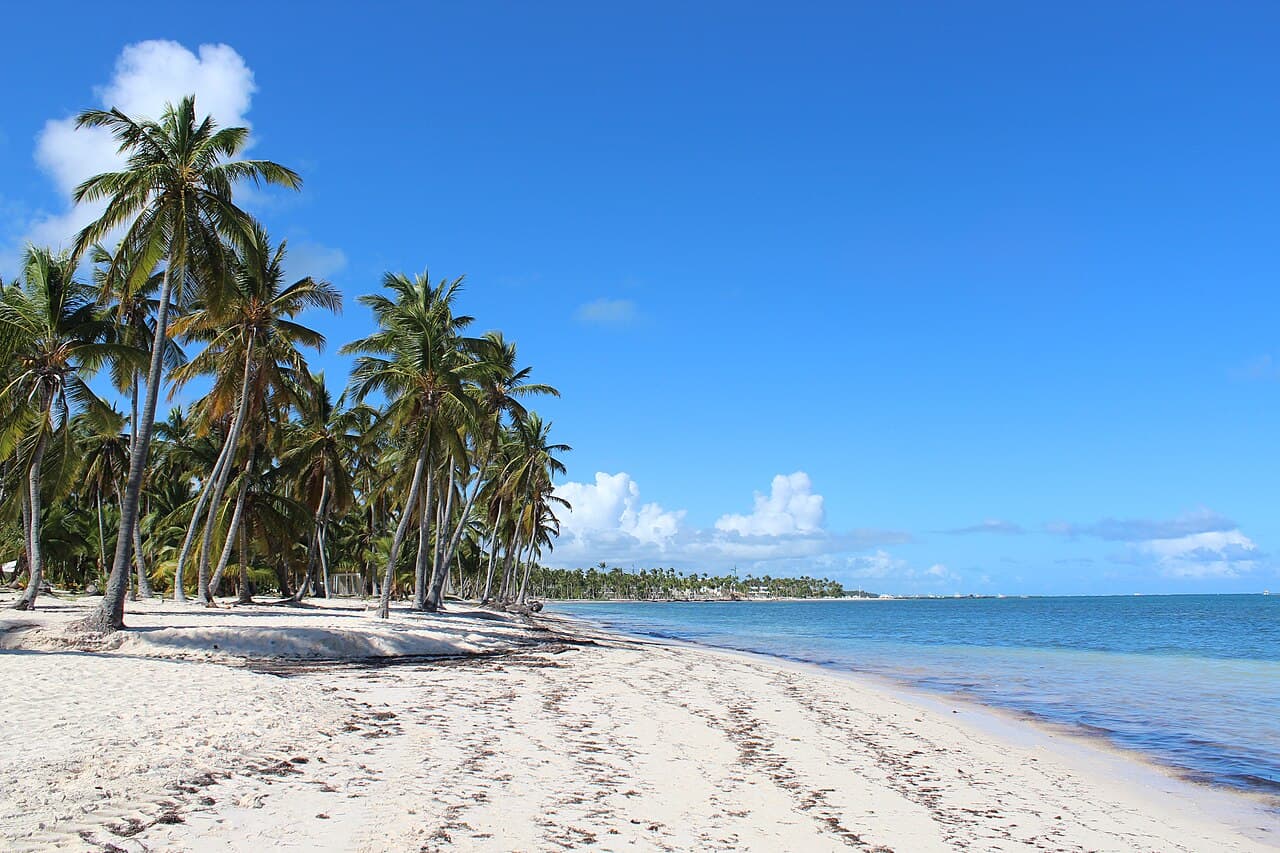
Dominican RepublicPhoto: Danu Widjajanto / Wikimedia Commons (CC BY-SA 4.0)

Dominican Republic

Country · DO · DOP · America/Santo_Domingo

This information may change. Always check the official source.Last verified: August 2026 by

Most visitors get 30 days without a visa. The E-Ticket is compulsory and free, and the copycat sites charging up to USD 90 for it are the single biggest rip-off aimed at visitors here.

  • The E-Ticket is compulsory and free, and the only address is eticket.migracion.gob.do. Copycat sites charge USD 36 to USD 90 for the identical government form.
  • If the address does not end in .gob.do, it is not the government. File once for the whole trip - the same submission covers entry and exit - and save the QR code offline.
  • 30 days is the standard tourist admission, granted on arrival with no application. The USD 10 tourist card and USD 20 departure tax are already in your airfare if you fly.
  • A valid US, Canadian, UK, Irish, Cypriot or Schengen visa or residence permit lets anyone in for 30 days without a Dominican visa. This exemption is generous and widely missed.
  • Overstaying is a bill, not a crime. There is no daily fine or arrest risk - you settle a sliding scale on departure, starting around RD$ 3,500 for 30 to 90 days.
More details

The E-Ticket is free. Say that again.

Every passenger flying into the Dominican Republic must file an electronic entry and exit form before check-in. It costs nothing. The only address is eticket.migracion.gob.do.

  • Fraudulent sites charge between USD 36 and USD 90 for filling in the identical free government form. They copy the colours and the fonts, they buy search advertising, and they rank above the real thing. Migración has publicly warned about them.
  • The rule is simple: if the address does not end in .gob.do, it is not the government. Anything ending .com, .net or .org offering to process your E-Ticket is a middleman.
  • File it once for the whole trip. The same submission covers entry and exit, and you can complete it as soon as you have flight details, up to 7 days ahead for the arrival leg.
  • You get a QR code. Save it offline and screenshot it. Airline staff ask for it at check-in and immigration scans it on arrival.

What you get at the desk

  • 30 days is the standard tourist admission for visa-free nationalities, and it is granted on arrival with no application.
  • The USD 10 tourist card is already in your airfare if you fly in. Arriving by land or sea, you buy one on the spot. The USD 20 departure tax is likewise bundled into the ticket.
  • Passports should have 6 months' validity. A temporary measure running to 31 December 2026 lets citizens of the EU, UK, Canada, the USA, Brazil, Chile, Argentina, Colombia and Ecuador enter on a passport merely valid for the length of the stay.
  • You will be fingerprinted and photographed on entry. This is routine.
  • Bring evidence of onward travel. Entry can be refused without it, and airlines check before boarding.

Where your nationality lands

Visa and entry in the Dominican Republic
You holdWhat you need
US, Canada, UK, EU, Australia, Japan, South Korea, Singapore, Taiwan, MalaysiaNo visa, 30 days
RussiaNo visa, 60 days within any 180-day period
China, India, Cambodia, Saudi ArabiaVisa in advance, unless the exemption below applies
  • The exemption is generous and widely missed. Anyone, of any nationality, holding a valid visa or residence permit from the United States, Canada, the United Kingdom, Ireland, Cyprus or a Schengen country may enter the Dominican Republic as a tourist for up to 30 days without a Dominican visa. If you hold a US or Schengen visa, you very probably do not need to apply for anything.

Overstaying is a bill, not a crime

This is unusual and worth understanding, because it is calmer than most countries.

  • There is no daily fine accruing in the background, no office to report to and no arrest risk for a tourist who stays past 30 days.
  • You settle it when you leave, on a published sliding scale tied to how long you actually stayed. It starts at about RD$ 3,500 for 30 to 90 days and climbs steeply from there.
  • It is payable at the airport by card on departure, or in advance at a Banco Reservas branch.
  • Extensions up to 120 days can be arranged through Migración for a fee if you would rather do it properly.
Sources (4)

The Dominican Republic's allowances are unremarkable, and the airport's attention is on drugs rather than duty.

  • Departure luggage is screened for narcotics at Punta Cana and Las Americas, sometimes twice, and bags are opened in front of you. Never carry anything for anybody.
  • The allowance is a carton of cigarettes and a couple of litres of spirits per adult, plus a value cap on other goods.
  • Cash equivalent to USD 10,000 or more must be declared on entry and exit.
  • Drones need permission from the aviation authority and are otherwise held at customs.
  • Coral, shells and amber of archaeological origin are restricted, though ordinary amber and larimar jewellery travels freely with a receipt.
More details
  • Departure luggage is screened for narcotics at Punta Cana and Las Americas, sometimes twice, and bags are opened in front of you. Never carry anything for anybody.
  • The allowance is a carton of cigarettes and a couple of litres of spirits per adult, plus a value cap on other goods.
  • Cash equivalent to USD 10,000 or more must be declared on entry and exit.
  • Drones need permission from the aviation authority and are otherwise held at customs.
  • Coral, shells and amber of archaeological origin are restricted, though ordinary amber and larimar jewellery travels freely with a receipt.
  • An electronic entry form covers customs and immigration together and is filled in before you fly.
Sources (1)

Do not drink the tap water, take mosquitoes seriously, and understand that an unpaid hospital bill can stop you leaving the country.

  • An unpaid hospital bill can stop you leaving the country. Travel insurance with medical cover and repatriation is not optional - check the ceiling and any watersports exclusions.
  • Private hospitals are good and expensive and expect payment up front or a direct guarantee from your insurer. The public system is not a realistic option for a visitor.
  • Tap water is not drinkable anywhere in the country. Ice in resorts and established restaurants is made from purified water; roadside ice is a gamble.
  • Dengue is the main risk and is present year round, with no specific treatment and repeat infections more dangerous than first ones.
  • Use DEET repellent by day as well as night - the mosquito that carries dengue bites in daylight, so an evening-only routine misses it.
More details

The rule that catches people

Private hospitals here expect payment, and the FCDO warns that visitors who cannot settle a hospital bill may be prevented from leaving the country.

  • Travel insurance with medical cover and repatriation is not optional. Check the ceiling, and check that it covers any watersports or motorcycling you plan.
  • Private hospitals are good and expensive; the public system is stretched and not a realistic option for a visitor.
  • Expect to pay up front or to have your insurer guarantee payment directly. Carry your policy number and the insurer's 24-hour line somewhere you can reach without data.
  • Punta Cana, Santo Domingo and Santiago have the best facilities. Serious cases from elsewhere are moved to one of those.

Water and food

  • Tap water is not drinkable anywhere in the country. This is unambiguous.
  • Drink bottled or filtered water, and use it for brushing your teeth if your stomach is sensitive.
  • Ice in resorts and established restaurants is made from purified water and is generally fine. Roadside ice is a gamble.
  • Street food is part of the experience, and the usual rules apply: busy stalls, hot food, high turnover.

Mosquitoes

  • Dengue is the main risk and is present year round, worse in the wet season. There is no specific treatment, and repeat infections are more dangerous than first ones.
  • Oropouche virus has been spreading in the region and is now a recognised risk here.
  • Malaria risk is low but not zero, concentrated in rural areas near the Haitian border. Check current advice if you are going there.
  • Use repellent with DEET, day and night. The mosquito that carries dengue bites in daylight, so an evening-only routine misses it.
  • Air conditioning and screens help more than anything else.

The rest

  • No vaccinations are required for entry, but check routine cover and hepatitis A and typhoid with a travel clinic 8 weeks out.
  • The sun is stronger than it feels in the sea breeze. High-factor sunscreen and shade in the middle of the day.
  • Pharmacies are good, widespread and cheap, and many drugs that need a prescription elsewhere are sold over the counter. Bring your own regular medication with a copy of the prescription.
  • Heat and dehydration are the most common problems visitors actually have. Drink far more water than you think you need.
Sources (2)

Santo Domingo

Long-term averages for Santo Domingo: the mean daily high, the mean overnight low and the mean monthly rainfall across 30 years of ERA5 reanalysis data (1995–2024).

DayNight
202530°C0200mmJanFebMarAprMayJunJulAugSepOctNovDecJanuary: Day 28 °C, Night 20 °C, Rain 31 mm. February: Day 28 °C, Night 20 °C, Rain 32 mm. March: Day 28 °C, Night 21 °C, Rain 43 mm. April: Day 29 °C, Night 22 °C, Rain 68 mm. May: Day 29 °C, Night 22 °C, Rain 112 mm. June: Day 30 °C, Night 23 °C, Rain 110 mm. July: Day 30 °C, Night 23 °C, Rain 123 mm. August: Day 30 °C, Night 24 °C, Rain 146 mm. September: Day 30 °C, Night 23 °C, Rain 129 mm. October: Day 29 °C, Night 23 °C, Rain 124 mm. November: Day 28 °C, Night 22 °C, Rain 82 mm. December: Day 28 °C, Night 21 °C, Rain 49 mm
Show the monthly table
Santo Domingo
MonthDay (°C)Night (°C)Rain (mm)
January282031
February282032
March282143
April292268
May2922112
June3023110
July3023123
August3024146
September3023129
October2923124
November282282
December282149

Punta Cana

Long-term averages for Punta Cana: the mean daily high, the mean overnight low and the mean monthly rainfall across 30 years of ERA5 reanalysis data (1995–2024).

DayNight
202530°C0200mmJanFebMarAprMayJunJulAugSepOctNovDecJanuary: Day 26 °C, Night 24 °C, Rain 47 mm. February: Day 26 °C, Night 23 °C, Rain 41 mm. March: Day 27 °C, Night 23 °C, Rain 42 mm. April: Day 27 °C, Night 24 °C, Rain 59 mm. May: Day 28 °C, Night 25 °C, Rain 104 mm. June: Day 29 °C, Night 26 °C, Rain 85 mm. July: Day 29 °C, Night 26 °C, Rain 105 mm. August: Day 29 °C, Night 26 °C, Rain 122 mm. September: Day 29 °C, Night 26 °C, Rain 135 mm. October: Day 29 °C, Night 26 °C, Rain 128 mm. November: Day 28 °C, Night 25 °C, Rain 122 mm. December: Day 27 °C, Night 24 °C, Rain 63 mm
Show the monthly table
Punta Cana
MonthDay (°C)Night (°C)Rain (mm)
January262447
February262341
March272342
April272459
May2825104
June292685
July2926105
August2926122
September2926135
October2926128
November2825122
December272463

Puerto Plata

Long-term averages for Puerto Plata: the mean daily high, the mean overnight low and the mean monthly rainfall across 30 years of ERA5 reanalysis data (1995–2024).

DayNight
202530°C0100mmJanFebMarAprMayJunJulAugSepOctNovDecJanuary: Day 26 °C, Night 22 °C, Rain 81 mm. February: Day 26 °C, Night 22 °C, Rain 59 mm. March: Day 27 °C, Night 22 °C, Rain 85 mm. April: Day 27 °C, Night 22 °C, Rain 69 mm. May: Day 28 °C, Night 23 °C, Rain 83 mm. June: Day 30 °C, Night 25 °C, Rain 46 mm. July: Day 30 °C, Night 25 °C, Rain 41 mm. August: Day 30 °C, Night 25 °C, Rain 57 mm. September: Day 30 °C, Night 25 °C, Rain 87 mm. October: Day 29 °C, Night 24 °C, Rain 91 mm. November: Day 28 °C, Night 23 °C, Rain 100 mm. December: Day 27 °C, Night 22 °C, Rain 77 mm
Show the monthly table
Puerto Plata
MonthDay (°C)Night (°C)Rain (mm)
January262281
February262259
March272285
April272269
May282383
June302546
July302541
August302557
September302587
October292491
November2823100
December272277
Sources (1)

The all-inclusive is the dominant model and often genuinely good value. Outside it, check what the quoted rate excludes.

  • Check whether a quoted resort rate already includes the 18 percent tax and 10 percent service charge. Some booking sites show the bare rate and add 28 percent at the end.
  • All-inclusive does not mean everything - premium spirits, à la carte restaurants, spa treatments, motorised watersports and excursions are usually extra, and tips are still expected.
  • The resort strip is not the country. Punta Cana is an enclave, and you will see very little of the Dominican Republic without deliberately leaving it.
  • Air conditioning and a reliable generator are the two things worth checking. Power cuts are frequent, and no inverter means no fan at 03:00.
  • Hurricane season runs June to November. Book refundable rates in September and October and read the cancellation terms rather than assuming.
More details

The all-inclusive question

Punta Cana and Bávaro are built almost entirely around all-inclusive resorts, and for a beach week the maths usually favours them.

  • Check whether the quoted rate already includes the 18 percent ITBIS and the 10 percent service charge. Some booking sites show the bare rate and add 28 percent at the end.
  • All-inclusive does not mean everything. Premium spirits, à la carte restaurants, spa treatments, motorised watersports and excursions are usually extra.
  • Tips are still expected even where the brochure says they are not needed. Cash in small notes.
  • The resort strip is not the country. Punta Cana is an enclave, and you will see very little of the Dominican Republic without deliberately leaving it.

Other options, and where

  • Santo Domingo's Zona Colonial has the best independent hotels in the country, in genuinely historic buildings, at a fraction of resort prices.
  • Cabarete and Las Terrenas run on smaller guesthouses and apartments, and suit longer, slower stays.
  • Jarabacoa and Constanza, up in the mountains, are cool, green and almost entirely domestic tourism. Worth a couple of nights for the contrast.
  • Samaná is where whale watching happens between January and March, and accommodation books out well ahead for it.

Practical

  • Air conditioning and a reliable generator are the two things worth checking. Power cuts are frequent, and a hotel without an inverter or generator means no fan at 03:00.
  • Hot water is not universal in cheaper places, which matters less than you would think in this climate.
  • Short-term rentals are widespread and legal, and Airbnb is well established in Santo Domingo, Cabarete and Las Terrenas.
  • Hurricane season runs June to November. Book refundable rates in September and October, the peak months, and check the cancellation terms rather than assuming.
Sources (2)

Three networks, cheap prepaid, and a passport plus a photograph required to register. Claro has the coverage once you leave the resort strip.

  • Claro has the best national coverage and is the one to pick if you leave the tourist areas; Altice is competitive in cities and resort zones, Viva cheapest and thinnest.
  • A Claro prepaid SIM is about RD$ 150, and Altice's tourist package is around RD$ 550 for roughly 15 GB with calls - the straightforward option for a week or two.
  • Bring your passport and expect to be photographed. Prepaid SIMs must be registered to a named person, staff copy the passport, and it is not optional.
  • Coverage thins fast in the mountains and the far southwest - the Cordillera Central, Pedernales and parts of the Samaná interior have real gaps.
  • Resort wifi is often poor and sometimes charged, so a local SIM usually beats paying the hotel. An eSIM such as Saily skips the registration desk at a higher price per gigabyte.
More details

Which network

SIM and eSIM in the Dominican Republic
OperatorNotes
ClaroBest national coverage. The one to pick if you leave the tourist areas
AlticeCompetitive tourist bundles, good in cities and resort zones
VivaCheapest, thinnest coverage
  • A Claro prepaid SIM costs about RD$ 150. Altice frequently gives the SIM away and sells short data bundles from around RD$ 50.
  • Altice's tourist package is around RD$ 550 for roughly 15 GB with calls and texts, which is the straightforward option for a one or two week stay.
  • Bring your passport, and expect to be photographed. Prepaid SIMs must be registered to a named person here. Staff take a copy of the passport and usually a photo of you. It takes a few minutes and it is not optional.
  • Kiosks at Punta Cana and Las Américas airports sell and activate on the spot, which is the least painful route.

Coverage and the resort trap

  • Coverage is good along the south coast, in Santo Domingo, Santiago and the resort corridors, and 4G is the norm with 5G in the cities.
  • It thins out fast in the mountains and the far southwest. The Cordillera Central, Pedernales and parts of the Samaná interior have real gaps.
  • Resort wifi is often poor and sometimes charged. A local SIM is usually better than paying the hotel, and much better than roaming.
  • An eSIM from a travel provider such as Saily works and skips the registration desk entirely, at a higher price per gigabyte. For a week in an all-inclusive that is a fair trade; for a longer or more mobile trip, buy local.
Sources (2)

Dominican sockets are Type and at 120 V, the American standard, and unearthed outlets are common.

  • American and Canadian plugs fit straight in. European, British and Australian ones need an adapter.
  • 120 V is the constraint. A 230 V-only European appliance will not run properly, and no plug adapter changes that.
  • Unearthed two-slot sockets are common outside newer hotels.
  • Resorts often fit European two-pin sockets alongside American ones for their guests, so a room can have both.
  • Power cuts are routine away from the resort corridors, and most hotels run generators that take a moment to pick up.
More details

Sockets in the Dominican Republic are Type , and at 120 V, 60 Hz - the American standard, with the odd two-round-pin outlet in tourist accommodation.

  • American and Canadian plugs fit straight in. European, British and Australian ones need an adapter.
  • 120 V is the constraint. A 230 V-only European appliance will not run properly, and no plug adapter changes that.
  • Unearthed two-slot sockets are common outside newer hotels.
  • Resorts often fit European two-pin sockets alongside American ones for their guests, so a room can have both.
  • Power cuts are routine away from the resort corridors, and most hotels run generators that take a moment to pick up.
Sources (1)

Spanish only outside the resorts, US-style plugs, and power cuts frequent enough to have their own word.

  • Very little English is spoken outside the resorts. Dominican Spanish is fast and drops consonants, so even confident speakers need a few days.
  • Electricity is 120 V, 60 Hz on US-style plugs. European and UK appliances need an adapter, and anything not dual-voltage needs a converter.
  • Power cuts are frequent enough to have a name, apagones, lasting minutes or hours. Check your hotel has an inverter or generator, and charge devices whenever the power is on.
  • Tipping the supermarket bagger is a local custom - they are often unpaid and work for tips, and RD$ 20 to RD$ 50 is normal.
  • Dress modestly away from the beach. Swimwear is for the beach and the pool, not the town, and Dominicans dress smartly.
More details

Language

  • Spanish is the language, and outside the resorts very little English is spoken. In Punta Cana hotels you will be fine; in a Santo Domingo colmado or a guagua you will not.
  • Dominican Spanish is fast and drops consonants. Final S disappears, so "¿cómo está?" becomes something closer to "¿cómo etá?". Even confident Spanish speakers need a few days.
  • A translation app with offline Spanish downloaded is worth ten minutes of preparation.

Power

  • Electricity is 120 V, 60 Hz, with US-style flat two-pin and three-pin plugs. European and UK appliances need an adapter, and anything not dual-voltage needs a converter.
  • Power cuts are frequent enough to have a name: apagones. They can last minutes or hours.
  • Most decent hotels and businesses run an inverter or a generator. This is worth checking when you book, because it is the difference between a brief flicker and a night without air conditioning.
  • Keep a power bank charged, and charge devices whenever the power is on rather than when you need it.

Everyday rhythm

  • Colmados are the corner shops that hold the country together, selling everything in whatever quantity you want, often with plastic chairs outside and music playing.
  • Music is loud and public and constant. Merengue, bachata and dembow, at volumes that visitors sometimes find startling. It is not aimed at you and complaining will get you nowhere.
  • Cash rules the informal economy. Colmados, guaguas, motoconchos and street vendors want pesos.
  • Tipping the supermarket bagger is a small local custom. They are often unpaid and work for tips. RD$ 20 to RD$ 50 is normal.
  • Dress modestly away from the beach. Swimwear is for the beach and the pool, not the town, and Dominicans dress smartly.
  • Baseball, not football, is the national sport. The winter league runs November to January and is a genuinely good night out.
  • The pace is unhurried. "Ahora" can mean now, later, or at some point. Build slack into plans and do not schedule tightly.
Sources (2)

Restaurant bills arrive with 28 percent already added, in two separate lines, and the 10 percent labelled as service usually does not reach your server.

  • A restaurant bill adds 28 percent to the menu price in two lines: 18 percent ITBIS tax and a 10 percent propina legal required by law.
  • That 10 percent service charge frequently does not reach the person who served you. Tip on top in cash, 5 to 10 percent handed directly, if the service was good.
  • Use pesos. US dollars are accepted in resorts at a rate designed to profit the seller, so you lose money every time you pay in them.
  • Card cloning is a genuine problem here - never let your card out of your sight, ask for the terminal to be brought to you, and check statements while you are still travelling.
  • Tell your bank you are travelling. Card blocks are common because most issuers flag the country for fraud.
More details

Read the bottom of the bill

A Dominican restaurant bill has three numbers, and the first one is the smallest.

Money and payments in the Dominican Republic
LineWhat it is
SubtotalThe food and drink
ITBIS, 18 percentValue added tax
Propina legal, 10 percentA service charge required by law
  • That is 28 percent on top of the menu price, and it is not a scam. It is how the law works, and the menu price is quoted before both.
  • The 10 percent propina legal frequently does not reach the person who served you. It goes to the establishment and is distributed at its discretion.
  • So tip on top, in cash, if the service was good. Five to 10 percent handed directly to the server is the local practice among those who know how the system works.
  • In all-inclusive resorts, USD 1 to USD 5 in cash for bar staff, housekeeping and porters is normal and genuinely appreciated. Small bills are worth bringing for exactly this.

Pesos and dollars

  • The peso (RD$) is the currency, and you should use it.
  • US dollars are accepted in resorts and tourist areas at a rate designed to profit the seller. You lose money every time you pay in dollars.
  • Change money at banks or established exchange houses, not at the airport and never with someone on the street.
  • ATMs are widespread and dispense pesos. Use machines inside bank branches during opening hours rather than standalone ones on the street, which is both a fraud and a safety point.
  • Tell your bank you are travelling. Card blocks are common here because the country is flagged for fraud by most issuers.

Cards, carefully

  • Card cloning and card fraud are a genuine problem and the FCDO warns about them specifically.
  • Never let your card out of your sight. Ask for the terminal to be brought to you.
  • Check statements while you are still travelling, not after you get home.
  • Carry some cash. Smaller restaurants, guaguas, colmados and motoconchos are cash only, and card acceptance drops away sharply outside the tourist strip.
  • Keep small denominations. Breaking a RD$ 2,000 note in a small shop is often impossible.
Sources (2)

Everyday prices

Typical prices in Dominican peso (DOP), averaged across the country by Numbeo and read on 12 August 2026. Tick Convert prices above the table to see every amount in your own currency.

Everyday prices
ItemTypical price
Inexpensive restaurant meal500 DOP
Dinner for two, mid-range, three courses3,000 DOP
Cappuccino126 DOP
Local draught beer, 0.5 l150 DOP
Bottled water, 0.33 l39 DOP
Public transport, one-way ticket40 DOP
Taxi, starting fare200 DOP
Petrol, 1 litre80 DOP
Cigarettes, pack of 20 (Marlboro)330 DOP
Average net monthly salary34,600 DOP

These are country-wide averages, not a price list: tourist districts, airports and islands sit well above them, and small towns below. The salary line is there for proportion - it is what people living here actually earn.

Sources (1)

Airport guides for Dominican Republic3

One page per airport: the routes into town, what they cost and the trap particular to that arrival.

See all 3 airports

Fixed-price taxis, no meters, and cash only at Punta Cana. Arrange the transfer before you land and you avoid the whole negotiation.

  • Licensed taxis run on fixed published fares, not meters. Punta Cana to Bávaro is roughly USD 35 to USD 45 per vehicle for up to 4 people.
  • Bring cash in dollars or pesos - airport taxis generally do not take cards, which surprises people at the worst moment.
  • Pre-booked transfers cost less and remove the haggling, from about USD 15 per person shared or USD 35 for a private car. If you booked a package, the transfer is usually included.
  • Uber works well in Santo Domingo and is markedly cheaper than an airport taxi; in Punta Cana the taxi union controls airport pickups.
  • Do not take a motoconcho with luggage. Motorcycle taxis are how a large share of the country's road casualties happen, and on a highway with a suitcase they are genuinely dangerous.
More details
Punta Cana (PUJ)

The busiest airport in the Caribbean, and the one where most visitors arrive.

  • Licensed taxis run on fixed published fares, not meters. Bávaro is roughly USD 35 to USD 45, priced per vehicle for up to 4 people rather than per person.
  • Bring cash, in US dollars or pesos. Airport taxis generally do not take cards, and this surprises people at the worst moment.
  • Pre-booked transfers cost less and remove the haggling. Shared shuttles run from about USD 15 per person, private cars from around USD 35.
  • If your hotel is an all-inclusive booked as a package, the transfer is usually included. Check before paying for one.
  • Uber exists in Punta Cana but not usefully at the airport, where the taxi union controls pickups.
Santo Domingo (SDQ, Las Américas)
  • About 30 km east of the city, and the drive takes 30 to 45 minutes depending on traffic.
  • Uber works well in Santo Domingo and is markedly cheaper than an airport taxi. Pickup arrangements at the terminal change, so check the app on arrival.
  • Fixed-fare taxis into the Zona Colonial run around USD 40.
Puerto Plata (POP) and Santiago (STI)
  • Puerto Plata serves Sosúa, Cabarete and the north coast, all within 15 to 40 minutes by taxi.
  • Santiago is the domestic and regional hub and is convenient for the Cibao valley and the mountains.
What not to do
  • Do not take a motoconcho with luggage. Motorcycle taxis are everywhere and cheap, and they are also how a large share of the country's road casualties happen. With a suitcase on a highway they are genuinely dangerous.
  • Guaguas, the shared minibuses, are the local way to travel and cost very little. They are also frequently uninsured and poorly maintained, and they fill well past capacity. Fine for a short hop in daylight, not for an airport run at night.
  • Avoid driving yourself on arrival day. Dominican traffic takes acclimatisation, and night driving outside cities is best avoided entirely.
Sources (2)

Getting around the country, and within it

Good long-distance coaches, chaotic local minibuses, and roads that are among the deadliest in the Americas.

  • Caribe Tours and Metro run proper long-distance coaches - air conditioned, cheap and reliable, with Santo Domingo to Puerto Plata about 4 hours. Book ahead for weekends and holidays.
  • Guaguas are the backbone of local transport: they stop anywhere, cost very little and leave when full, with no timetable and no route map you can rely on.
  • Road deaths here are among the highest in the Americas and motorcycles account for most of them. Assume nothing is signalled.
  • Do not drive at night outside the cities. Lighting is poor to absent and the hazards are worse.
  • Uber works in Santo Domingo, Santiago and to a degree in Punta Cana, and WhatsApp is how the whole country communicates, hotels and drivers included.
More details

Between cities

  • Caribe Tours and Metro run proper long-distance coaches, air conditioned, cheap and reliable. Santo Domingo to Puerto Plata is a few hundred pesos and about 4 hours.
  • Book ahead for weekends and holidays, when Dominicans travel in force.
  • Domestic flights barely exist and are not worth the cost for a country this size. The coach is the sensible option.

Within cities

  • Santo Domingo has a metro, two lines, clean, cheap and useful for the modern city though not for the Zona Colonial.
  • Guaguas are the backbone of local transport. They stop anywhere, cost very little, and leave when full. There is no timetable and no route map you can rely on; ask, and someone will tell you.
  • Carros públicos are shared cars running fixed routes, cramming in far more people than seems possible.
  • Motoconchos are the fastest way across a town and the most dangerous. No helmets are offered. If you use one, accept that you are taking a real risk.

Driving

  • Road deaths here are among the highest in the Americas, and motorcycles account for most of them.
  • Assume nothing is signalled. Overtaking on blind bends, vehicles without lights at night and livestock on the road are all normal.
  • Do not drive at night outside the cities. Lighting is poor to absent and the hazards are worse.
  • Police checkpoints are routine. Have your licence and rental papers, be polite, and note that requests for informal payments do happen.
  • Fuel is sold by the gallon and attendants pump it for you. A small tip is customary.

Apps

  • Uber works in Santo Domingo, Santiago and to a degree in Punta Cana. It is cheaper and less stressful than negotiating a taxi.
  • Indrive is widely used and lets you propose your own fare.
  • Google Maps is reliable for driving and useless for guaguas.
  • WhatsApp is how the whole country communicates, including hotels, drivers and tour operators. Have it working before you arrive.
Sources (2)

Dominican toll roads are fast and worth paying for, and the motoconchos are the thing to watch.

  • The Autopista del Coral and the Santo Domingo-Santiago highway are tolled and are far safer than the parallel local roads.
  • Motoconchos - moped taxis - ride against the traffic, at night without lights, and are the most common cause of accidents involving visitors.
  • The alcohol limit is 0.05 %.
  • Do not drive at night between towns. Unlit vehicles and animals on unlit roads make it the standard local advice.
  • Fuel is served by attendants and cash is useful outside the cities.
More details

Tolled highways that are worth the money, and mopeds coming from every direction.

  • The Autopista del Coral and the Santo Domingo-Santiago highway are tolled and are far safer than the parallel local roads.
  • Motoconchos - moped taxis - ride against the traffic, at night without lights, and are the most common cause of accidents involving visitors.
  • The alcohol limit is 0.05 %.
  • Do not drive at night between towns. Unlit vehicles and animals on unlit roads make it the standard local advice.
  • Fuel is served by attendants and cash is useful outside the cities.
  • Toll payment is by cash or the Paso Rapido tag, which most hire cars carry.
Sources (1)

Resort areas are heavily policed and mostly uneventful. Elsewhere the crime rate is high, and the specific pattern is thieves on motorcycles.

  • Theft from motorcycles is the characteristic crime here - riders snatch bags and phones from pedestrians and reach through open car windows at traffic lights.
  • Walk with your bag on the side away from the road, keep the phone away near traffic, and keep car windows up and doors locked in city traffic.
  • Resort zones in Punta Cana and Bávaro are heavily patrolled, and CESTUR, the tourist police, exists specifically for visitors.
  • Do not walk on unlit beaches at night, where a disproportionate share of incidents against visitors happen.
  • Rip currents kill swimmers on the north and east coasts and many beaches have no lifeguard and no flags. If caught, swim parallel to the shore rather than against it.
More details

The pattern that repeats

Theft from motorcycles is the characteristic crime here.

  • Riders snatch bags and phones from pedestrians as they pass, and reach through open car windows at traffic lights.
  • Walk with your bag on the side away from the road. Keep the phone away entirely when you are near traffic.
  • Keep car windows up and doors locked in city traffic, particularly at junctions.
  • Armed muggings do happen in daylight, including in residential districts. If it happens, hand everything over without hesitation.

Where and when

  • Resort zones in Punta Cana and Bávaro are heavily patrolled and see very little of this. The tourist police, CESTUR (still widely called Politur), exist specifically for visitors.
  • Santo Domingo's Zona Colonial is fine by day and warrants ordinary caution after dark. Some outer barrios should be avoided entirely.
  • Do not walk on unlit beaches at night. This is where a disproportionate share of incidents against visitors occur.
  • Avoid remote areas after dark, and do not display jewellery, cameras or an expensive phone.

Things worth stating plainly

  • The FCDO records reports of sexual assault against foreign visitors, in some cases involving hotel staff or other guests. Do not walk alone at night, be careful about drinks left unattended, and be wary of invitations from strangers.
  • Drug offences carry severe prison sentences. Do not carry anything for anyone, and never leave your bag unattended at the airport.
  • Excursion operators are not regulated to European or North American standards. Check for lifejackets and functioning equipment yourself, and walk away if it looks wrong.

Scams

  • The fake E-Ticket sites are the big one, charging up to USD 90 for a free government form.
  • Card cloning at restaurants and standalone ATMs.
  • The "closed hotel" taxi routine, where a driver claims your accommodation has shut down and takes you to a place paying commission. Call your hotel.
  • Short-changing on dollar transactions, particularly with unfamiliar peso denominations. Count it.
  • Timeshare and excursion touts on the resort beaches, who are persistent rather than dangerous. A firm no works.

Weather and ground

  • Hurricane season runs June to November, peaking September and October. Follow the local forecast, and follow hotel instructions if a storm is coming.
  • The country sits on an active fault line. Earthquakes are possible and a coastal tsunami risk exists. Know your hotel's assembly point.
  • Rip currents kill swimmers on the north and east coasts. Many beaches have no lifeguard and no flags. If you are caught in one, swim parallel to the shore rather than against it.
Sources (1)

911 works and is genuinely good in the areas it covers, which is not the whole country. The tourist police have their own national number worth saving.

  • 911 works well in Santo Domingo, Santiago, Punta Cana and the main centres, often with English-speaking operators - but coverage is not national.
  • CESTUR, the tourist police, has its own national number and is the right first call for a theft, a lost passport or a problem with an operator.
  • Report any theft and get the written report. No insurer pays without it, and obtaining it later from another country is impossible.
  • Know the name and district of where you are staying, in Spanish. A resort name is not always enough for an emergency dispatcher.
  • If a storm is forecast, do not plan to fly out at the last moment. Airports close and the last flights fill days ahead.
More details

The numbers

Emergency information in the Dominican Republic
WhatNumber
Police, fire, ambulance911
Tourist police (CESTUR / Politur)+1 809 200 3500
Red Cross ambulance+1 809 682 4545
  • The 911 system is real and works well in Santo Domingo, Santiago, Punta Cana and the main population centres, with English-speaking operators often available.
  • Coverage is not national. In remote areas it may not reach you, which is why the tourist police number matters.
  • CESTUR, still widely called Politur, is the force dedicated to visitors. They are present in every resort area and are the right first call for a theft, a lost passport or a problem with an operator.
  • Save both numbers to your phone before you need them, not after.

Practicalities

  • Report any theft to the police and get the written report. No insurer will pay a claim without it, and getting it afterwards from another country is impossible.
  • Photograph your passport and your E-Ticket QR code, and keep copies somewhere separate.
  • If you lose your passport, report it to CESTUR, then contact your embassy in Santo Domingo. Nearly all embassies are there rather than in the resort areas, which means a journey.
  • Know the name and district of where you are staying, in Spanish. Resort names are not always enough for an emergency dispatcher.

Weather emergencies

  • Hurricane warnings are broadcast on local radio and television, and hotels will brief you.
  • COE, the Centro de Operaciones de Emergencias, is the national body that issues alerts and evacuation instructions. Follow them rather than your own judgement about the sea.
  • If a storm is forecast, do not plan to fly out at the last moment. Airports close, and the last flights fill days ahead.

Before anything goes wrong

  • Save your insurer's 24-hour emergency line offline.
  • Tell someone at home your itinerary, particularly if you are travelling outside the resort areas.
  • Keep enough cash to get yourself somewhere safe, because a card is no use during a power cut.
Sources (2)