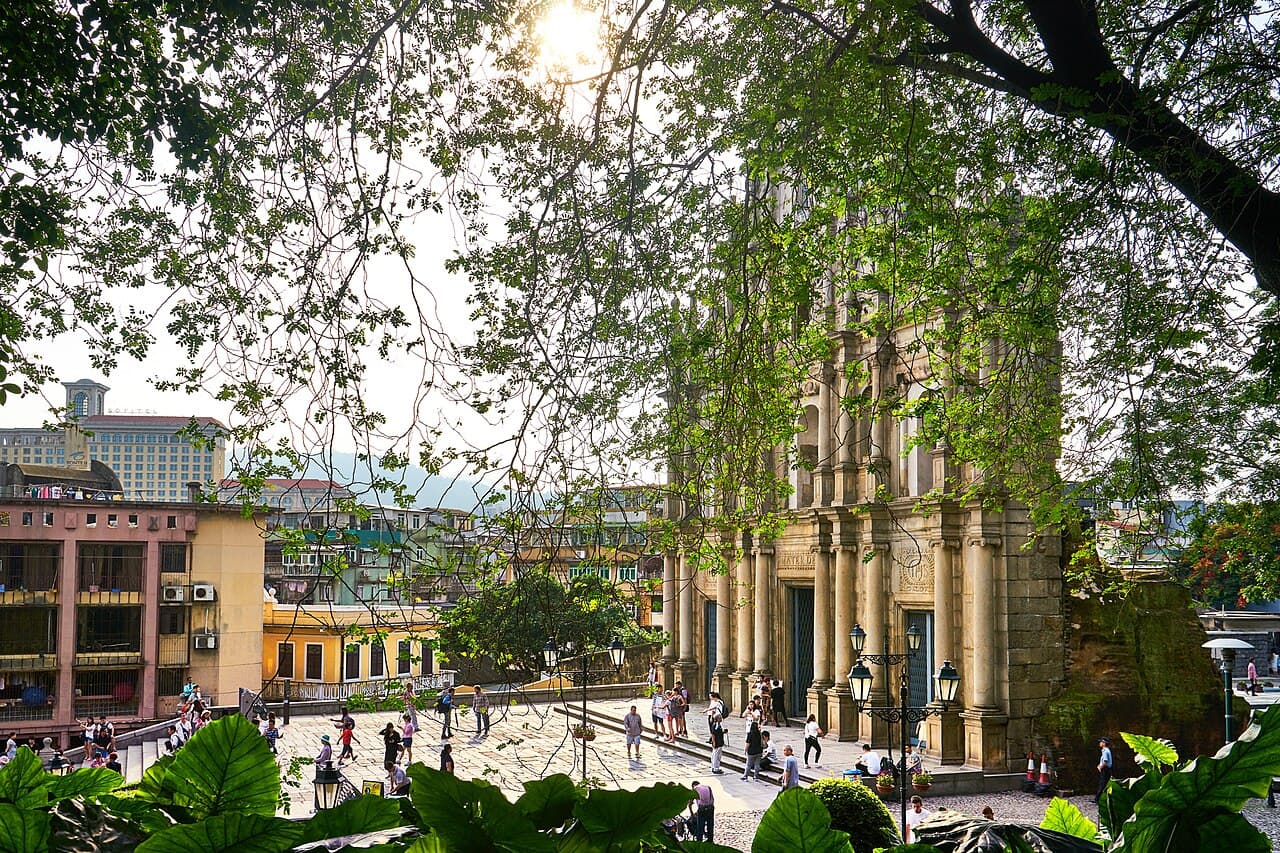
MacaoPhoto: Mike / Wikimedia Commons (CC BY 3.0)

Macao

Country · MO · MOP · Asia/Macau

This information may change. Always check the official source.Last verified: August 2026 by

Macao is neither China nor Hong Kong at the border. Most visitors get 30 days, Europeans 90 and British citizens six months, and almost anyone else can buy a visa at the desk.

  • A Chinese visa does not admit you to Macao, and a Macao entry does not admit you to the mainland.
  • Your passport must be valid at least 90 days beyond the stay, which is stricter than Hong Kong's one month next door - a passport that is fine for Hong Kong may not be fine here.
  • Almost everyone can buy a visa at the border. The visa-upon-arrival counter at the checkpoint issues it while you wait: MOP 100 for an individual, MOP 50 for a child under 12, MOP 200 on a family passport, and MOP 50 per person for an organised group of ten or more. It grants 30 days.
  • You get a paper arrival slip, not a passport stamp. It carries the date your permitted stay ends. Keep it with the passport - it is the only proof of your status.
More details

Three borders, not one

Macao runs its own immigration control, separate from both mainland China and Hong Kong. Nothing carries over between them.

  • A Chinese visa does not admit you to Macao, and a Macao entry does not admit you to the mainland.
  • Hong Kong and Macao are separate from each other too. The ferry across is an international crossing with immigration at both ends.
  • Crossing to Zhuhai through the Border Gate or the Hengqin port needs a Chinese visa, and coming back into Macao uses a fresh entry.

How long you get

Visa and entry in Macao
You holdAuthorisation to stay
United Kingdom (British citizens)6 months
Germany, France, Italy, Spain, Netherlands, Poland and the rest of the EU and Schengen, plus Japan, South Korea, Brazil, Mexico and around 20 more90 days
USA, Canada, Australia, Singapore, Malaysia, India, Russia, Saudi Arabia and most other nationalities30 days
Hong Kong permanent residents1 year
Brunei, Kazakhstan14 days
  • Your passport must be valid at least 90 days beyond the stay, which is stricter than Hong Kong's one month next door - a passport that is fine for Hong Kong may not be fine here.
  • No stay may run past 90 days before the passport expires, whatever band you are in.

If you are not exempt

  • Almost everyone can buy a visa at the border. The visa-upon-arrival counter at the checkpoint issues it while you wait: MOP 100 for an individual, MOP 50 for a child under 12, MOP 200 on a family passport, and MOP 50 per person for an organised group of ten or more. It grants 30 days.
  • Six nationalities cannot use that counter and must obtain a Macao visa in advance from a Chinese diplomatic mission: Bangladesh, Nepal, Nigeria, Pakistan, Sri Lanka and Vietnam.
  • Mainland Chinese residents need an Exit-Entry Permit for Travelling to and from Hong Kong and Macao with a valid endorsement, issued on the mainland.
  • Taiwan residents are admitted on a Taiwan passport for 30 days; the Mainland Travel Permit for Taiwan Residents is also accepted.

At the desk and after it

  • You get a paper arrival slip, not a passport stamp. It carries the date your permitted stay ends. Keep it with the passport - it is the only proof of your status.
  • Declare cash of MOP 120,000 or more, including travellers cheques and money orders, through the red channel. Under-declaring on the way out is fined from MOP 1,000 to MOP 500,000, and in a city built on casinos this is enforced.
  • There is no arrival card to fill in.
Sources (3)

Macao is a free port like Hong Kong, with the same tiny cigarette allowance and the same outright ban on vapes.

  • The tobacco allowance is 19 cigarettes per adult, the same odd figure as Hong Kong, and it is enforced at the ferry terminals as well as the airport.
  • Electronic cigarettes are prohibited. Importing, selling or carrying one through the border is an offence, and they are confiscated on the spot.
  • Alcohol is 1 litre of spirits over 30 %, and everything under that carries no duty.
  • Macao levies no general customs duty, which is the point of a free port - the prices in the casinos' shopping malls are not the result of a tax break, though.
  • MOP 120,000 or more in cash must be declared when asked, and the crossings to Hong Kong and Zhuhai are all customs boundaries even though all three are China.
More details
  • The tobacco allowance is 19 cigarettes per adult, the same odd figure as Hong Kong, and it is enforced at the ferry terminals as well as the airport.
  • Electronic cigarettes are prohibited. Importing, selling or carrying one through the border is an offence, and they are confiscated on the spot.
  • Alcohol is 1 litre of spirits over 30 %, and everything under that carries no duty.
  • Macao levies no general customs duty, which is the point of a free port - the prices in the casinos' shopping malls are not the result of a tax break, though.
  • MOP 120,000 or more in cash must be declared when asked, and the crossings to Hong Kong and Zhuhai are all customs boundaries even though all three are China.
Sources (1)

Two hospitals run 24-hour emergency departments, the tap water is treated, and a visitor pays for everything.

  • Both main hospitals run 24-hour emergency departments and both are used to foreign patients.
  • For anything less than urgent, the public health centres are quicker than a hospital.
  • No health certificates are required of visitors in normal circumstances.
  • The water is supplied from the mainland, purified and chlorinated. Hotels and restaurants provide distilled drinking water as a matter of course, which is what most people actually drink.
  • Carry prescriptions in the original packaging. Macao regulates controlled medicines strictly and this is a border where a loose bag of pills is a problem.
More details

Where to go

Health and medical care
HospitalPhoneNote
Hospital Centre S. Januario (government)+853 2831 373124-hour emergency
Kiang Wu Hospital (private)+853 2837 133324-hour emergency
University Hospital (private), Taipa+853 2882 1819Near the airport and Cotai
  • Both main hospitals run 24-hour emergency departments and both are used to foreign patients.
  • For anything less than urgent, the public health centres are quicker than a hospital.
  • You will be billed as a visitor. Take insurance covering treatment and repatriation; Hong Kong is 15 minutes away by helicopter and an hour by ferry if you need a bigger hospital.

Everyday health

  • No health certificates are required of visitors in normal circumstances.
  • The water is supplied from the mainland, purified and chlorinated. Hotels and restaurants provide distilled drinking water as a matter of course, which is what most people actually drink.
  • Summer is hot and very humid, and Macao's streets are narrow and unshaded. The historic centre in August is harder work than it looks on a map.
  • Pharmacies are common; the Pharmaceutical Administration Bureau lists the registered ones.

Medicines

  • Carry prescriptions in the original packaging. Macao regulates controlled medicines strictly and this is a border where a loose bag of pills is a problem.
  • Anything containing CBD or cannabis is illegal, exactly as in Hong Kong and mainland China.
Sources (2)

Macao

Long-term averages for Macao: the mean daily high, the mean overnight low and the mean monthly rainfall across 30 years of ERA5 reanalysis data (1995–2024).

DayNight
1015202530°C0500mmJanFebMarAprMayJunJulAugSepOctNovDecJanuary: Day 18 °C, Night 13 °C, Rain 27 mm. February: Day 19 °C, Night 15 °C, Rain 41 mm. March: Day 22 °C, Night 18 °C, Rain 70 mm. April: Day 25 °C, Night 21 °C, Rain 128 mm. May: Day 28 °C, Night 24 °C, Rain 226 mm. June: Day 29 °C, Night 26 °C, Rain 293 mm. July: Day 30 °C, Night 27 °C, Rain 249 mm. August: Day 30 °C, Night 27 °C, Rain 345 mm. September: Day 29 °C, Night 25 °C, Rain 233 mm. October: Day 27 °C, Night 23 °C, Rain 104 mm. November: Day 24 °C, Night 19 °C, Rain 41 mm. December: Day 20 °C, Night 14 °C, Rain 27 mm
Show the monthly table
Macao
MonthDay (°C)Night (°C)Rain (mm)
January181327
February191541
March221870
April2521128
May2824226
June2926293
July3027249
August3027345
September2925233
October2723104
November241941
December201427

When to visit

Macao's dry, mild half is November to March at 18-24 C. The other half is the rain - 226 to 345 mm a month from May to September - and the typhoon signal that suspends every bus in the city.

There is no ambiguity in Macao's table. May to September takes 226, 293, 249, 345 and 233 mm; November, December and January take 41, 27 and 27. That is an eight-fold difference, and it lines up with the temperature: the wet months are the 28-30 C ones and the dry months are the 18-24 C ones.

More details

The year splits cleanly in two

There is no ambiguity in Macao's table. May to September takes 226, 293, 249, 345 and 233 mm; November, December and January take 41, 27 and 27. That is an eight-fold difference, and it lines up with the temperature: the wet months are the 28-30 C ones and the dry months are the 18-24 C ones.

November to March is what this page picks, at 18-24 C by day and 13-19 C at night, with the year's lowest rainfall. It is the season for walking the Historic Centre, the Taipa villages and the Coloane trails, all of which are outdoor propositions that a 345 mm August does not reward.

The trade-off is small: even January averages 18 C by day, so this is a mild winter rather than a cold one, and nothing is closed by it.

The typhoon signal is a travel fact, not a weather fact

Between roughly May and November the region is in tropical cyclone season, and Macao's response to one is administrative rather than advisory. When typhoon signal No. 8 or above is hoisted, all public transport services in Macao are suspended, on the tourism office's own notice - and tourist information counters and government-run attractions close with them.

That is what makes a summer trip here different from a merely rainy one. A signal 8 can be raised and lowered inside a day, but while it stands the buses stop, outdoor events are postponed, and the border and ferry connections that make Macao a day trip from Hong Kong or Zhuhai are not something to count on. The tourism hotline runs around the clock through it.

If a summer date is fixed, build a day of slack into it. If it is not, the dry half of the year has none of this.

Sources (2)

Where to stay

Cotai for the resorts, the peninsula for the actual city. Midweek costs a fraction of the weekend.

  • Cotai is the strip of enormous integrated resorts built on reclaimed land between Taipa and Coloane - the Venetian, the Parisian, and the rest. Rooms are large by regional standards, everything is indoors and air-conditioned, and you will not see Macao.
  • Midweek is a different city from the weekend. Macao fills up on Friday and Saturday with visitors from the mainland and Hong Kong, and resort room rates can multiply.
  • The free shuttles make hotel location matter less than it looks. A cheaper hotel next to a big resort inherits that resort's transport network.
More details

Two different trips

  • Cotai is the strip of enormous integrated resorts built on reclaimed land between Taipa and Coloane - the Venetian, the Parisian, and the rest. Rooms are large by regional standards, everything is indoors and air-conditioned, and you will not see Macao.
  • The Macao peninsula is the old city: the UNESCO historic centre, Senado Square, the Portuguese street tiles, the food. Hotels are smaller and older, and this is where the place is actually interesting.
  • Taipa Village sits between the two and is the compromise a lot of repeat visitors settle on.

Prices move violently with the day of the week

  • Midweek is a different city from the weekend. Macao fills up on Friday and Saturday with visitors from the mainland and Hong Kong, and resort room rates can multiply.
  • Arriving Sunday to Thursday is the single biggest saving available here, and it is far larger than the difference between hotels.
  • Public holidays on the mainland, especially Lunar New Year and the October Golden Week, fill everything at any price.

Practical

  • The free shuttles make hotel location matter less than it looks. A cheaper hotel next to a big resort inherits that resort's transport network.
  • Rooms in the old peninsula hotels are small and can be tired. Check a recent photograph, not the listing's.
  • Guesthouses are licensed and unlicensed here, and unlicensed ones are periodically shut down with guests inside. Book something registered.
Sources (1)

Getting online in Macao

Macao is small enough that free public wi-fi almost covers it, and a Hong Kong tourist SIM often includes Macao data.

  • CTM, Hutchison Telecom (3) and China Telecom (Macau) are the three networks. All sell prepaid tourist SIMs at the airport, the ferry terminals and their own shops.
  • If you are coming from Hong Kong, check what you already have. The csl tourist SIM - HK$88 for 7 days, HK$118 for 15 - carries an allowance shared between Hong Kong and Macao, so a two-city trip often needs no second SIM at all.
  • Macao is a two-night city for most people, which is precisely the case where an eSIM beats a plastic SIM: no shop, no deposit, no leftover credit.
  • FreeWiFi.MO is the government network. Look for any network name containing - it runs in public buildings, squares, ferry terminals and libraries.
More details

The local options

  • CTM, Hutchison Telecom (3) and China Telecom (Macau) are the three networks. All sell prepaid tourist SIMs at the airport, the ferry terminals and their own shops.
  • If you are coming from Hong Kong, check what you already have. The csl tourist SIM - HK$88 for 7 days, HK$118 for 15 - carries an allowance shared between Hong Kong and Macao, so a two-city trip often needs no second SIM at all.
  • A mainland Chinese SIM does not roam here on a domestic plan. Macao is foreign to it, exactly as your passport is.

An eSIM instead

  • Macao is a two-night city for most people, which is precisely the case where an eSIM beats a plastic SIM: no shop, no deposit, no leftover credit.
  • Buy a Macao plan, not a China plan. They are different products and the wrong one gives you no signal at all.

Free wi-fi genuinely covers the place

  • FreeWiFi.MO is the government network. Look for any network name containing - it runs in public buildings, squares, ferry terminals and libraries.
  • Every casino and hotel lobby has open wi-fi, and there is a casino roughly every 300 metres.
  • Macao is 33 square kilometres. Between free wi-fi and the fact that you are rarely more than ten minutes from a hotel, going without mobile data here is more realistic than almost anywhere.
Sources (2)

Macao uses British Type sockets at 230 V, unlike neighbouring mainland China.

  • A plug that works in Zhuhai will not work here. Mainland Chinese Type and plugs need an adapter in Macao, and vice versa.
  • British and Hong Kong plugs fit straight in.
  • Legacy round-pin Type and outlets appear in older buildings and are not in general use.
  • 230 V, so European appliances need only the right shape; American 120 V-only equipment needs a converter.
  • The big casino hotels fit universal sockets in most rooms, which is the one place you can plug in anything.
More details

Sockets in Macao are Type at 230 V, 50 Hz - the British three-pin standard, not the Chinese one used across the border.

  • A plug that works in Zhuhai will not work here. Mainland Chinese Type and plugs need an adapter in Macao, and vice versa.
  • British and Hong Kong plugs fit straight in.
  • Legacy round-pin Type and outlets appear in older buildings and are not in general use.
  • 230 V, so European appliances need only the right shape; American 120 V-only equipment needs a converter.
  • The big casino hotels fit universal sockets in most rooms, which is the one place you can plug in anything.
Sources (1)

Portuguese on the street signs, Cantonese in the shops, English in the casinos, and British plugs.

  • 230 V, 50 Hz, and the plug is the British three-pin type in most places - though round three-pin sockets survive in older buildings, so check before you plug in.
  • Chinese and Portuguese are the official languages. Street signs are in both. Cantonese is what people speak; Portuguese is almost never heard.
  • Carry the address in Chinese. Any hotel front desk will write it. Macao's Portuguese street names are beautiful and useless to a taxi driver.
  • Coins for the bus, or a Macau Pass. This is one of the last places where exact change still matters.
  • Portuguese-Macanese food is the point and is not the same thing as Portuguese food. Try it on the peninsula or in Taipa Village rather than in a resort.
More details

The basics

  • 230 V, 50 Hz, and the plug is the British three-pin type in most places - though round three-pin sockets survive in older buildings, so check before you plug in.
  • Chinese and Portuguese are the official languages. Street signs are in both. Cantonese is what people speak; Portuguese is almost never heard.
  • English works in hotels, casinos and restaurants and much less well on a bus or in a market.
  • The dialling code is +853, and 00 gets you out.
  • UTC+8 all year, no daylight saving.

Small things that help

  • Carry the address in Chinese. Any hotel front desk will write it. Macao's Portuguese street names are beautiful and useless to a taxi driver.
  • Coins for the bus, or a Macau Pass. This is one of the last places where exact change still matters.
  • Everything is closer than it looks. Macao is 33 square kilometres; a taxi ride you expected to take 20 minutes takes six.
  • The historic centre is a UNESCO World Heritage site made up of about 25 separate listed sites within walking distance of each other, not one monument.

Food and hours

  • Portuguese-Macanese food is the point and is not the same thing as Portuguese food. Try it on the peninsula or in Taipa Village rather than in a resort.
  • Restaurants close between lunch and dinner, roughly 15:00 to 18:00, which catches out visitors on an afternoon walk.
  • Casinos never close, and neither do the food courts inside them - which is the fallback at 04:00.
Sources (1)

The pataca, and the Hong Kong dollar trap

Hong Kong dollars are taken everywhere at one to one, and the pataca is worth three percent more. Paying in the wrong one is a tax on the whole trip.

  • The pataca (MOP) is pegged to the Hong Kong dollar at MOP 103.20 to HKD 100.00. The pataca is the stronger of the two.
  • Cards work almost everywhere: Visa, Mastercard, UnionPay, American Express and JCB.
  • Declare MOP 120,000 or more on arrival through the red channel, including cheques and money orders. On departure, disclose it honestly when asked - the fine runs from MOP 1,000 to MOP 500,000.
  • Hotels and larger restaurants add 10% service. Beyond that, rounding up is enough. Casino dealers are tipped by players, not by visitors watching.
More details

The currency, and the three percent

  • The pataca (MOP) is pegged to the Hong Kong dollar at MOP 103.20 to HKD 100.00. The pataca is the stronger of the two.
  • Hong Kong dollars are accepted everywhere in Macao - at one to one. That is the trap. Every payment you make in Hong Kong dollars costs you about 3% more than the same payment in patacas, and nobody will mention it.
  • Change comes back in patacas, so a trip that starts with a pocket of Hong Kong dollars ends with a pocket of patacas you cannot spend in Hong Kong. Patacas are not accepted in Hong Kong.
  • If you are only here for a day, that 3% is not worth a bank queue. If you are staying, withdraw patacas from an ATM on arrival.
  • Roughly 8 patacas to the US dollar, which is the easy mental arithmetic.

Cards and wallets

  • Cards work almost everywhere: Visa, Mastercard, UnionPay, American Express and JCB.
  • Alipay, WeChat Pay and a long list of Asian wallets are accepted more widely here than cards are in some European cities.
  • ATMs are on every second corner - this is a casino town and cash machines are its infrastructure. Decline the offer to be charged in your home currency; that is dynamic currency conversion and it is always the worse rate.
  • Some machines dispense both patacas and Hong Kong dollars. Choose patacas.

Cash rules

  • Declare MOP 120,000 or more on arrival through the red channel, including cheques and money orders. On departure, disclose it honestly when asked - the fine runs from MOP 1,000 to MOP 500,000.
  • Casinos are not banks. Changing money at a casino cage is not a service offered to non-players.

Tipping

  • Hotels and larger restaurants add 10% service. Beyond that, rounding up is enough. Casino dealers are tipped by players, not by visitors watching.
Sources (2)

Everyday prices

Typical prices in pataca (MOP), averaged across the country by Numbeo and read on 19 August 2026. Tick Convert prices above the table to see every amount in your own currency.

Everyday prices
ItemTypical price
Inexpensive restaurant meal50 MOP
Dinner for two, mid-range, three courses450 MOP
Cappuccino41 MOP
Local draught beer, 0.5 l46 MOP
Bottled water, 0.33 l6.50 MOP
Public transport, one-way ticket6.00 MOP
Taxi, starting fare21 MOP
Petrol, 1 litre15 MOP
Cigarettes, pack of 20 (Marlboro)54 MOP
Average net monthly salary16,300 MOP

These are country-wide averages, not a price list: tourist districts, airports and islands sit well above them, and small towns below. The salary line is there for proportion - it is what people living here actually earn.

Sources (1)

Arriving in Macao, by air, ferry or bridge

The airport is on Taipa and ten minutes from most places. The free hotel shuttles outside arrivals will take you further than a taxi for nothing.

  • 10 minutes to Taipa Village, 15 to the Outer Harbour Ferry Terminal, 20 to the Border Gate. Those are driving times and they are honest ones.
  • TurboJET ferries run from Hong Kong to the Outer Harbour Ferry Terminal on the peninsula, including a service direct from SkyPier at Hong Kong airport - which means you can reach Macao without formally entering Hong Kong at all.
  • The Border Gate at Portas do Cerco connects to Zhuhai and is one of the busiest land crossings in the world. The Hengqin port is the newer, calmer option.
More details
By air, into Taipa

Macau International Airport sits on Taipa, and Macao is small. Nothing is far.

  • 10 minutes to Taipa Village, 15 to the Outer Harbour Ferry Terminal, 20 to the Border Gate. Those are driving times and they are honest ones.
  • The free hotel and casino shuttles are the answer. Every major resort runs a bus from the airport, they are free, they are frequent, and you do not have to be staying there - ride to the resort nearest your hotel and walk. This is the single most useful thing to know about getting around Macao.
  • Public buses stop at the airport and cost the same MOP 6.00 flat fare as everywhere else. Have coins: no change is given.
  • Taxis are black with a cream roof. MOP 21.00 covers the first 1,600 metres, then MOP 2.00 per 220 metres, plus MOP 3.00 for each bag in the boot. Waiting is MOP 2.00 per 55 seconds.
From Hong Kong
  • TurboJET ferries run from Hong Kong to the Outer Harbour Ferry Terminal on the peninsula, including a service direct from SkyPier at Hong Kong airport - which means you can reach Macao without formally entering Hong Kong at all.
  • Cross-boundary buses cross the Hong Kong-Zhuhai-Macao Bridge to the Macao Port, with a direct service from Hong Kong airport.
  • A helicopter runs from Shun Tak Centre in Sheung Wan to the Outer Harbour terminal in about 15 minutes, if the money is not the point.
  • Whichever you take, it is an immigration crossing. Passport out, passport in, both ends.
From the mainland
  • The Border Gate at Portas do Cerco connects to Zhuhai and is one of the busiest land crossings in the world. The Hengqin port is the newer, calmer option.
  • You need a Chinese visa to go that way, and a fresh Macao entry to come back.
Sources (2)

Getting around Macao

Free casino shuttles, a MOP 6 bus and a light rail that does not go where you want yet. Walking covers most of it.

  • Every casino resort runs free shuttle buses between itself, the airport, the ferry terminals and the Border Gate. They are comfortable, frequent and free.
  • A flat MOP 6.00 anywhere, and the network reaches everything including Coloane.
  • The LRT runs on Taipa with the Seac Pai Van and Hengqin lines, and an East Line under construction.
  • Black with a cream roof, metered, MOP 21.00 to start. Drivers may not speak English - have the destination in Chinese, which every hotel will write for you.
  • The peninsula is walkable end to end and the historic centre is a UNESCO site best seen on foot.
More details

The free network nobody explains

  • Every casino resort runs free shuttle buses between itself, the airport, the ferry terminals and the Border Gate. They are comfortable, frequent and free.
  • You are not required to be a guest or a gambler. Nobody checks. Chaining two shuttles gets you across Macao for nothing.
  • They are genuinely faster than the bus at peak times, because they use different routes.

Buses

  • A flat MOP 6.00 anywhere, and the network reaches everything including Coloane.
  • No change is given. Carry coins, or use a Macau Pass, the local stored-value card, which also works in convenience stores and vending machines.
  • Route signs at stops are in Chinese and Portuguese, not English. Have the route number and the stop name written down.

Light Rapid Transit

  • The LRT runs on Taipa with the Seac Pai Van and Hengqin lines, and an East Line under construction.
  • It does not yet reach the historic centre on the peninsula, which is where most visitors want to be, so for now it is useful for the airport, Taipa and the Cotai resorts and not much else.

Taxi, and what not to use

  • Black with a cream roof, metered, MOP 21.00 to start. Drivers may not speak English - have the destination in Chinese, which every hotel will write for you.
  • Uber is illegal in Macao. The FCDO is explicit that police act against the passenger as well as the driver in an unlicensed car. Do not use ride-hailing here.

Walking

  • The peninsula is walkable end to end and the historic centre is a UNESCO site best seen on foot.
  • Cotai is not. The resorts are enormous and the distances between them are longer than they look; use the shuttles.

Apps and platforms

Three apps and a stored-value card cover it.

  • Macau Pass - the stored-value card for buses and small shops. Buy it at a convenience store; it saves hunting for coins on every bus.
  • FreeWiFi.MO - finds the government free wi-fi hotspots, which are dense enough to matter here.
  • Alipay and WeChat Pay are accepted almost everywhere, far more widely than in Europe, and are what the majority of visitors pay with.
  • The Tourism Hotline on +853 2833 3000 is a real, staffed service covering transport, hotels and sights, and is faster than any app when something has gone wrong.
  • Uber, Grab and Bolt. Ride-hailing is illegal here and the passenger is liable too.
More details

Worth having

  • Macau Pass - the stored-value card for buses and small shops. Buy it at a convenience store; it saves hunting for coins on every bus.
  • FreeWiFi.MO - finds the government free wi-fi hotspots, which are dense enough to matter here.
  • Alipay and WeChat Pay are accepted almost everywhere, far more widely than in Europe, and are what the majority of visitors pay with.
  • The Tourism Hotline on +853 2833 3000 is a real, staffed service covering transport, hotels and sights, and is faster than any app when something has gone wrong.

Skip

  • Uber, Grab and Bolt. Ride-hailing is illegal here and the passenger is liable too.
Sources (3)

Macao drives on the left, unlike mainland China across the border, and the peninsula is small enough to walk.

  • The side of the road changes at the border. Macao drives on the left, mainland China on the right, and the Lotus Bridge crossing handles the swap.
  • The peninsula is 9 km2 with dense traffic and almost no visitor parking; the casinos run free shuttle buses from the ferry terminals and the border.
  • The alcohol limit is 0.05 %.
  • Taipa and Coloane are the only parts where a car helps, and the buses reach both for a few patacas.
  • An International Driving Permit is accepted for short visits, and hire cars are available but rarely worth it.
More details

Left-hand traffic in a territory bordered by right-hand traffic, and nowhere to put a car.

  • The side of the road changes at the border. Macao drives on the left, mainland China on the right, and the Lotus Bridge crossing handles the swap.
  • The peninsula is 9 km2 with dense traffic and almost no visitor parking; the casinos run free shuttle buses from the ferry terminals and the border.
  • The alcohol limit is 0.05 %.
  • Taipa and Coloane are the only parts where a car helps, and the buses reach both for a few patacas.
  • An International Driving Permit is accepted for short visits, and hire cars are available but rarely worth it.
Sources (1)

Safety, the law and typhoons

One of the safest cities anywhere for street crime. The risks are the casino economy, the national security law and the weather.

  • Macao is one of the safest cities in the world to walk at night, and it is watched by more cameras per square metre than almost anywhere.
  • Pickpocketing happens where crowds do: Senado Square, the ferry terminals, packed casino floors.
  • You must be 21 to enter a casino floor, and identity is checked.
  • The Safeguarding National Security Law covers treason, secession and subversion, is drawn broadly, and is asserted to apply to conduct outside Macao. Authorities can access social media and private messages in enforcing it.
  • The season runs May to November and peaks July to September.
More details

Street crime is genuinely low

  • Macao is one of the safest cities in the world to walk at night, and it is watched by more cameras per square metre than almost anywhere.
  • Pickpocketing happens where crowds do: Senado Square, the ferry terminals, packed casino floors.
  • The exception is money. Large amounts of cash move through this city and people carrying it are targeted. Do not walk out of a cage with a visible bundle.

The casino economy

  • You must be 21 to enter a casino floor, and identity is checked.
  • Photography on the gaming floor is prohibited. This is enforced firmly and immediately.
  • Do not accept a loan from anyone inside a casino. Loan-sharking around the gaming floors is a real and violent business, and the debt does not stay in Macao.
  • Currency exchange offered on the floor by an individual is not a service; it is the front end of that same business.

The law

  • The Safeguarding National Security Law covers treason, secession and subversion, is drawn broadly, and is asserted to apply to conduct outside Macao. Authorities can access social media and private messages in enforcing it.
  • Drug possession means imprisonment. There is no visitor's allowance and no discretion.
  • Uber and unlicensed cars are illegal and the police act against passengers as well as drivers.
  • Do not photograph military installations.

Typhoons

  • The season runs May to November and peaks July to September.
  • The signals are 1, 3, 8, 9 and 10. Signal 1 means a cyclone within 800 km. Signal 3 means sustained winds of 41 to 62 km/h. Signal 8 means 63 to 117 km/h with gusts over 180, and at that point the city stops.
  • The cross-sea bridges close at Signal 8, which strands people on the wrong island - and the airport is on Taipa, across a bridge from the peninsula. If a Signal 8 is coming and your flight is not cancelled yet, get to the airport side early.
  • Ferries to Hong Kong stop well before the airport does.
  • A storm surge warning is separate and matters in the low-lying Inner Harbour, which has flooded to first-floor height in living memory.
Sources (2)

Emergency numbers and what to do

999 is the emergency number, and 110 and 112 also work.

  • Three emergency numbers work, which is unusual and useful: 999 is local, but 112 works from a European phone's muscle memory and 110 from a mainland Chinese one.
  • The Tourism Hotline is staffed and genuinely helpful for the large category of problems that are not emergencies - a lost booking, a dispute over a bill, a missed ferry.
  • Get a police report for an insurance claim. Police stations are marked and staffed around the clock.
  • At Signal 8 the bridges close. If you are on the peninsula and your flight leaves from Taipa, you are on the wrong side and there is no way across.
More details

The numbers

Emergency numbers and what to do
ForCall
Police, fire, ambulance999 - and 110 or 112 also connect
Tourism Hotline+853 2833 3000
Hospital Centre S. Januario+853 2831 3731
Kiang Wu Hospital+853 2837 1333
  • Three emergency numbers work, which is unusual and useful: 999 is local, but 112 works from a European phone's muscle memory and 110 from a mainland Chinese one.
  • The Tourism Hotline is staffed and genuinely helpful for the large category of problems that are not emergencies - a lost booking, a dispute over a bill, a missed ferry.

If something goes wrong

  • Get a police report for an insurance claim. Police stations are marked and staffed around the clock.
  • Lost passport: report to the police, then contact your consulate. Most countries have no consulate in Macao - they cover it from Hong Kong, an hour away by ferry, and you will need to go there. This is the main practical difference from Hong Kong.
  • Keep the arrival slip with your passport. Without it, proving how long you have lawfully been here is difficult.
  • Hospital emergency departments treat first and bill afterwards. Have the insurance details on you.

During a typhoon

  • At Signal 8 the bridges close. If you are on the peninsula and your flight leaves from Taipa, you are on the wrong side and there is no way across.
  • Ferries to Hong Kong stop earlier than flights do.
  • Stay in the hotel. Resorts are built for this, keep their restaurants open and will not turn you out.
Sources (2)