Malaysia

Country · MY · MYR · Asia/Kuala_Lumpur

Visa and entry in Malaysia

This information may change. Always check the official source.

Visa and entry in Malaysia

Warning Important

Decision flow

Identifying the correct immigration regime for entering Malaysia requires a sequential assessment of several criteria. The first step is to verify the technical compliance of the travel document, which must show validity of at least six months from the date of the planned border crossing, with any replacement travel documents subject to individual assessment. Next, the applicant's nationality is assessed. Citizens of European Union member states fall under the visa-free regime with a maximum continuous stay of ninety days, while for citizens of some Asian countries, such as Singapore or Thailand, a visa-free limit of thirty days applies. A significant temporary exception applies to nationals of China and India, for whom a special visa-free regime with a permitted stay of ninety and thirty days respectively has been introduced until 31 December 2026. The third step is submitting the electronic arrival card, which is mandatory for all foreign nationals with the exception of specific categories. In the final stage of immigration control, it is necessary to demonstrate fulfillment of the material conditions, which include presenting a confirmed return ticket and proving financial self-sufficiency.

Entry formalities applicable to everyone

Entry formalities at Malaysian borders require fulfilling several strict obligations. All foreign travelers, with the exception of Singaporean citizens, holders of long-term visas and specific diplomatic passports, are required to submit a completed digital arrival card under the official name Malaysia Digital Arrival Card (MDAC). This form must be submitted through the government immigration portal no later than 72 hours before the planned arrival in the country. Customs regulations of the Malaysian Kingdom are enforced without compromise. The import of tobacco products carries a zero duty-free allowance, meaning that all cigarettes, tobacco and e-cigarettes must be declared in the red channel and are subject to excise duty and customs duty from the very first item. The import of alcohol is limited to a maximum of one litre per person, and this allowance applies exclusively to non-Muslim travelers over eighteen years of age who have spent more than 72 hours outside Malaysian territory. Any sharing or pooling of alcohol allowances among family members is prohibited. The import and export of physical currency or negotiable securities exceeding the equivalent of 10,000 USD (approximately 46,500 RM as of February 2026) is subject to a mandatory written declaration on Customs Form No. 7, and prior approval from the central bank, Bank Negara Malaysia, is required for carrying domestic currency above this limit.

What matters in practice

In practice, entering Malaysia is where frequent mistakes occur. Traveler experience from online forums at the turn of 2025/2026 points to a common misunderstanding of how the automated Autogate gates work. Although Malaysia expanded e-gate access to 63 countries as of 1 June 2024, newly arriving tourists cannot use this gate on their first entry. The first immigration clearance must always be done manually at a counter with an officer, who carries out biometric registration and fingerprinting. Only upon departure from the country, and during all subsequent visits, does passage through Autogate become fully available. Another serious mistake is attempting to import e-cigarettes (vapes) and nicotine-containing liquids. As of the start of 2026, these products are subject to a blanket ban on both sale and import in Malaysia, and finding them in luggage during random airport checks leads to immediate confiscation and financial penalties. Travelers also often expose themselves to risk when booking accommodation in private apartments, where hosts fraudulently show fake occupancy confirmations and then demand unauthorized cash top-up payments outside official booking channels.

This information may change. Always check the official source.

Report a change

Suggest a correction

JPEG, PNG or WebP, up to 5 MB. Location metadata is removed.

Corrections and photos are private and visible only to the review team.

SIM and eSIM in Malaysia

SIM and eSIM in Malaysia

SIM and eSIM: what to buy right after arrival

Securing a mobile internet connection immediately after arrival is essential for navigation and booking transport into the city. All physical SIM cards and electronic profiles (eSIM) purchased in Malaysia require mandatory registration using a physical passport. This process is carried out by an authorized dealer, who scans the passport's data page and takes a photo of the traveler's face for the national operator database, in accordance with regulations from the Malaysian Communications and Multimedia Commission. As of February 2026, prepaid cards for foreign tourists are standardly limited to a maximum validity of ninety days, which corresponds to the visa-free stay limit. In terms of speed and coverage, it is recommended to choose packages with full-speed 5G, since cheap unlimited plans are often artificially throttled to 6 Mbps, which significantly limits the functionality of map applications and multimedia apps.

Comparison table

The following table compares official prepaid tourist packages from the main Malaysian operators, valid as of February 2026:

OperatorTourist packagePriceData allowanceValidityWhere to buyPassport registration
CelcomDigiTourist Highspeed Pass39 RM (approx. 8.40 USD / 7.80 EUR)65 GB (unthrottled speed, 5G/4G)30 daysAirport arrival halls, branded storesYes, mandatory via physical passport
Maxis / HotlinkTravel SIM Prepaid35 RM (approx. 7.50 USD / 7.00 EUR)100 GB (unthrottled speed, incl. roaming in SG/TH/ID)15 daysAirport kiosks, Hotlink mobile appYes, mandatory via physical passport / app
U MobileUnlimited Travel Pass35 RM (approx. 7.50 USD / 7.00 EUR)Unlimited (speed capped at 6 Mbps, 50 GB toll-free FUP)14 daysAirport arrival halls, convenience storesYes, mandatory via physical passport
Yes5G Prepaid Plan30 RM (approx. 6.50 USD / 6.00 EUR)Unlimited (unthrottled speed on the Yes 5G network)30 daysSelected stores in city centersYes, mandatory via physical passport

Where exactly to buy

Buying a prepaid SIM card is easiest right at the international airports, where operators have dedicated sales points. At KLIA Terminal 1, CelcomDigi and Maxis (Hotlink) kiosks are located in the arrivals hall (Level 3) immediately after passing through customs and operate around the clock. In Terminal 2, stores are located in the Gateway@klia commercial area on Level 2 and near the bus station on Level 17. According to traveler field experience from 2025, airport prices are approximately 10 RM to 15 RM higher than at brick-and-mortar stores in the city. If maximum savings are required, it is recommended to buy a SIM card at the NU Sentral shopping mall right in Kuala Lumpur, or at 7-Eleven or KK Mart convenience store chains, where staff are trained to carry out immediate registration.

Brief verdict

For the average international visitor, the most reliable choice is the CelcomDigi Tourist Highspeed Pass for 39 RM, which guarantees stable, fast connectivity across the entire federation, including island areas. For travelers with a follow-on itinerary in neighboring countries (Singapore, Thailand, Indonesia), the optimal choice is the Maxis Hotlink Travel SIM for 35 RM, since it integrates free regional data roaming.

This information may change. Always check the official source.

Report a change

Suggest a correction

JPEG, PNG or WebP, up to 5 MB. Location metadata is removed.

Corrections and photos are private and visible only to the review team.

Transport from the airport in Malaysia

Transport from the airport in Malaysia

Kuala Lumpur International Airport (KLIA)

Kuala Lumpur International Airport (KUL) is located in Sepang, approximately 60 kilometers south of the capital. The airport consists of two separate terminals, Terminal 1 for full-service airlines and Terminal 2 for low-cost carriers. Transfer into the city center can be done in several ways:

Mode of transportRouteTravel timeApproximate price (MYR)Operating hoursDeparture point
KLIA EkspresKLIA T1/T2 → KL Sentral28/31 minutes55 RM (49.50 RM when purchased online)05:00 - 01:00Ground floor of the terminals (train stations)
Airport busKLIA T1/T2 → KL Sentral60 - 75 minutes13 - 15 RM00:00 - 23:30 (depending on operator)T1: Block C, T2: Level 1 Transportation Hub
Ride-hailingKLIA T1/T2 → city center50 - 75 minutes65 - 85 RM (+ toll gate fee approx. 8-10 RM)24/7T1: Level 1 (Door 3/4), T2: Level 1 (Door 5)
Official taxi (Limo)KLIA T1/T2 → city center50 - 75 minutesfrom 32.20 RM (+ 50% surcharge 00:00-06:00)24/7Dedicated ranks at the hall exits

Penang International Airport (PEN)

Penang International Airport (PEN) is a key gateway in the north of the country, located approximately 16 kilometers from the historic center of George Town. To get into the city, you can use:

  • Ride-hailing apps: Grab and Bolt offer the fastest transport option, with an average fare between 25 RM and 40 RM (approx. 5.40–8.60 USD) as of February 2026, though the price fluctuates depending on traffic conditions around the bridges and the historic core.
  • Rapid Penang city buses: Routes 401, 401E and 102 connect the airport terminal with the central KOMTAR station in George Town. The fare is 2.70 RM (approx. 0.60 USD) as of February 2026, paid exclusively to the driver in cash (drivers cannot give change and require the exact amount). The journey takes approximately 45 to 60 minutes.
  • Metered airport taxi: Requires purchasing a boarding coupon in advance at the counter in the arrivals hall to fix the price, which runs around 45 RM to 60 RM (approx. 9.70–12.90 USD) to central George Town, as of February 2026.

Recommendations by traveler type

When choosing the best mode of transport after arrival, it's important to consider the composition of the travel group and time factors. For solo travelers, the fastest and most traffic-jam-proof option is the KLIA Ekspres rail link. For a limited budget, the most cost-effective choice is the airport bus at 13–15 RM. Families with children or groups of three or more people achieve better financial and time efficiency by booking a 6-seat vehicle via the Grab app (price approx. 100 RM to 120 RM including tolls), which eliminates the need to walk with luggage through transfer hubs. For a late-night arrival between 01:00 and 05:00, when train service is not running, it is recommended to use exclusively a prepaid coupon taxi (Airport Limo) or a verified ride-hailing app.

This information may change. Always check the official source.

Report a change

Suggest a correction

JPEG, PNG or WebP, up to 5 MB. Location metadata is removed.

Corrections and photos are private and visible only to the review team.

Useful local apps in Malaysia

Useful local apps in Malaysia

Getting around the city and apps

Public transit in Kuala Lumpur is highly developed and eco-friendly. The backbone network consists of unmanned metro lines (LRT, MRT) and an elevated monorail (Monorail). To pay fares, it is necessary to get a contactless Touch 'n Go (TnG) card, which is sold for a fixed, non-refundable fee of 10 RM (approx. 2.15 USD / 2.00 EUR) with no credit loaded, as of February 2026. The card is available at Touch 'n Go Hub sales points in the NU Sentral shopping mall (next to KL Sentral, open from 10:00), at selected metro stations, or at Watsons stores. To enter the metro's paid area, the card must show a minimum balance of 10 RM. The card is non-transferable and may only be used by one person at a time. An alternative for short stays is single-use plastic tokens purchasable from station vending machines with cash. The local e-hailing market is highly competitive. The dominant player is the Grab app (iOS/Android), followed by the Bolt platform (iOS/Android), which travelers appreciate for transparent pricing with tolls included in the base fare. For specific airport transfer needs, a reliable option is the AirAsia MOVE app (iOS/Android), which combines air and ground services under a single platform.

This information may change. Always check the official source.

Report a change

Suggest a correction

JPEG, PNG or WebP, up to 5 MB. Location metadata is removed.

Corrections and photos are private and visible only to the review team.

Local transport and booking in Malaysia

Local transport and booking in Malaysia

Recommendations by traveler type

When choosing the best mode of transport after arrival, it's important to consider the composition of the travel group and time factors. For solo travelers, the fastest and most traffic-jam-proof option is the KLIA Ekspres rail link. For a limited budget, the most cost-effective choice is the airport bus at 13–15 RM. Families with children or groups of three or more people achieve better financial and time efficiency by booking a 6-seat vehicle via the Grab app (price approx. 100 RM to 120 RM including tolls), which eliminates the need to walk with luggage through transfer hubs. For a late-night arrival between 01:00 and 05:00, when train service is not running, it is recommended to use exclusively a prepaid coupon taxi (Airport Limo) or a verified ride-hailing app.

Getting around the city and apps

Public transit in Kuala Lumpur is highly developed and eco-friendly. The backbone network consists of unmanned metro lines (LRT, MRT) and an elevated monorail (Monorail). To pay fares, it is necessary to get a contactless Touch 'n Go (TnG) card, which is sold for a fixed, non-refundable fee of 10 RM (approx. 2.15 USD / 2.00 EUR) with no credit loaded, as of February 2026. The card is available at Touch 'n Go Hub sales points in the NU Sentral shopping mall (next to KL Sentral, open from 10:00), at selected metro stations, or at Watsons stores. To enter the metro's paid area, the card must show a minimum balance of 10 RM. The card is non-transferable and may only be used by one person at a time. An alternative for short stays is single-use plastic tokens purchasable from station vending machines with cash. The local e-hailing market is highly competitive. The dominant player is the Grab app (iOS/Android), followed by the Bolt platform (iOS/Android), which travelers appreciate for transparent pricing with tolls included in the base fare. For specific airport transfer needs, a reliable option is the AirAsia MOVE app (iOS/Android), which combines air and ground services under a single platform.

This information may change. Always check the official source.

Report a change

Suggest a correction

JPEG, PNG or WebP, up to 5 MB. Location metadata is removed.

Corrections and photos are private and visible only to the review team.

Money and payments in Malaysia

Money and payments in Malaysia

Money and payments

The official currency in Malaysia is the Malaysian ringgit (MYR, locally marked RM). The approximate exchange rate as of February 2026 is 1 USD = 4.65 RM (1 EUR = approx. 5.00 RM). ATM withdrawals in Malaysia for foreign cardholders carry no local transaction fee from most Malaysian banks (including Maybank and CIMB). The single-withdrawal limit is typically between 1,500 RM and 3,000 RM (approx. 320–645 USD). The key threat when withdrawing cash is Dynamic Currency Conversion (DCC); to avoid an unfavorable exchange rate with a markup of up to 8%, you must always select the settlement in local currency (Without Conversion) option on the ATM screen. Physical cash exchange outside ATMs is subject to strict regulation. Since 2025, licensed exchange offices have been required to request the original passport and record the customer's personal details for every transaction, including amounts below the 3,000 RM threshold. Payment cards are widely accepted in shopping malls and hotels, but cash or mobile payment via the pink DuitNow QR code is necessary for payments to street food vendors. This national standard can be used through the foreign Wise app, if the given code carries the Alipay+63 network logo. Tipping is not customary in Malaysia; most food and beverage establishments automatically add a 10% service charge to the bill.

This information may change. Always check the official source.

Report a change

Suggest a correction

JPEG, PNG or WebP, up to 5 MB. Location metadata is removed.

Corrections and photos are private and visible only to the review team.

Accommodation in Malaysia

Accommodation in Malaysia

Accommodation

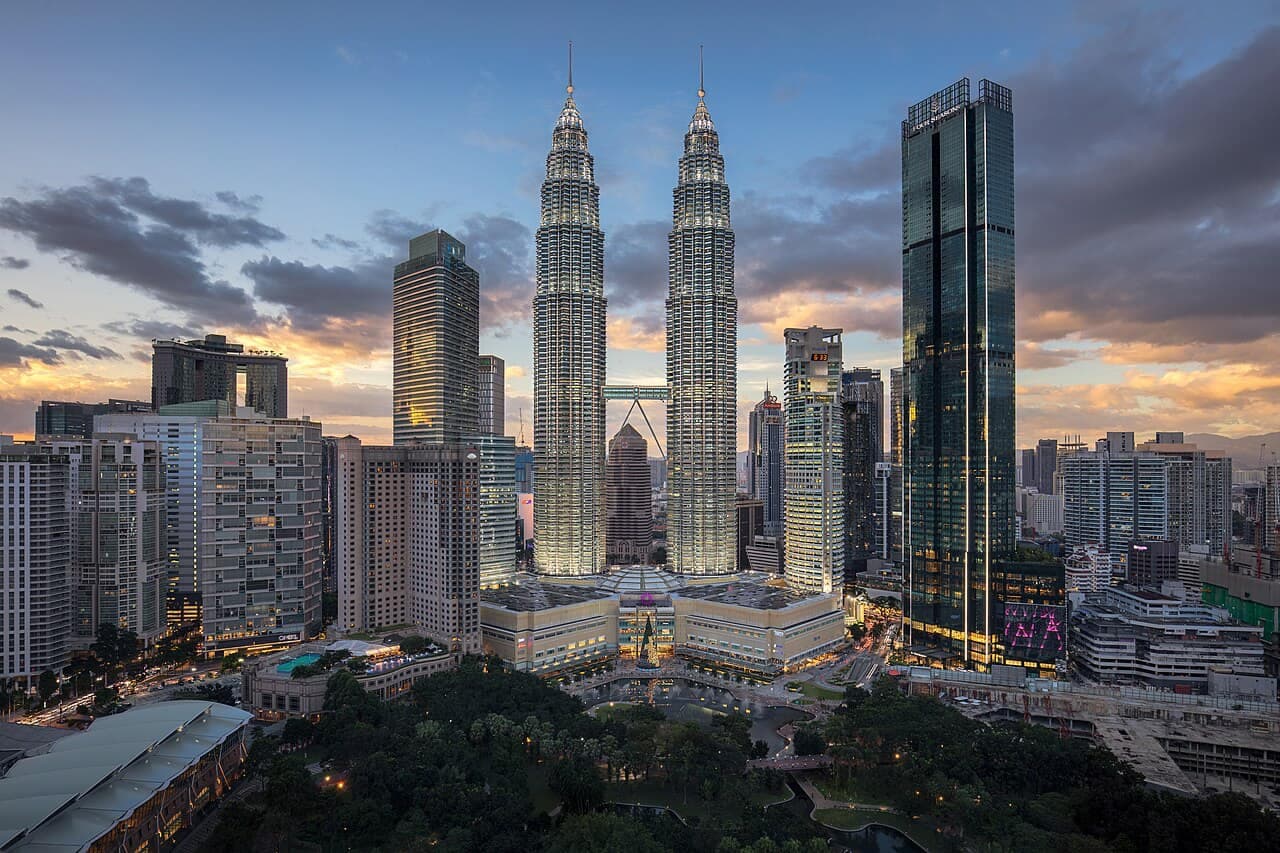
Kuala Lumpur offers accommodation in several distinct neighborhoods suitable for the first nights after arrival. Bukit Bintang is the central hub for shopping, entertainment and street food (Jalan Alor), with a price range from 110 RM for a basic budget hotel to 600+ RM for international luxury chains, as of February 2026. The KLCC area is sought after for direct views of the Petronas Twin Towers and a luxury accommodation standard, with prices from 450 RM to 1,000 RM per night. Chinatown offers a historic atmosphere and the cheapest accommodation capacity (hostels from 30 RM, private rooms from 70 RM). For a short transit stay, the optimal neighborhood is Brickfields (Little India), within walking distance of KL Sentral, with clean hotels for 100 RM to 200 RM per night. All accommodation services in Malaysia for foreign guests are subject to a mandatory Tourism Tax (TTx) of 10 RM per room per night. Effective from 1 January 2026, this tax must be integrated into the final prices on online booking platforms (Agoda, Booking.com); otherwise it is paid in cash at reception at check-in. In addition, since 1 March 2024, a Service Tax (SST) of 8% has applied to accommodation services. At check-in, a physical passport is standardly required for registration, along with a refundable deposit paid in cash or as a hold on a card (typically 100 RM to 200 RM).

This information may change. Always check the official source.

Report a change

Suggest a correction

JPEG, PNG or WebP, up to 5 MB. Location metadata is removed.

Corrections and photos are private and visible only to the review team.

Safety and common scams in Malaysia

This information may change. Always check the official source.

Safety and common scams in Malaysia

Warning Important

Safety and common scams

Malaysia is a politically stable and safe country, though minor property crime occurs in large urban areas. The most common type is snatch theft from moving motorcycles, where perpetrators on light motorcycles tear handbags, backpacks or mobile phones from pedestrians while riding, often causing the victim to fall and be injured. It is recommended to walk on sidewalks with your bag positioned away from the road. Very widespread is the foreign currency display scam, in which organized groups of foreigners approach tourists under the pretext of asking for directions and then ask to see banknotes of the tourist's home currency, using high manual dexterity to discreetly pull money from the wallet unnoticed. Also common are unofficial taxi driver scams at airports and tourist centers, where drivers refuse to turn on the meter and charge several times the normal rate. On the northern border with Thailand and in the coastal waters of eastern Sabah (Sulu Sea), official advice recommends maximum caution due to the threat of kidnapping by Philippine separatist groups.

This information may change. Always check the official source.

Report a change

Suggest a correction

JPEG, PNG or WebP, up to 5 MB. Location metadata is removed.

Corrections and photos are private and visible only to the review team.

Health in Malaysia

This information may change. Always check the official source.

Health in Malaysia

Warning Important

Health and emergencies

No mandatory vaccinations are required to enter the country, except for an international yellow fever vaccination certificate when arriving from at-risk countries. The main health risk in Malaysia is dengue fever, a viral illness transmitted by the daytime activity of Aedes mosquitoes. The critical period is the monsoon season from November to March, and the only effective protection is regular use of DEET-based repellents. In the Bornean state of Sarawak, there is a persistent risk of rabies infection from wild and stray animals, which is fatal without immediate medical treatment. Tap water is not drinkable; bottled or boiled water is required for both consumption and dental hygiene. Medical care for foreigners is top-tier at private hospitals such as Gleneagles Hospital or Prince Court Medical Centre in Kuala Lumpur, but treatment is financially costly and requires arranging quality travel insurance in advance. In an emergency, free emergency numbers are available:

  • Unified emergency line (police and ambulance): 999 (from mobile phones without a SIM card: 112).
  • Fire and Rescue Department: 994.
  • Civil Defense: 991.
  • Kuala Lumpur Tourist Police: 03-2149 6590 (headquartered at MaTiC on Jalan Ampang).

This information may change. Always check the official source.

Report a change

Suggest a correction

JPEG, PNG or WebP, up to 5 MB. Location metadata is removed.

Corrections and photos are private and visible only to the review team.

Everyday practical information in Malaysia

Everyday practical information in Malaysia

Local rules and cultural differences

Malaysia's legal system punishes any drug offenses very strictly. Possession, distribution or smuggling of any quantity of prohibited substances (including marijuana) is classified as the most serious crime, for which courts impose life imprisonment or the death penalty without exception. Since 2026, a complete ban on e-cigarettes and vaping has applied in the country. Importing these devices or nicotine refills is illegal and leads to confiscation at the customs border. Using vapes in public spaces and restaurants is punished with a fine of up to 10,000 RM (approx. 2,150 USD) or up to two years' imprisonment. Operating unmanned aircraft (drones) is subject to strict regulation by the CAAM authority. Malaysia applies no exemptions for drones under 250 grams; every flight requires an approved Authorisation to Fly (ATF) sent to drone.atf@caam.gov.my at least 14 working days in advance, with a fee of 250 RM for drones up to 20 kg. Flying without this authorization is classified as a criminal offense with a fine of up to 50,000 RM (approx. 10,700 USD) or up to 3 years' imprisonment. When visiting mosques and temples, covering the shoulders and knees and removing footwear is mandatory.

Everyday practical information

The electrical grid in Malaysia uses Type G outlets (British standard with three flat pins) with an operating voltage of 240 V and a frequency of 50 Hz, requiring an adapter for European appliances. The entire federation falls under a single time zone, UTC+8, which does not observe daylight saving time. Department stores and supermarkets are typically open from 10:00 to 22:00, seven days a week. During the Islamic fasting month of Ramadan and major public holidays, smaller private restaurants and services may have reduced operating hours, but public transport and large chains operate without interruption. Free Wi-Fi access is standard in the vast majority of cafés and hotels, as well as at airports under the network name "FREE_WIFI@KLIA", where only quick registration via a web browser is required.

This information may change. Always check the official source.

Report a change

Suggest a correction

JPEG, PNG or WebP, up to 5 MB. Location metadata is removed.

Corrections and photos are private and visible only to the review team.

Emergency information in Malaysia

This information may change. Always check the official source.

Emergency information in Malaysia

Warning Important

Health and emergencies

No mandatory vaccinations are required to enter the country, except for an international yellow fever vaccination certificate when arriving from at-risk countries. The main health risk in Malaysia is dengue fever, a viral illness transmitted by the daytime activity of Aedes mosquitoes. The critical period is the monsoon season from November to March, and the only effective protection is regular use of DEET-based repellents. In the Bornean state of Sarawak, there is a persistent risk of rabies infection from wild and stray animals, which is fatal without immediate medical treatment. Tap water is not drinkable; bottled or boiled water is required for both consumption and dental hygiene. Medical care for foreigners is top-tier at private hospitals such as Gleneagles Hospital or Prince Court Medical Centre in Kuala Lumpur, but treatment is financially costly and requires arranging quality travel insurance in advance. In an emergency, free emergency numbers are available:

  • Unified emergency line (police and ambulance): 999 (from mobile phones without a SIM card: 112).
  • Fire and Rescue Department: 994.
  • Civil Defense: 991.
  • Kuala Lumpur Tourist Police: 03-2149 6590 (headquartered at MaTiC on Jalan Ampang).

This information may change. Always check the official source.

Report a change

Suggest a correction

JPEG, PNG or WebP, up to 5 MB. Location metadata is removed.

Corrections and photos are private and visible only to the review team.

Experiences

Nothing here yet.

General tips

Nothing here yet.

Share a tip

Sign in to continue.