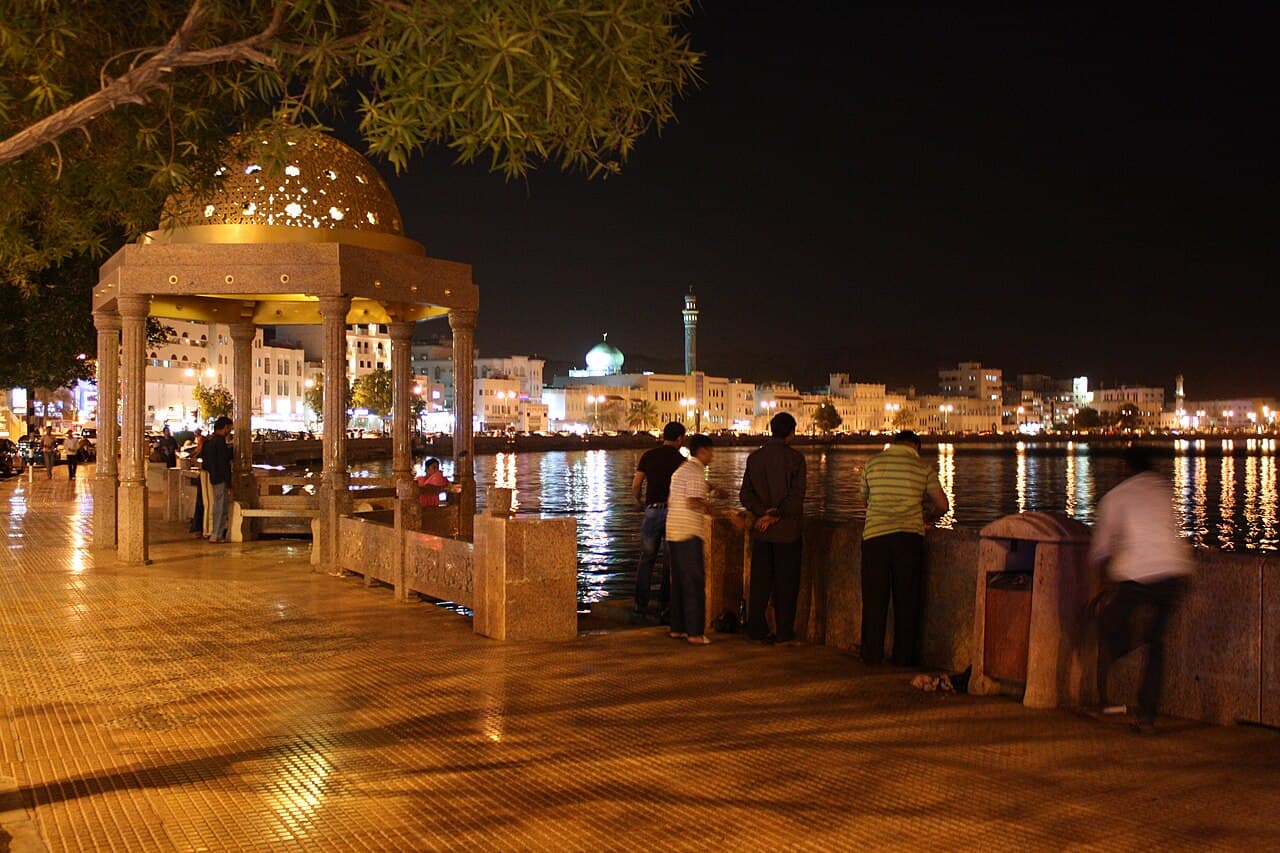
OmanPhoto: Omar AV / Wikimedia Commons (CC BY 3.0)

Oman

Country · OM · OMR · Asia/Muscat

This information may change. Always check the official source.Last verified: August 2026 by

Fourteen days without a visa, and a border that will ask to see your travel insurance before it lets you in.

  • Many nationalities enter Oman visa-free for 14 days, including British citizens on a full British passport. It is granted on arrival with no fee and no form.
  • Proof of travel health insurance. Have the certificate on your phone and printed. See the health section for why Oman takes this seriously.
  • The fine is up to 10 Omani rials a day, capped at 500. It is charged on departure and there is no discretion.
  • Apply through the Royal Oman Police portal directly. There is a large industry of resellers charging several times the government fee for the same document, and Oman's own site is not hard to use.
More details

Fourteen days, and that is the constraint

  • Many nationalities enter Oman visa-free for 14 days, including British citizens on a full British passport. It is granted on arrival with no fee and no form.
  • Fourteen days is short for a country this size. Muscat to Salalah is about 1,000 km. Plan the itinerary around the fortnight rather than assuming a month.
  • For longer, apply for an unsponsored visit visa through the Royal Oman Police portal at , or get one on arrival at an Omani airport. There are several durations; the portal's eligibility wizard tells you which apply to your passport.

What the border actually asks for

Oman checks more at the desk than its Gulf neighbours, and all three of these are stated requirements rather than possibilities:

  • Proof of travel health insurance. Have the certificate on your phone and printed. See the health section for why Oman takes this seriously.
  • A return or onward ticket.
  • Proof of accommodation - a hotel booking is enough.
  • A passport valid at least 6 months from arrival.

Overstaying

  • The fine is up to 10 Omani rials a day, capped at 500. It is charged on departure and there is no discretion.
  • The 14 days are counted from the day you arrive, and the day you arrive is day one.

Getting the visa right

  • Apply through the Royal Oman Police portal directly. There is a large industry of resellers charging several times the government fee for the same document, and Oman's own site is not hard to use.
  • The portal's fee schedule sits behind an interactive wizard, so check the price there for your own nationality and visa type rather than trusting a figure quoted elsewhere.
Sources (2)

Oman bans e-cigarettes at the border and allows non-Muslim visitors a small amount of alcohol - the reverse of what most people assume.

  • Electronic cigarettes and their liquids are prohibited. The import ban is enforced at Muscat and at the land crossings from the UAE.
  • Non-Muslim adults may bring in a small quantity of alcohol - a couple of litres arriving by air. Coming overland from Saudi Arabia, none.
  • Medicines containing codeine or tramadol need a prescription and are best declared.
  • Cash above the declarable threshold must be reported.
  • Drones require prior permission and are otherwise confiscated.
More details
  • Electronic cigarettes and their liquids are prohibited. The import ban is enforced at Muscat and at the land crossings from the UAE.
  • Non-Muslim adults may bring in a small quantity of alcohol - a couple of litres arriving by air. Coming overland from Saudi Arabia, none.
  • Medicines containing codeine or tramadol need a prescription and are best declared.
  • Cash above the declarable threshold must be reported.
  • Drones require prior permission and are otherwise confiscated.
  • Archaeological items and marine life may not be exported, which includes shells and coral from the beaches at Ras al Jinz.
Sources (1)

Facilities match UK standards, visitors pay privately, and an unpaid bill can stop you leaving the country.

  • Medical facilities in Oman match UK quality standards. That is the good news.
  • Extreme heat has caused deaths in Oman through dehydration and heat exhaustion. This is the leading health risk here and it is entirely preventable.
  • Dengue is present and the FCDO lists it explicitly; the mosquito bites in daylight.
  • Some medicines that are ordinary at home are regulated differently here. Carry the prescription and check anything controlled before flying.
  • 9999 for an ambulance, and it is the general emergency number - not 999 or 911.
More details

The rule that shapes everything

  • Medical facilities in Oman match UK quality standards. That is the good news.
  • Visitors must use private healthcare, and it is billed privately.
  • Visitors without travel insurance or the means to settle the charges may be stopped from leaving the country until the debt is paid. That is the FCDO's own statement, and it is why Oman also asks to see your insurance at the border.
  • Take a policy that covers treatment and evacuation, carry the certificate, and know the assistance number.

Heat

  • Extreme heat has caused deaths in Oman through dehydration and heat exhaustion. This is the leading health risk here and it is entirely preventable.
  • Summer runs May to September and inland temperatures pass 45 C routinely.
  • Fluid and salt, not just water. Start walks at dawn. Stop in the middle of the day.

Other risks

  • Dengue is present and the FCDO lists it explicitly; the mosquito bites in daylight.
  • MERS coronavirus is a regional risk and is associated with camels - avoid contact with them and do not drink unpasteurised camel milk.
  • Altitude sickness is possible on Jebel Shams at 3,000 m.

Medicines

  • Some medicines that are ordinary at home are regulated differently here. Carry the prescription and check anything controlled before flying.

Numbers

  • 9999 for an ambulance, and it is the general emergency number - not 999 or 911.
Sources (1)

Muscat

Long-term averages for Muscat: the mean daily high, the mean overnight low and the mean monthly rainfall across 30 years of ERA5 reanalysis data (1995–2024).

DayNight
152025303540°C020mmJanFebMarAprMayJunJulAugSepOctNovDecJanuary: Day 24 °C, Night 17 °C, Rain 14 mm. February: Day 26 °C, Night 18 °C, Rain 11 mm. March: Day 29 °C, Night 20 °C, Rain 17 mm. April: Day 33 °C, Night 24 °C, Rain 8 mm. May: Day 37 °C, Night 28 °C, Rain 1 mm. June: Day 38 °C, Night 30 °C, Rain 10 mm. July: Day 37 °C, Night 30 °C, Rain 6 mm. August: Day 36 °C, Night 29 °C, Rain 1 mm. September: Day 35 °C, Night 27 °C, Rain 0 mm. October: Day 33 °C, Night 25 °C, Rain 6 mm. November: Day 29 °C, Night 21 °C, Rain 13 mm. December: Day 25 °C, Night 18 °C, Rain 15 mm
Show the monthly table
Muscat
MonthDay (°C)Night (°C)Rain (mm)
January241714
February261811
March292017
April33248
May37281
June383010
July37306
August36291
September35270
October33256
November292113
December251815

Salalah

Long-term averages for Salalah: the mean daily high, the mean overnight low and the mean monthly rainfall across 30 years of ERA5 reanalysis data (1995–2024).

DayNight
1520253035°C050mmJanFebMarAprMayJunJulAugSepOctNovDecJanuary: Day 26 °C, Night 17 °C, Rain 2 mm. February: Day 27 °C, Night 18 °C, Rain 1 mm. March: Day 29 °C, Night 21 °C, Rain 10 mm. April: Day 32 °C, Night 24 °C, Rain 4 mm. May: Day 33 °C, Night 25 °C, Rain 41 mm. June: Day 32 °C, Night 26 °C, Rain 16 mm. July: Day 29 °C, Night 24 °C, Rain 20 mm. August: Day 28 °C, Night 23 °C, Rain 10 mm. September: Day 30 °C, Night 23 °C, Rain 12 mm. October: Day 31 °C, Night 24 °C, Rain 14 mm. November: Day 30 °C, Night 22 °C, Rain 8 mm. December: Day 28 °C, Night 19 °C, Rain 2 mm
Show the monthly table
Salalah
MonthDay (°C)Night (°C)Rain (mm)
January26172
February27181
March292110
April32244
May332541
June322616
July292420
August282310
September302312
October312414
November30228
December28192

Nizwa

Long-term averages for Nizwa: the mean daily high, the mean overnight low and the mean monthly rainfall across 30 years of ERA5 reanalysis data (1995–2024).

DayNight
10203040°C025mmJanFebMarAprMayJunJulAugSepOctNovDecJanuary: Day 25 °C, Night 13 °C, Rain 7 mm. February: Day 28 °C, Night 15 °C, Rain 6 mm. March: Day 31 °C, Night 18 °C, Rain 23 mm. April: Day 36 °C, Night 22 °C, Rain 13 mm. May: Day 40 °C, Night 26 °C, Rain 4 mm. June: Day 42 °C, Night 28 °C, Rain 7 mm. July: Day 41 °C, Night 28 °C, Rain 15 mm. August: Day 40 °C, Night 27 °C, Rain 11 mm. September: Day 38 °C, Night 26 °C, Rain 2 mm. October: Day 35 °C, Night 23 °C, Rain 4 mm. November: Day 30 °C, Night 19 °C, Rain 11 mm. December: Day 27 °C, Night 15 °C, Rain 8 mm
Show the monthly table
Nizwa
MonthDay (°C)Night (°C)Rain (mm)
January25137
February28156
March311823
April362213
May40264
June42287
July412815
August402711
September38262
October35234
November301911
December27158
Sources (1)

Where to stay

Muscat for a base, Nizwa for the interior, a desert camp for the Wahiba, and Salalah for a different climate entirely.

  • Muttrah - the old port, the corniche and the souq. The most atmospheric place to stay and walkable.
  • Qurum and Shatti Al Qurum - beaches, restaurants and the mid-range and upper hotels.
  • Nizwa - the old capital, the fort, the Friday goat market, and the base for Jebel Akhdar and Jebel Shams.
  • Sur and Ras Al Jinz - the turtle beach, where green turtles nest year round and the viewing is organised and licensed.
  • Dress code applies in the hotel too. Swimwear is for the pool and tourist beaches only, not the lobby or the street.
More details

Muscat

  • Muttrah - the old port, the corniche and the souq. The most atmospheric place to stay and walkable.
  • Qurum and Shatti Al Qurum - beaches, restaurants and the mid-range and upper hotels.
  • Muscat is very spread out - it runs 50 km along the coast - so where you stay determines how much driving you do.

The interior

  • Nizwa - the old capital, the fort, the Friday goat market, and the base for Jebel Akhdar and Jebel Shams.
  • Jebel Akhdar - cool at 2,000 m, terraced rose farms, and a handful of expensive mountain hotels. Access requires four-wheel drive and it is checked at the bottom.
  • Wahiba Sands - desert camps, from basic to luxurious. Book with a camp that collects you from the tarmac, unless you have a proper 4x4 and know how to drive sand.

The coast and the south

  • Sur and Ras Al Jinz - the turtle beach, where green turtles nest year round and the viewing is organised and licensed.
  • Salalah - 1,000 km south, and during the khareef monsoon from June to September it turns green, which is unique in Arabia and is why Gulf families fill it every summer. Book far ahead for that season.

Practical

  • Dress code applies in the hotel too. Swimwear is for the pool and tourist beaches only, not the lobby or the street.
  • Camping is legal and common in Oman and wild camping on the beaches is normal - but not in a wadi bed between October and March.
  • Ramadan changes hotel restaurant hours substantially.
Sources (1)

Getting online in Oman

Two networks, good coverage on the roads that matter, and nothing in the mountains or the Empty Quarter.

  • Omantel and Ooredoo are the two networks. Both sell tourist prepaid SIMs at Muscat airport and in every mall.
  • Registration needs the passport and is done at the counter.
  • Fine for a city-based trip. Oman's networks are well supported.
  • Flash flood warnings are issued by the authorities and spread by phone. Between October and March a wadi can go from dry to lethal in minutes after rain that fell somewhere you cannot see.
  • Hotels and malls have it everywhere and it is good.
More details

The local SIM

  • Omantel and Ooredoo are the two networks. Both sell tourist prepaid SIMs at Muscat airport and in every mall.
  • Registration needs the passport and is done at the counter.
  • Coverage is good along the coast and the main highways, and along the Muscat-Nizwa-Sur triangle where most visitors go.
  • It disappears in the Hajar mountains, the wadis and the Empty Quarter. That is not a network failure, it is the terrain.

An eSIM instead

  • Fine for a city-based trip. Oman's networks are well supported.
  • A local SIM is worth having if you are driving into the interior, because being able to call for help matters more here than in a city, and a local number is what a rescue or a hotel will call back on.

Why the connection matters here

  • Flash flood warnings are issued by the authorities and spread by phone. Between October and March a wadi can go from dry to lethal in minutes after rain that fell somewhere you cannot see.
  • Download offline maps before you leave Muscat. The mountain tracks are not reliably mapped and the signal is not there to load them.

Wi-fi

  • Hotels and malls have it everywhere and it is good.
  • Desert camps have satellite or nothing. Assume nothing.
Sources (1)

Omani sockets are British Type at 240 V, as in the rest of the southern Gulf.

  • British plugs fit straight in. European, American and Australian ones need an adapter.
  • 240 V is the top of the European band and makes no practical difference to a 230 V appliance.
  • American 120 V-only equipment needs a converter.
  • Desert camps and mountain guesthouses run on generators with limited hours, so sockets can be live only in the evening.
  • The UAE, Saudi Arabia and Bahrain match, so one adapter covers a Gulf itinerary; Qatar and Kuwait mix in other types in older buildings.
More details

Sockets in Oman are Type at 240 V, 50 Hz - the British three-pin plug.

  • British plugs fit straight in. European, American and Australian ones need an adapter.
  • 240 V is the top of the European band and makes no practical difference to a 230 V appliance.
  • American 120 V-only equipment needs a converter.
  • Desert camps and mountain guesthouses run on generators with limited hours, so sockets can be live only in the evening.
  • The UAE, Saudi Arabia and Bahrain match, so one adapter covers a Gulf itinerary; Qatar and Kuwait mix in other types in older buildings.
  • Frequency is not uniform in the Gulf. Saudi Arabia runs the same 230 V at 60 Hz, which changes nothing for electronics and makes mains-timed motors run faster.
Sources (1)

British plugs, a Friday-Saturday weekend, and a country that is far more conservative in dress than in temperament.

  • Plugs are the British three-pin type , 240 V. UK chargers work as they are.
  • Arabic is the language and English is very widely spoken - in hotels, shops, taxis and government offices. Signs are bilingual.
  • Oman is more conservative in dress than the UAE and less so than Saudi Arabia. Cover shoulders and knees, men and women.
  • Everything shuts in the middle of the day in summer, and life happens early and late.
  • Omanis are notably courteous and reserved. Greetings are unhurried, and rushing a transaction reads badly.
More details

The basics

  • Plugs are the British three-pin type , 240 V. UK chargers work as they are.
  • Arabic is the language and English is very widely spoken - in hotels, shops, taxis and government offices. Signs are bilingual.
  • UTC+4 all year, no daylight saving. Note this is an hour ahead of Saudi Arabia and the same as the UAE.
  • The weekend is Friday and Saturday. Sunday is a working day.

Dress, which matters more than you expect

  • Oman is more conservative in dress than the UAE and less so than Saudi Arabia. Cover shoulders and knees, men and women.
  • Women do not need a headscarf except in a mosque, where one is required along with covered arms and ankles.
  • The Sultan Qaboos Grand Mosque in Muscat admits non-Muslims in the mornings, with a strict dress code enforced at the gate. It is one of the great buildings of the region and worth arranging your day around.

The rhythm

  • Everything shuts in the middle of the day in summer, and life happens early and late.
  • Fridays: many businesses closed until after midday prayers.
  • Ramadan changes opening hours across the country and restaurants serve after sunset.

Small things

  • Omanis are notably courteous and reserved. Greetings are unhurried, and rushing a transaction reads badly.
  • Ask before photographing anyone, and accept refusal.
  • The khareef in Salalah, June to September, turns the Dhofar mountains green and misty while the rest of Arabia bakes. It is the single most surprising thing about Omani geography.
  • Frankincense is Oman's souvenir, sold in the souqs of Muscat and Salalah, and the good stuff is expensive for a reason.
Sources (2)

The rial, which is worth more than you think

One of the highest-value currencies in the world, split into 1,000 baisa - so the small change has three decimal places.

  • The Omani rial is one of the highest-value currencies in the world, pegged to the US dollar and worth well over two dollars.
  • Cards work in Muscat, hotels, malls and larger restaurants.
  • This is the important money fact in Oman. Visitors use private healthcare, and the FCDO states that those without insurance or the means to settle the charges may be stopped from leaving the country until the debt is paid.
  • Oman is mid-priced for the Gulf - cheaper than the UAE, more expensive than Egypt or Jordan.
  • Not obligatory. Rounding up and 10% in a restaurant are both normal.
More details

The rial

  • The Omani rial is one of the highest-value currencies in the world, pegged to the US dollar and worth well over two dollars.
  • It divides into 1,000 baisa, not 100. Prices are written to three decimal places - 2.500 OMR is two and a half rials, not two thousand five hundred of anything.
  • This trips people up constantly in the first day. A coffee at 1.200 is not expensive; a hotel at 120.000 is.
  • Small notes and baisa coins matter for taxis, souqs and parking.

Cards and cash

  • Cards work in Muscat, hotels, malls and larger restaurants.
  • Cash is needed in the souqs, small towns, roadside places and for many entry fees at sights.
  • Cash machines are common in the cities and rare in the interior. Take cash before driving into the mountains or the desert.
  • Decline the offer to be billed in your own currency.

The bill you must be able to pay

  • This is the important money fact in Oman. Visitors use private healthcare, and the FCDO states that those without insurance or the means to settle the charges may be stopped from leaving the country until the debt is paid.
  • An unpaid hospital bill is an exit problem, not just a debt. Insurance is what stands between a bad week and a much worse one.

Costs

  • Oman is mid-priced for the Gulf - cheaper than the UAE, more expensive than Egypt or Jordan.
  • Fuel and food are cheap; hotels are not. Desert camps and mountain lodges price like the experiences they are.

Tipping

  • Not obligatory. Rounding up and 10% in a restaurant are both normal.
Sources (2)

Everyday prices

Typical prices in Omani rial (OMR), averaged across the country by Numbeo and read on 19 August 2026. Tick Convert prices above the table to see every amount in your own currency.

Everyday prices
ItemTypical price
Inexpensive restaurant meal2.00 OMR
Dinner for two, mid-range, three courses10 OMR
Cappuccino1.83 OMR
Local draught beer, 0.5 l5.00 OMR
Bottled water, 0.33 l0.10 OMR
Public transport, one-way ticket0.50 OMR
Taxi, starting fare1.25 OMR
Petrol, 1 litre0.24 OMR
Cigarettes, pack of 20 (Marlboro)2.40 OMR
Average net monthly salary1,020 OMR

These are country-wide averages, not a price list: tourist districts, airports and islands sit well above them, and small towns below. The salary line is there for proportion - it is what people living here actually earn.

Sources (1)

Airport guides for Oman1

One page per airport: the routes into town, what they cost and the trap particular to that arrival.

See all 1 airports

From Muscat International into the city

A modern airport 30 minutes from Muscat, and a country where renting a car is the normal decision.

  • Muscat International (MCT) is modern, calm and about 25 km from the old city at Muttrah - 30 to 40 minutes depending on traffic.
  • Visas on arrival are issued here if you need one and did not apply online.
  • Airport taxis are metered or fixed-price from the official rank. Agree it before setting off if there is no meter.
  • Otaxi and Marhaba are the local ride-hailing apps. Uber does not operate in Oman.
  • Oman is a driving country. The road network is excellent, fuel is cheap, distances are large, and the places worth going - Nizwa, Jebel Shams, Wadi Shab, the Wahiba Sands, Sur - are awkward without a car.
More details
The airport
  • Muscat International (MCT) is modern, calm and about 25 km from the old city at Muttrah - 30 to 40 minutes depending on traffic.
  • Visas on arrival are issued here if you need one and did not apply online.
  • Salalah (SLL) is the other international airport, in Dhofar in the far south, and is a three-hour flight or a very long drive from Muscat.
Getting into town
  • Airport taxis are metered or fixed-price from the official rank. Agree it before setting off if there is no meter.
  • Otaxi and Marhaba are the local ride-hailing apps. Uber does not operate in Oman.
  • The Mwasalat airport bus runs into the city cheaply and is perfectly usable with light luggage.
  • Hotels will send a car and it is often not much more than a taxi.
The real decision: rent a car
  • Oman is a driving country. The road network is excellent, fuel is cheap, distances are large, and the places worth going - Nizwa, Jebel Shams, Wadi Shab, the Wahiba Sands, Sur - are awkward without a car.
  • Rent at the airport. It is the cheapest and simplest place to do it.
  • Two-wheel drive is fine for the main roads and the main sights. Four-wheel drive is genuinely required for the mountain tracks and the dunes, and rental agreements say so.
  • The FCDO notes accident rates well above the UK. Speed cameras are everywhere and enforcement is strict: seatbelts mandatory, car seats for under-threes, no phone use.
Sources (2)

Getting around Oman

Drive. There is no rail, the buses are limited, and the country is built around the car.

  • There is no passenger rail network in Oman. The car is the transport system.
  • Roads are excellent and well signed in English and Arabic. Fuel is cheap.
  • Wadis flood October to March after heavy rain, and the rain may fall many kilometres away and out of sight.
  • Mwasalat runs intercity coaches between the main towns, including Muscat to Salalah, and they are comfortable and cheap.
  • Musandam is a separate exclave north of the UAE, reached by flight from Muscat or by driving through the UAE - which needs a UAE visa and two more border crossings.
More details

Driving

  • There is no passenger rail network in Oman. The car is the transport system.
  • Roads are excellent and well signed in English and Arabic. Fuel is cheap.
  • Distances are long and empty. Muscat to Salalah is 1,000 km of desert highway. Carry water, fill up when you can, and do not rely on finding a service station.
  • Accident rates are well above the UK's. Speeding fines are automatic and attach to the rental.
  • Four-wheel drive for the mountains and the sands, and do not take a saloon car up Jebel Shams or into the Wahiba.

Wadis and flash floods

  • Wadis flood October to March after heavy rain, and the rain may fall many kilometres away and out of sight.
  • Do not cross flowing water in a vehicle, at any depth that looks manageable. This is how people die here every year.
  • If you are caught, get to high ground and stay there. That is the FCDO's advice and it is the right one.
  • Do not camp in a wadi bed in the rainy season, however dry it looks.

Buses and taxis

  • Mwasalat runs intercity coaches between the main towns, including Muscat to Salalah, and they are comfortable and cheap.
  • Otaxi and Marhaba are the ride-hailing apps in Muscat. No Uber, no Careem.
  • Shared taxis (baisa taxis) run fixed routes in the cities for very little.

Getting to Musandam

  • Musandam is a separate exclave north of the UAE, reached by flight from Muscat or by driving through the UAE - which needs a UAE visa and two more border crossings.

Apps and platforms

Local ride-hailing, the police portal, and offline maps that matter more than usual.

  • Otaxi and Marhaba - the Omani ride-hailing apps. Uber and Careem do not operate here.
  • The Royal Oman Police eVisa portal for the visa, and it is also where you check your application. The call centre is 80080011 inside Oman and +968 22848200 from abroad.
  • A drone needs a valid licence in Oman, and flying one without is an offence rather than a telling-off. Do not bring one on the assumption you will be fine.
  • Government buildings and military sites are off limits.
  • Ask before photographing people, and expect no to be the answer more often than in other Gulf countries. Oman is more conservative in this respect than its reputation suggests.
More details

Worth having

  • Otaxi and Marhaba - the Omani ride-hailing apps. Uber and Careem do not operate here.
  • The Royal Oman Police eVisa portal for the visa, and it is also where you check your application. The call centre is 80080011 inside Oman and +968 22848200 from abroad.
  • Offline maps. The mountain and desert tracks are poorly mapped and unsignalled, and this is the app that matters most in Oman.
  • A weather app that carries official warnings, for the wadi flooding.

Drones

  • A drone needs a valid licence in Oman, and flying one without is an offence rather than a telling-off. Do not bring one on the assumption you will be fine.

What not to photograph

  • Government buildings and military sites are off limits.
  • Ask before photographing people, and expect no to be the answer more often than in other Gulf countries. Oman is more conservative in this respect than its reputation suggests.
Sources (2)

Omani roads are free and excellent, but the wadis and mountain tracks need a real 4x4 and the speed enforcement is strict.

  • Roads are free and the highways are wide, well surfaced and long.
  • Speed cameras are frequent and Oman fines aggressively; some roads use average-speed enforcement.
  • The mountain roads need 4x4 by law. Jebel Shams and Jebel Akhdar have checkpoints that turn back two-wheel-drive cars, and hire agreements exclude the tracks entirely.
  • Wadi driving after rain kills people every year. Flash floods fill a dry wadi in minutes; the rule is never to cross running water.
  • The alcohol limit is zero at the wheel.
More details

Free roads of high quality, and a set of tracks beyond them that need a proper 4x4.

  • Roads are free and the highways are wide, well surfaced and long.
  • Speed cameras are frequent and Oman fines aggressively; some roads use average-speed enforcement.
  • The mountain roads need 4x4 by law. Jebel Shams and Jebel Akhdar have checkpoints that turn back two-wheel-drive cars, and hire agreements exclude the tracks entirely.
  • Wadi driving after rain kills people every year. Flash floods fill a dry wadi in minutes; the rule is never to cross running water.
  • The alcohol limit is zero at the wheel.
Sources (1)

Safety, the law and the wadis

One of the safest countries in the region. The dangers are the roads, the water and the heat.

  • Oman is one of the safest countries in the Middle East and street crime is very low.
  • Alcohol is legal for tourists in licensed venues - hotels and licensed restaurants - from age 21. This is more relaxed than Saudi Arabia and stricter than the UAE.
  • Possession may carry the death penalty. The FCDO notes there is no distinction between "soft" and "hard" drugs in Omani law.
  • Cover arms and legs to below the knee, men and women. Tight clothing draws attention.
  • Flash floods between October and March kill people in Oman. The rain that causes them may fall out of sight, kilometres upstream.
More details

Crime is not the issue

  • Oman is one of the safest countries in the Middle East and street crime is very low.
  • Sexual assault against foreigners is relatively rare but does happen, and the FCDO advises the same personal awareness you would use at home.

Alcohol

  • Alcohol is legal for tourists in licensed venues - hotels and licensed restaurants - from age 21. This is more relaxed than Saudi Arabia and stricter than the UAE.
  • Public intoxication and drink-driving are serious offences carrying imprisonment. There is no acceptable blood alcohol level for driving.
  • You cannot buy alcohol in a shop as a visitor, and importing it is restricted.

Drugs

  • Possession may carry the death penalty. The FCDO notes there is no distinction between "soft" and "hard" drugs in Omani law.

Dress and behaviour

  • Cover arms and legs to below the knee, men and women. Tight clothing draws attention.
  • Swimwear only at pools and tourist beaches. Not in a town, not in a shop, not walking back to the hotel.
  • Ramadan: no eating, drinking, smoking or chewing gum in public during daylight. No loud music, dancing or swearing.
  • Same-sex sexual activity is illegal.

The wadis

  • Flash floods between October and March kill people in Oman. The rain that causes them may fall out of sight, kilometres upstream.
  • Never drive through flowing water. Never camp in a wadi bed in that season.
  • If flooding starts, get to high ground and stay put rather than trying to cross.
  • Wadi Shab, Wadi Bani Khalid and Wadi Tiwi are the ones everyone visits, and they are exactly the terrain in question.

Heat

  • Extreme heat has caused deaths in Oman from dehydration and heat exhaustion. Summer inland routinely passes 45 C.
  • Hike early, carry more water than you think, and take salt as well as fluid.

Driving

  • Accident rates are well above the UK's. This is the most likely thing to go wrong on an Oman trip.
Sources (2)

Emergency numbers and what to do

The number is 9999, not 999 or 911 - and it is the one people get wrong.

  • It is 9999, four nines. Not 999 and not 911, both of which people try first and neither of which is the Omani number. Save it before you need it.
  • Operators generally handle English.
  • Have the insurance certificate ready. Private hospitals will treat you and bill you, and an unsettled bill can stop you leaving the country.
  • Get to high ground. Do not cross flowing water, on foot or in a vehicle.
  • Fines are automatic and attach to the rental car, and then to you. Settle them before returning the vehicle.
More details

The number

Emergency numbers and what to do
ForCall
Police, fire, ambulance9999
Royal Oman Police visa call centre80080011, or +968 22848200 from abroad
  • It is 9999, four nines. Not 999 and not 911, both of which people try first and neither of which is the Omani number. Save it before you need it.
  • Operators generally handle English.

If something goes wrong

  • Have the insurance certificate ready. Private hospitals will treat you and bill you, and an unsettled bill can stop you leaving the country.
  • Contact your insurer's assistance line at the same time as the hospital, not afterwards.
  • A road accident: do not move the vehicles until the police arrive. This is enforced.

In a wadi or a flood

  • Get to high ground. Do not cross flowing water, on foot or in a vehicle.
  • Tell someone your route before driving into the mountains or the desert, and a time you will check in. There is no phone signal out there and no passing traffic to flag down.

On the road

  • Fines are automatic and attach to the rental car, and then to you. Settle them before returning the vehicle.
  • Do not drive after any alcohol at all. The offence carries imprisonment and there is no permitted level.
Sources (2)