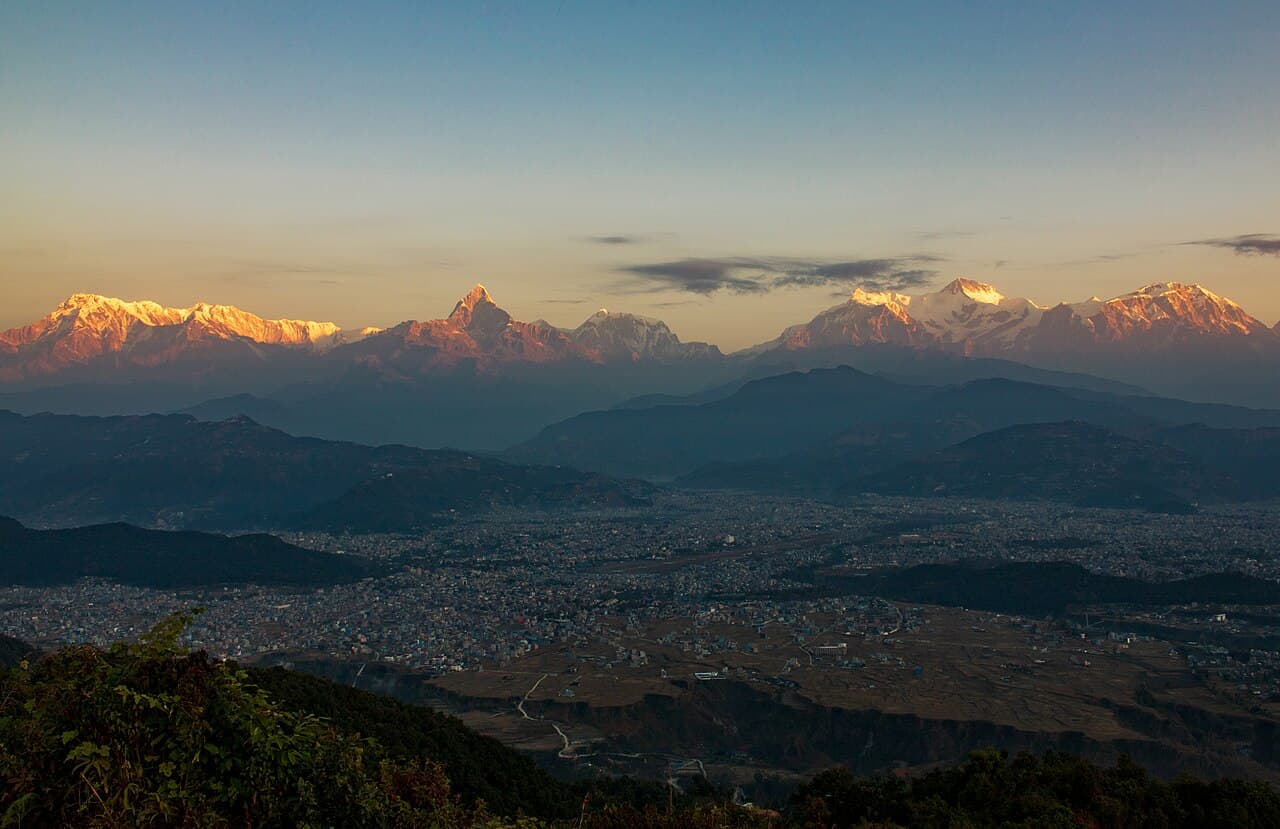
NepalPhoto: Nirojsedhai / Wikimedia Commons (CC BY-SA 4.0)

Nepal

Country · NP · NPR · Asia/Kathmandu

This information may change. Always check the official source.Last verified: August 2026 by

Almost everyone gets a visa on arrival: USD 30 for 15 days, USD 50 for 30, USD 125 for 90. Fill the form online first, and bring clean US dollar notes, because the card terminal is the queue that fails.

  • Almost everyone can buy a visa on landing: USD 30 for 15 days, USD 50 for 30, USD 125 for 90, all with multiple entry included.
  • Fill in the application online before you fly - up to 15 days ahead - and you land with a receipt and skip the kiosk queue entirely.
  • Bring clean US dollar notes. The card terminal works most of the time, and when it does not there is no cash machine before immigration.
  • Torn, taped or heavily marked bills get refused at the counter, as do older series notes at some windows. Nepali rupees are not accepted for the fee.
  • You may stay 150 days in one calendar year, however you slice it, and the clock resets on 1 January rather than a year after arrival.
More details

The visa on arrival, which is most people's route

  • Nationals of all but 13 countries can buy a tourist visa on landing, at Kathmandu and at the land borders with India and China.
  • The fees are in US dollars: USD 30 for 15 days, USD 50 for 30 days, USD 125 for 90 days. They are per person and the clock starts on the day you enter.
  • Multiple entry is included in all three, which matters if you plan a side trip to India or Bhutan and come back.
  • Your passport must be valid for at least 6 months beyond the date you arrive.
  • Fill in the application online before you fly. The Department of Immigration form can be submitted up to 15 days before arrival; you land with a submission receipt and skip the kiosk queue entirely.

The three queues, in order

  1. The kiosks, in the arrivals hall, if you did not apply online. They print a receipt with a barcode. They jam, and there is no one to fix them.
  2. The bank counter, where you pay. This is the one to prepare for.
  3. The immigration desk, which takes the receipt and the payment slip and stamps you in.
  • Bring clean US dollar notes. Cards are accepted and the terminal works most of the time, and when it does not there is no cash machine before immigration.
  • Torn, taped or heavily marked dollar bills get refused at the counter, as do pre-2009 series notes at some windows.
  • Other major currencies are usually accepted at the visa counter - euros, sterling, Australian and Canadian dollars - at a rate you will not enjoy.
  • Nepali rupees are not accepted for the visa fee.

Who pays nothing, and who cannot use it

  • Indian nationals need no visa at all and may enter on a passport or on an Indian voter ID card. Flying in, carry the passport.
  • Chinese nationals pay no visa fee, under the tourism arrangement between the two countries. The visa itself is still issued on arrival.
  • SAARC nationals - Bangladesh, Bhutan, Maldives, Pakistan, Sri Lanka - get a free 30-day visa once per calendar year. Afghanistan is excluded.
  • Children under 10 are free.
  • Thirteen nationalities cannot use the visa on arrival at all and must apply at a Nepali mission in advance: Afghanistan, Cameroon, Ethiopia, Ghana, Iraq, Liberia, Nigeria, Palestine, Somalia, Eswatini, Syria and Zimbabwe, plus holders of refugee travel documents.

Extending, and the ceiling nobody mentions

  • Extensions are applied for online through the Department of Immigration and then collected in person in Kathmandu or Pokhara.
  • The cost is USD 3 per day, with a 15-day minimum of USD 45.
  • You may stay 150 days in one calendar year, total, however you slice it. That is a calendar year, not a rolling one, so a January arrival resets on 1 January.
  • Overstaying is treated as an offence, not an oversight: a daily fine, and at the extremes a bar on returning. Sort the extension before the visa runs out, not at the airport.

Where your nationality lands

Visa and entry in Nepal
You holdWhat you need
IndiaNothing. No visa, and a voter ID is accepted overland
ChinaVisa on arrival, fee waived
USA, Canada, Australia, UK, Germany, France, Italy, Spain, Netherlands, Poland, Japan, South Korea, Malaysia, Singapore, Taiwan, Russia, Saudi Arabia, CambodiaVisa on arrival, USD 30, 50 or 125
  • Trekking permits are separate from the visa and are covered in the section on getting around. Nobody sells you both at once.
Sources (2)

Nepal bans vapes and controls what leaves far more tightly than what arrives: anything old needs an archaeology certificate.

  • Antiquities may not be exported. Any object that could be over a hundred years old - a statue, a thangka, a carved window - needs a certificate from the Department of Archaeology, and the airport checks for it.
  • Electronic cigarettes are prohibited to import.
  • The allowance is 200 cigarettes and one bottle of spirits per adult, with a value cap on other goods.
  • Cash above the declarable threshold must be reported, and taking Indian rupees in denominations above the permitted notes is separately restricted.
  • Trekking gear is not restricted, but drones need permission and are barred over much of the Khumbu and the national parks.
More details
  • Antiquities may not be exported. Any object that could be over a hundred years old - a statue, a thangka, a carved window - needs a certificate from the Department of Archaeology, and the airport checks for it.
  • Electronic cigarettes are prohibited to import.
  • The allowance is 200 cigarettes and one bottle of spirits per adult, with a value cap on other goods.
  • Cash above the declarable threshold must be reported, and taking Indian rupees in denominations above the permitted notes is separately restricted.
  • Trekking gear is not restricted, but drones need permission and are barred over much of the Khumbu and the national parks.
Sources (1)

Kathmandu has clinics that treat foreigners well and the rest of the country does not. Insurance must name helicopter evacuation, and never drink the tap water.

  • Your policy must name helicopter evacuation and cover the altitude you are actually going to - the cheap ones exclude above 4,000 m.
  • A rescue flight costs USD 3,000 to USD 10,000, and helicopters want a guarantee from your insurer before they lift.
  • Descent is the treatment for altitude sickness - 500 m usually turns a bad night around. Confusion or breathlessness lying down means go down now, at night, with someone.
  • CIWEC Hospital in Kathmandu is the clinic foreigners use, and it knows altitude illness better than anywhere. Outside the valley facilities are basic to none.
  • Never drink the tap water, hotels and teeth included. Dal bhat is the safe order - cooked to death, endlessly refilled and served everywhere.
More details

Insurance, which is not optional here

  • Your policy must name helicopter evacuation and cover the altitude you are actually going to. A trek to Everest Base Camp tops out around 5,550 m.
  • A rescue flight costs USD 3,000 to USD 10,000.
  • Helicopters want a guarantee of payment from your insurer before they lift, so carry the insurer's 24-hour number and your policy number where a guide can read them.
  • Check the policy does not exclude trekking above a set altitude, which the cheap ones do at 4,000 m.

Altitude sickness

  • Ascend slowly and sleep low. Above 3,000 m, gain no more than 300 to 500 m of sleeping altitude a day and take a rest day every 1,000 m.
  • Acetazolamide (Diamox) helps you acclimatise; it does not make you safe. Talk to a doctor before you go.
  • Descent is the treatment. 500 m of descent usually turns a bad night around.
  • HACE and HAPE kill. Confusion, stumbling or breathlessness lying down means go down now, at night, with someone.
  • Alcohol and sleeping pills make it worse.

Where to go when ill

  • CIWEC Hospital in Kathmandu is the clinic foreigners use, with a Pokhara branch, and it knows altitude illness and traveller's diarrhoea better than anywhere.
  • Nepal International Clinic and Mediciti are the other Kathmandu options.
  • Outside the valley, facilities are basic to none. Serious illness means getting to Kathmandu.
  • Pharmacies are everywhere and sell most things over the counter. Bring your own supply of anything you actually depend on.

Water and food

  • Never drink the tap water, including in hotels and including for teeth.
  • Bottled water is everywhere and the plastic is a problem; a filter bottle or purification tablets is better and works on the trail.
  • Boiled water is sold by the litre in teahouses and is the standard trekking answer.
  • Stomach trouble is close to universal. Eat food that is hot and freshly cooked; be careful with salad, ice and anything reheated.
  • Dal bhat is the safe order - it is cooked to death, endlessly refilled and served everywhere.

Before you go

  • Hepatitis A and typhoid are the standard recommendations, with rabies worth considering.
  • Rabies is real here. Dogs are everywhere and a bite or a scratch means treatment the same day, not when you get home.
  • Kathmandu's air is genuinely bad in the dry season. If you have asthma, bring what you need and an N95 for the worst days.
  • Take a first aid kit, including rehydration salts and blister care. The pharmacy is a week away on a trail.
Sources (2)

Kathmandu

Long-term averages for Kathmandu: the mean daily high, the mean overnight low and the mean monthly rainfall across 30 years of ERA5 reanalysis data (1995–2024).

DayNight
51015202530°C01000mmJanFebMarAprMayJunJulAugSepOctNovDecJanuary: Day 16 °C, Night 6 °C, Rain 33 mm. February: Day 18 °C, Night 8 °C, Rain 44 mm. March: Day 22 °C, Night 11 °C, Rain 54 mm. April: Day 25 °C, Night 14 °C, Rain 76 mm. May: Day 26 °C, Night 17 °C, Rain 216 mm. June: Day 26 °C, Night 19 °C, Rain 475 mm. July: Day 26 °C, Night 20 °C, Rain 814 mm. August: Day 26 °C, Night 20 °C, Rain 671 mm. September: Day 25 °C, Night 19 °C, Rain 361 mm. October: Day 23 °C, Night 15 °C, Rain 98 mm. November: Day 20 °C, Night 11 °C, Rain 19 mm. December: Day 17 °C, Night 8 °C, Rain 17 mm
Show the monthly table
Kathmandu
MonthDay (°C)Night (°C)Rain (mm)
January16633
February18844
March221154
April251476
May2617216
June2619475
July2620814
August2620671
September2519361
October231598
November201119
December17817

Pokhara

Long-term averages for Pokhara: the mean daily high, the mean overnight low and the mean monthly rainfall across 30 years of ERA5 reanalysis data (1995–2024).

DayNight
51015202530°C02000mmJanFebMarAprMayJunJulAugSepOctNovDecJanuary: Day 16 °C, Night 5 °C, Rain 98 mm. February: Day 18 °C, Night 6 °C, Rain 133 mm. March: Day 22 °C, Night 9 °C, Rain 122 mm. April: Day 26 °C, Night 12 °C, Rain 126 mm. May: Day 26 °C, Night 16 °C, Rain 325 mm. June: Day 26 °C, Night 20 °C, Rain 622 mm. July: Day 26 °C, Night 22 °C, Rain 1041 mm. August: Day 26 °C, Night 22 °C, Rain 868 mm. September: Day 25 °C, Night 20 °C, Rain 525 mm. October: Day 23 °C, Night 15 °C, Rain 151 mm. November: Day 20 °C, Night 11 °C, Rain 113 mm. December: Day 17 °C, Night 8 °C, Rain 79 mm
Show the monthly table
Pokhara
MonthDay (°C)Night (°C)Rain (mm)
January16598
February186133
March229122
April2612126
May2616325
June2620622
July26221041
August2622868
September2520525
October2315151
November2011113
December17879

Chitwan

Long-term averages for Chitwan: the mean daily high, the mean overnight low and the mean monthly rainfall across 30 years of ERA5 reanalysis data (1995–2024).

DayNight
101520253035°C01000mmJanFebMarAprMayJunJulAugSepOctNovDecJanuary: Day 21 °C, Night 10 °C, Rain 16 mm. February: Day 24 °C, Night 12 °C, Rain 26 mm. March: Day 30 °C, Night 16 °C, Rain 21 mm. April: Day 34 °C, Night 20 °C, Rain 41 mm. May: Day 33 °C, Night 23 °C, Rain 158 mm. June: Day 32 °C, Night 25 °C, Rain 381 mm. July: Day 30 °C, Night 25 °C, Rain 561 mm. August: Day 30 °C, Night 25 °C, Rain 452 mm. September: Day 30 °C, Night 24 °C, Rain 265 mm. October: Day 29 °C, Night 20 °C, Rain 66 mm. November: Day 26 °C, Night 15 °C, Rain 7 mm. December: Day 23 °C, Night 11 °C, Rain 10 mm
Show the monthly table
Chitwan
MonthDay (°C)Night (°C)Rain (mm)
January211016
February241226
March301621
April342041
May3323158
June3225381
July3025561
August3025452
September3024265
October292066
November26157
December231110
Sources (1)

Cheap and plentiful, and worth booking only for the first night. On the trails you take what the teahouse has, and the room is nearly free if you eat there.

  • Book the first night only. Once you are here, walking in gets you a better room for less, and you can see it first.
  • Teahouses are the only accommodation on the trails, and the room is cheap or free if you eat dinner and breakfast there - that is the business model.
  • Prices rise with altitude because everything is carried up, and hot showers and charging cost extra per use.
  • In peak season the popular villages fill by mid-afternoon. Walking on to find a bed at 17:00 at 4,000 m is how people get into trouble - start early.
  • Bring a sleeping bag rated for the altitude. The teahouse blanket is not enough above 3,500 m.
More details

In the cities

  • Thamel in Kathmandu and Lakeside in Pokhara are where visitors stay, and both have everything from NPR 800 dorms to proper hotels.
  • Book the first night only. Once you are here, walking in gets you a better room for less, and you can see it first.
  • Ask for a room off the street. Thamel is loud until late and the walls are thin.
  • Hot water is a question, not an assumption, and in winter so is heating. Nothing in Kathmandu is centrally heated.
  • Check the wi-fi in the room rather than in the lobby, and ask about power cuts if you need to work.

On the trails

  • Teahouses are the accommodation and there is no other kind. A room is a plywood box with two beds and a blanket.
  • The room is cheap or free if you eat dinner and breakfast there, which is the whole business model. Do not turn up expecting to eat elsewhere.
  • Prices rise with altitude because everything is carried up: expect NPR 500 to NPR 1,500 for a room low down, and food that doubles as you climb.
  • Hot showers and charging cost extra, per shower and per hour, and both get expensive high up.
  • In peak season the popular villages fill by mid-afternoon. Walking further to find a bed at 17:00 at 4,000 m is how people get into trouble - start early.
  • Bring a sleeping bag rated for the altitude you are going to. The blanket is not enough above 3,500 m.

Booking and season

  • October and November are the busiest weeks of the year, then March to May. Everything is fuller and pricier.
  • Monsoon, June to September, is quiet and wet, and lodges in the hills are cheap and half empty.
  • Winter is cold but clear. Low-altitude trekking is excellent; high passes are snowed in.
  • Booking.com and Agoda work in the cities. Nothing on the trails takes a booking you can rely on, and cancellations are not a concept.

Practical

  • A 13% VAT and often a 10% service charge sit on top of the quoted room rate. Ask whether the price includes them.
  • Fire safety is poor. Look at where the exit is before you unpack, especially in an old Thamel building.
  • Bring a padlock for the teahouse doors, which have a latch and nothing else.
  • Homestays in the middle hills are excellent value and are how you actually meet anyone.
Sources (2)

A local SIM costs about NPR 500 with a passport and a photo, and Ncell reaches further up the trekking trails than anything else. An eSIM is the expensive option here, not the cheap one.

  • Ncell is the easier buy and the better data network; Nepal Telecom goes further into the hills and the far west.
  • You need your passport and a passport photo. Registration is legally required, and without the photo some sellers will send you away.
  • A SIM is about NPR 500 and a data pack NPR 500 to NPR 1,000 for 5 to 10 GB over 28 to 30 days, which outlasts most trips.
  • On the trails Ncell keeps working furthest - to about Namche on the Everest route and Manang on Annapurna. Above the last village there is nothing.
  • Nepal is one of the few countries where the eSIM is worse value than the shop. Buy one only for a two-day stopover.
More details

Buying a SIM

  • Two networks matter: Ncell and Nepal Telecom (NTC). Ncell is the easier buy and the better data network; NTC goes further into the hills.
  • The counters are in the arrivals hall at Kathmandu and in every high street afterwards. Thamel is full of them.
  • You need your passport and a passport photo. Registration is legally required and the shop does it on the spot; without the photo some sellers will take a phone snap, others will send you away.
  • A SIM with a starter balance is about NPR 500, and the data pack is bought on top.
  • Data packs are cheap: roughly NPR 500 to NPR 1,000 buys 5 to 10 GB for 28 to 30 days, which outlasts most trips.

Coverage, which is the part that matters

  • Kathmandu, Pokhara and the highway towns have solid 4G.
  • On the trails Ncell is the one that keeps working: the Everest route to about Namche Bazaar, Annapurna to about Manang, Langtang to Kyanjin Gompa.
  • NTC is the better bet in the far west and in remote districts where Ncell never built.
  • Above the last village there is nothing, and teahouses sell wi-fi by the day instead. Everest Link and AirLink cards are the usual ones and they are not cheap.
  • Download offline maps and your permits before you leave the road.

eSIM

  • Saily sells one Nepal plan: 1 GB over 7 days at USD 9.99. That is the honest picture - Nepal is one of the few countries where the eSIM is worse value than the shop.
  • It is still the right choice for a two-day stopover, where the passport, photo and shop queue are not worth it.
  • For anything longer, buy the local SIM. NPR 1,000 for 10 GB is a different order of price.
  • Check your phone takes an eSIM before relying on one, and buy it before you fly.

Practical

  • Keep your passport handy when you buy, not in the hotel safe.
  • Roaming is expensive on most foreign plans and Nepal is rarely in a bundle.
  • A working phone is how you pay for nothing here. It is how you book buses and call your guide; payment is still cash.
Sources (2)

Nepali sockets are Type , and at 230 V, and the supply is the bigger problem than the shape.

  • A Europlug fits the small holes of a Type socket. It is common, it is loose, and it is the reason so many Nepali sockets are scorched.
  • Indian plugs work here. British, American and Australian ones need an adapter.
  • Trekking lodges charge by the hour from solar and micro-hydro, and a power bank is worth more than any adapter above Namche.
  • 230 V, so American 120 V-only appliances need a converter.
  • Voltage swings are real in Kathmandu, which is why locals run computers through stabilisers.
More details

Sockets in Nepal are Type , and at 230 V, 50 Hz - round-pin outlets in the Indian pattern, in two sizes, plus two-pin holes for Europlugs.

  • A Europlug fits the small holes of a Type socket. It is common, it is loose, and it is the reason so many Nepali sockets are scorched.
  • Indian plugs work here. British, American and Australian ones need an adapter.
  • Trekking lodges charge by the hour from solar and micro-hydro, and a power bank is worth more than any adapter above Namche.
  • 230 V, so American 120 V-only appliances need a converter.
  • Voltage swings are real in Kathmandu, which is why locals run computers through stabilisers.
Sources (1)

Saturday is the weekend, the clock is 45 minutes off the hour, the year is 2083, and the greeting is namaste with both hands. None of that is a joke.

  • Namaste with palms together is the greeting, and you eat and hand things over with the right hand.
  • Take your shoes off entering a home and most temples, never point your feet at a person or shrine, and walk clockwise around stupas.
  • Nepal is UTC+5:45 - a 45-minute offset unique to the country, which every airline booking will surprise you with.
  • Saturday is the weekly holiday, and Sunday is a working day. Dashain and Tihar close the country for days.
  • 230 V on types , and sockets, so a universal adaptor is the only sane answer.
More details

The basics that stop you looking rude

  • Namaste, palms together, is the greeting and works in every situation.
  • Eat and hand things over with the right hand. The left is for the bathroom.
  • Take your shoes off entering a home and most temples, and never point the soles of your feet at a person or a shrine.
  • Do not touch anyone's head, including a child's.
  • Walk clockwise around stupas and mani walls, keeping them on your right.
  • Beef is off the menu - the cow is sacred, and killing one is a criminal offence.

Temples and photographs

  • Pashupatinath does not admit non-Hindus to the main temple courtyard, and no leather is allowed inside - belts and bags included.
  • Cremations at Pashupatinath are not a photo opportunity. Watch from the far bank if you must, quietly.
  • Ask before photographing people, especially sadhus, who will then ask for money.
  • Drones need permission and are banned outright over Kathmandu, near airports and in national parks. The fines are serious.

The calendar, the clock and the week

  • Nepal is UTC+5:45. A 45-minute offset is unique to Nepal and every airline booking will surprise you.
  • The official calendar is Bikram Sambat, currently in the 2080s, so official dates and festival dates are not the Gregorian ones.
  • Saturday is the weekly holiday. Government offices and many businesses close; Sunday is a working day.
  • Dashain in September or October and Tihar a fortnight later close the country for days: shops shut, buses fill, and Kathmandu empties as everyone goes home.
  • Book transport well ahead around Dashain, or do not plan to move.

Power, plugs and connectivity

  • 230 V, and the sockets take types , and . A universal adaptor is the only sane answer.
  • Load shedding is over - the scheduled national blackouts ended years ago - but cuts still happen, and hotels run inverters for a reason.
  • Charge everything when you have power, and carry a power bank on the trails where charging costs money.

Behaviour and the law

  • Dress modestly: covered shoulders and knees at temples, and it is noticed everywhere else.
  • Public affection is not done. Holding hands is fine; more is not.
  • Cannabis is illegal despite the shops' hints and the history, and foreigners are prosecuted.
  • Homosexuality is legal and Nepal is the most liberal country in the region on this, with same-sex marriage registration allowed since 2023, though public affection draws the same disapproval as it does for anyone.
  • Bargaining is normal in markets and never aggressive. Fixed prices in supermarkets and restaurants.

Small useful things

  • Toilet paper is not standard. Carry your own, and expect a bucket and tap.
  • Rubbish disposal on the trails barely exists. Carry your wrappers back down.
  • English is widely spoken in tourism and much less so off it.
  • A little Nepali goes far: dhanyabad for thank you, kati parcha for how much.
Sources (2)

A cash country. ATMs charge about NPR 500 a withdrawal and cap you near NPR 35,000, so take the maximum each time. Cards work in hotels and little else.

  • Nepal runs on cash - teahouses, taxis, buses, small restaurants and permits at a checkpoint.
  • ATM fees are roughly NPR 500 per withdrawal on a foreign card, with a cap of NPR 25,000 to NPR 35,000, so take the maximum every time.
  • ATMs run dry around festivals, especially Dashain, when the whole country wants cash at once.
  • A 3% to 4% surcharge for paying by card is normal and openly quoted; Amex is close to useless.
  • Break big notes whenever you can - nobody in a village has change for NPR 1,000 - and check what you are handed, because worn notes get refused later.
More details

Cash, and how much of it

  • The Nepali rupee (NPR) is pegged to the Indian rupee at 1.60, which has held for decades and makes the exchange rate boringly stable.
  • Nepal runs on cash. Teahouses, taxis, buses, small restaurants, permits at a checkpoint: cash, in rupees.
  • ATM fees are the thing to plan around. Nepali banks charge roughly NPR 500 per withdrawal on a foreign card, on top of whatever your own bank takes.
  • The per-withdrawal cap is usually NPR 25,000 to NPR 35,000. Nabil Bank and Himalayan Bank sit at the top end, which is why people queue at them.
  • Take the maximum every time. Two big withdrawals cost half what four small ones do.
  • ATMs run dry around festivals, especially Dashain, when the whole country wants cash at once.

Cards

  • Hotels, established restaurants, trekking agencies and supermarkets take cards. Most other places do not.
  • A 3% to 4% surcharge for paying by card is normal and openly quoted.
  • Amex is close to useless. Visa and Mastercard both work.
  • Tell your bank you are travelling. A blocked card in a cash country with a NPR 500 ATM fee is a bad afternoon.

Changing money

  • Exchange counters in Thamel and Lakeside are competitive and quick and beat the airport by a wide margin.
  • US dollars are the easiest currency to change, then euros and sterling.
  • Keep the receipts if you want to change rupees back on the way out; the rules ask for them.
  • Rupees are hard to spend elsewhere. Change back what you do not need before you leave.

Indian rupees, which changed in 2026

  • Since 24 July 2026 you may bring INR 200 and INR 500 notes into Nepal, up to INR 25,000 per person, ending a ban that had run since 2019.
  • The notes must be from the post-2016 series.
  • INR 2,000 notes remain banned outright.
  • INR 100 notes and below have always been fine and circulate near the border as a matter of course.

Small things that cost you

  • Break big notes whenever you can. Nobody in a village has change for NPR 1,000.
  • Check notes you are given. Very worn or torn rupee notes get refused later and you are the one holding them.
  • Tipping is expected in tourism and not much else: NPR 100 to NPR 200 for a porter with your bags, 10% at a tourist restaurant if no service charge was added, and for a trekking guide and porter a day's pay per week is the going rate.
  • A 13% VAT and a 10% service charge are added in tourist restaurants, and the menu price is not what you pay.
Sources (2)

Everyday prices

Typical prices in Nepalese rupee (NPR), averaged across the country by Numbeo and read on 13 August 2026. Tick Convert prices above the table to see every amount in your own currency.

Everyday prices
ItemTypical price
Inexpensive restaurant meal300 NPR
Dinner for two, mid-range, three courses2,280 NPR
Cappuccino213 NPR
Local draught beer, 0.5 l350 NPR
Bottled water, 0.33 l23 NPR
Public transport, one-way ticket30 NPR
Taxi, starting fare250 NPR
Petrol, 1 litre185 NPR
Cigarettes, pack of 20 (Marlboro)400 NPR
Average net monthly salary32,400 NPR

These are country-wide averages, not a price list: tourist districts, airports and islands sit well above them, and small towns below. The salary line is there for proportion - it is what people living here actually earn.

Sources (1)

Airport guides for Nepal1

One page per airport: the routes into town, what they cost and the trap particular to that arrival.

See all 1 airports

Kathmandu airport is 5 km from Thamel and the drive takes 20 to 40 minutes. The prepaid taxi desk is about NPR 900; a ride-hailing app is nearer NPR 600 if you walk out to the car park.

  • Thamel is 5.5 km from the airport and the time is entirely about traffic - 20 minutes early, 40 mid-afternoon.
  • The prepaid taxi desk in the arrivals hall is about NPR 900, fixed and with no haggling; a ride-hailing app is nearer NPR 500 to NPR 700.
  • Ride-hailing drivers cannot pick up at the terminal door - expect a walk to the car park and a phone call.
  • Taxis take cash in rupees only, so change enough for the taxi and the first day at the arrivals-hall counters, and ask for small notes.
  • Allow an hour and a half from wheels down to kerb on a busy evening: immigration, baggage, then a customs X-ray of everything.
More details
Tribhuvan International (KTM) to the city
Transport from the airport in Nepal
OptionCostTimeNotes
Hotel pickupNPR 800 to NPR 1,500, often free20 to 40 minArranged when you book. The least friction on a first night
Prepaid taxi deskabout NPR 900 to Thamel20 to 40 minIn the arrivals hall, fixed price, no haggling
Pathao or InDriveNPR 500 to NPR 70020 to 40 minCheapest, but you walk out to meet the driver
Street taxi at the gateNPR 1,000 upwards20 to 40 minMeters are never used. Agree the price first
  • Thamel is 5.5 km away and the time is entirely about traffic. Mid-afternoon it can take 40 minutes.
  • Taxis take cash in rupees only. Nothing at the rank takes a card.
  • The prepaid desk charges more after 21:00 and more again for air conditioning. It is still the calmest option at midnight.
  • Ride-hailing drivers cannot pick up at the terminal door. The app will point you to the car park or the road outside; expect a short walk and a phone call.
Getting rupees before you leave the terminal
  • There are ATMs and exchange counters in the arrivals hall, past immigration and baggage.
  • Change enough for the taxi and the first day - a few thousand rupees - and no more. Airport rates are poor.
  • The visa counter is before all of this, which is why dollars for the visa fee cannot be an afterthought.
  • Ask for small notes. Nobody at 23:00 has change for a NPR 1,000 note.
The arrival, honestly
  • Immigration, then baggage, then a customs X-ray of everything. Allow an hour and a half from wheels down to kerb on a busy evening.
  • The porters in the hall expect a tip if they take your bag. NPR 200 is generous; refuse politely if you do not want the help.
  • Keep your bags where you can see them, in the hall and at the kerb.
  • The domestic terminal is a separate building a few minutes' walk away, which matters if you are connecting to Pokhara.
The other airports
  • Pokhara (PKR) has a new international terminal with almost no international flights; in practice you arrive from Kathmandu. The lakeside is 15 minutes and about NPR 500 by taxi.
  • Bhairahawa (BWA), for Lumbini, is the same story.
  • Manthali (Ramechhap) is not somewhere you fly into - it is where the Lukla flights leave from in season. See getting around.
Sources (2)

Roads are slow and mountainous: Kathmandu to Pokhara is 200 km and most of a day. In trekking season the Lukla flight leaves from Manthali, a 4 to 5 hour drive from Kathmandu, at 01:00.

  • In trekking season Lukla flights leave from Manthali, not Kathmandu - a 4 to 5 hour drive, with jeeps leaving between 01:00 and 02:00.
  • Nobody tells you this when you book the trek. Ask your agency which airport your flight leaves from, in writing.
  • Lukla flights only fly in the morning and only in clear weather. Build two spare days into the end of any Everest trek.
  • Bus accidents are the single biggest physical risk to visitors. Take the tourist coach, sit away from the cliff side, and refuse night buses on mountain roads.
  • Trekking permits are separate from everything - Annapurna and Sagarmatha are NPR 3,000 each, and the Everest route adds a further NPR 3,000 collected at Lukla or Monjo.
More details

The Lukla trap, if you are going to Everest

  • In the two trekking seasons - roughly March to May and October to November - Lukla flights do not leave from Kathmandu. They leave from Manthali airport in Ramechhap.
  • Manthali is a 4 to 5 hour drive from Kathmandu, and the jeeps leave between 01:00 and 02:00 to make the morning flight window.
  • Outside those seasons the flights go from Kathmandu as everyone assumes.
  • Nobody tells you this when you book the trek. Ask your agency which airport your flight leaves from, in writing, before you plan the night before.
  • Lukla flights only fly in the morning and only in clear weather. Build two spare days into the end of any Everest trek, or you will miss an international flight.

Domestic flights

  • Buddha Air, Yeti Airlines and Shree Airlines run the network. Kathmandu to Pokhara is 25 minutes against most of a day on the road.
  • Foreigners pay a separate, higher fare than Nepali and SAARC nationals. Kathmandu to Pokhara is around USD 120 for a foreign passenger.
  • Every Nepali carrier is on the UK Air Safety List and barred from EU and UK airspace. It is a real assessment of the country's oversight, and it is why some insurers ask.
  • Book flights, not connections. A domestic delay that costs you an international departure is your problem, not the airline's.

Buses, which are how the country moves

  • Tourist coaches on the Kathmandu to Pokhara and Chitwan routes are the sensible option: NPR 1,200 to NPR 2,500, 6 to 8 hours, with a lunch stop.
  • Greenline and the tourist operators leave early, usually 07:00, from Kantipath or Sorhakhutte in Kathmandu.
  • Local buses cost a fraction and take longer, are crowded, and drive the same cliffs.
  • Book through 12Go, a guesthouse or the operator directly. In season the good coaches sell out a day or two ahead.
  • Bus accidents are the single biggest physical risk to visitors here. Choose the tourist coach, sit away from the cliff side, and refuse night buses on mountain roads.

Trekking permits, which are separate from everything

  • Most trekking areas need a national park or conservation area permit. Annapurna (ACAP) and Sagarmatha are NPR 3,000 each for foreign nationals, plus 13% VAT.
  • The Everest route adds a Khumbu rural municipality fee of NPR 3,000 collected at Lukla or Monjo, on top of the park permit.
  • Permits are issued in Kathmandu and Pokhara at the Nepal Tourism Board offices, and at some checkpoints. Bring passport photos and photocopies.
  • The rule is that trekkers in the national parks take a licensed guide. Enforcement at checkpoints is uneven and has been since it was introduced, but the checkpoint decides on the day, not the internet.
  • Restricted areas - Upper Mustang, Manaslu, Dolpo - require a group, an agency and a much larger permit fee, and there is no way around it.

Around town

  • Taxis do not use meters. Agree the fare first: most rides inside Kathmandu are NPR 300 to NPR 600.
  • Pathao and InDrive work in Kathmandu and Pokhara and end the negotiation. Bikes are cheaper than cars and much faster in traffic.
  • Kathmandu's air is bad in the dry season. A ride in an open tuk-tuk in March is a decision, not a saving.
  • Renting a motorbike is easy and the traffic is not. You need an International Driving Permit with a motorcycle category; police checks do happen.

Apps worth having

  • Pathao and InDrive for rides.
  • Maps.me or Google Maps offline, downloaded before you leave the city.
  • 12Go for tourist buses.
  • eSewa and Khalti are the local wallets, and they need a Nepali bank account, so they are for watching other people use.
Sources (3)

Nepal accepts an International Driving Permit, but the roads make hiring a car with a driver the sensible answer.

  • A car with a driver costs barely more than the car and is what visitors and residents alike use for anything outside Kathmandu.
  • The mountain roads are the reason. Landslides, single-lane sections above drops, buses that overtake on bends, and journeys where 200 km takes eight hours.
  • Traffic drives on the left.
  • The alcohol limit is zero and checkpoints in Kathmandu at night are routine.
  • Fuel shortages happen during political disruption, and queues at pumps can last a day.
More details

Legal to self-drive with a permit; almost nobody does, and for good reasons.

  • A car with a driver costs barely more than the car and is what visitors and residents alike use for anything outside Kathmandu.
  • The mountain roads are the reason. Landslides, single-lane sections above drops, buses that overtake on bends, and journeys where 200 km takes eight hours.
  • Traffic drives on the left.
  • The alcohol limit is zero and checkpoints in Kathmandu at night are routine.
  • Fuel shortages happen during political disruption, and queues at pumps can last a day.
  • An International Driving Permit is required alongside your own licence, and it must be obtained before you fly - Nepal does not issue one for a foreign licence.
Sources (1)

Violent crime against visitors is rare. The real risks are the roads, the altitude and the monsoon, in that order. Politics can close the roads at short notice.

  • The roads are the honest number one risk. Bus and jeep accidents kill people every month - take the tourist coach and refuse overnight mountain journeys.
  • Above 3,000 m, gain no more than 300 to 500 m of sleeping altitude a day, with a rest day every 1,000 m. Flying into Lukla puts you at 2,860 m immediately.
  • Nobody is too fit for altitude. Being strong makes it more likely you climb too fast; headache or breathlessness at rest means descend, not tomorrow.
  • A bandh - a general strike - closes roads and shops at short notice, sometimes with no warning, and the road to the airport is the road that closes.
  • Fake helicopter rescues are an industry. Do not agree to an evacuation for a mild headache and do not sign a blank form.
More details

The roads, which is the honest number one

  • Bus and jeep accidents kill people on these roads every month. Mountain highways, old vehicles, long shifts.
  • Take the tourist coach over the local bus and refuse overnight journeys on mountain roads where you can.
  • Sit away from the drop side and wear the belt if there is one.
  • Do not get on a bike without a helmet, and do not accept a lift from a driver who has been drinking. Both are common and both are ordinary here.

Altitude, which is the one that surprises people

  • Anything above 3,000 m is altitude country, and the trails go far higher.
  • The rule is 300 to 500 m of sleeping altitude a day above 3,000 m, with a rest day every 1,000 m. Fly to Lukla at 2,860 m and you are already in it.
  • Headache, nausea, breathlessness at rest, poor sleep: descend. Not tomorrow.
  • Nobody is too fit for this. Being strong makes it more likely you climb too fast.

Protests, strikes and politics

  • Demonstrations are common and can turn violent, and the police response can be heavy. Walk away from crowds.
  • A bandh - a general strike - closes roads and shops at short notice, sometimes with a day's warning and sometimes none. Nothing moves; taxis included.
  • The country is settled after the September 2025 protests and the election of 5 March 2026, and an elected government took office on 27 March 2026. What remains for a traveller is the ordinary risk: crowds, roadblocks and the odd curfew.
  • Check local news and your embassy's alerts if you have a flight to catch, because the road to the airport is the road that closes.

Weather and ground

  • Monsoon runs June to September: landslides close highways, flights cancel and trails wash out. Trekking in the monsoon is a different sport.
  • Nepal is seismically active. Know where the open ground is near where you sleep.
  • Wildfire smoke and dust make March and April the worst air of the year in the valley.

Crime

  • Serious crime against visitors is rare. Pickpocketing and bag snatching in Thamel, at the airport and on buses is not.
  • Drink spiking and methanol in cheap spirits are documented risks. Watch your drink, and be wary of unlabelled homemade liquor.
  • Women travelling alone report harassment, particularly after dark in Thamel. Take a taxi rather than walk back late.
  • Trekking alone is legally discouraged and practically unwise - most of the trouble on the trails involves someone who was on their own when it started.

Helicopter rescue, and the scam attached to it

  • Real rescues save lives, and a fake one is an industry. There have been documented cases of guides and clinics arranging unnecessary evacuations for the insurance payout.
  • Do not agree to a helicopter for a mild headache, and do not sign a blank form.
  • A genuine emergency is worth every rupee, and your insurer needs to be told while it is happening, not afterwards.
Sources (2)

Police 100, ambulance 102, fire 101, and Tourist Police on 1144. There is no 112, and an ambulance is a van, not a paramedic.

  • There is no working 112 here. Police is 100, ambulance 102, fire 101.
  • The Tourist Police on 1144 are the useful ones for theft, lost documents and disputes, with English on the phone.
  • An ambulance is transport, not treatment. In Kathmandu a taxi to CIWEC is often faster than waiting for one.
  • On a trek, your guide and agency are the first call and the insurer is the second. Give both numbers to someone at home before you leave.
  • Leave your route and dates with someone at home before any trek. If you go missing, that document is the search.
More details

The numbers

Emergency information in Nepal
ServiceNumber
Police100
Ambulance102
Fire101
Tourist Police1144
Traffic police103
  • There is no working 112. Dial the specific service.
  • The Tourist Police are the useful ones for theft, lost documents and disputes, with desks in Kathmandu, Pokhara and Chitwan and English on the phone.
  • An ambulance is transport, not treatment. In Kathmandu a taxi to CIWEC is often faster than waiting.
  • Save your hotel's address in Nepali to show a driver. Written English is not always enough.

If something goes wrong

  • Theft: report it to the Tourist Police and get the report in writing. Your insurer will want it and no online form replaces it.
  • A lost passport means the police report first, then your embassy, all of which are in Kathmandu.
  • On a trek, your guide and agency are the first call and the insurer is the second. Give both numbers to someone at home before you leave.
  • Tell your insurer while it is happening. A guarantee of payment issued during the emergency is what gets a helicopter into the air.

Worth saving now

  • Your insurer's 24-hour assistance number and policy number, written down as well as in the phone.
  • CIWEC Hospital, Kathmandu, which answers around the clock.
  • Your embassy in Kathmandu, and register with its travel alerts if it offers them.
  • Nepal's country code is +977, and mobiles are 10 digits.
  • Leave your route and dates with someone at home before any trek. If you go missing, that document is the search.
Sources (2)