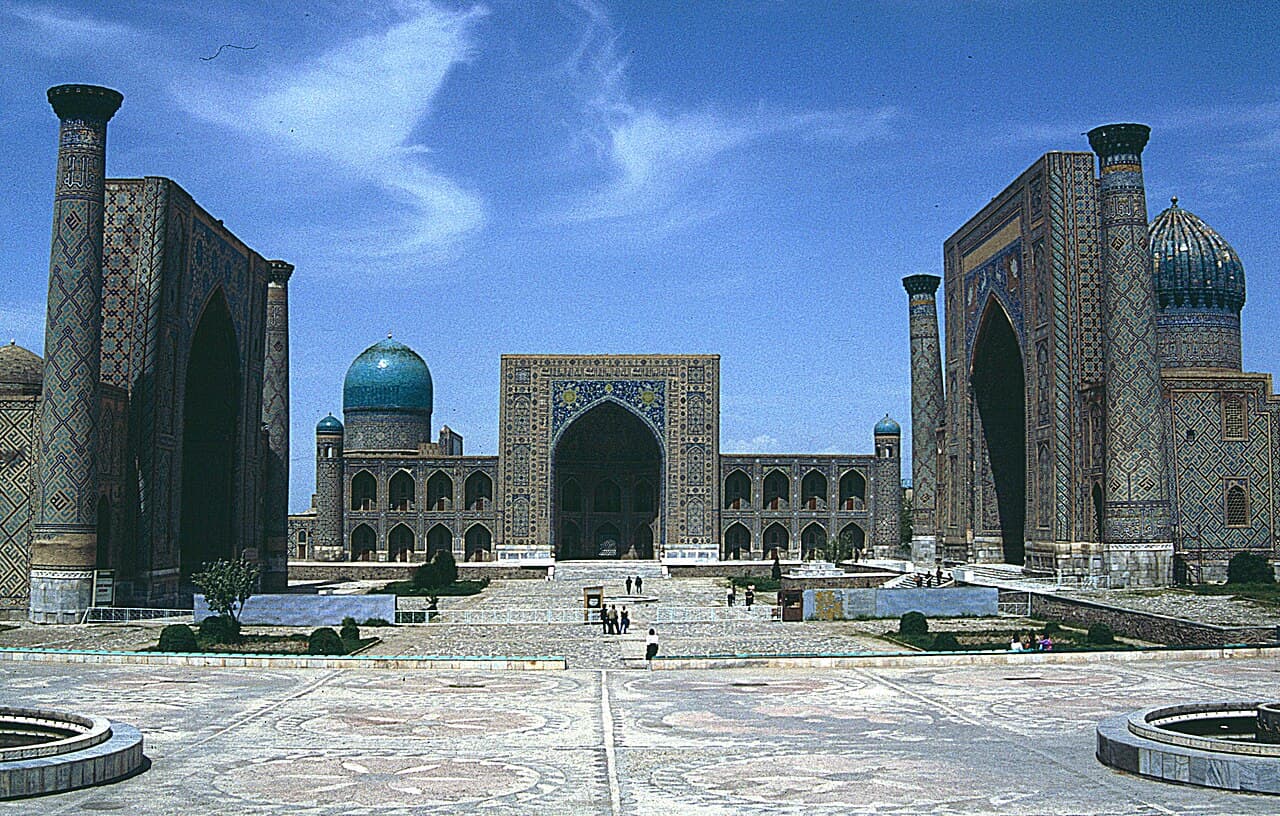
UzbekistanPhoto: Ziegler175 / Wikimedia Commons (CC BY-SA 4.0)

Uzbekistan

Country · UZ · UZS · Asia/Tashkent

This information may change. Always check the official source.Last verified: August 2026 by

More than 90 nationalities enter free for 30 days, and since 1 January 2026 that includes every American. Registration is the rule that still trips people, and hotels handle it for you.

  • More than 90 nationalities enter visa-free, almost always for 30 days, with no arrival form, no fee and no interview. Your passport needs 3 months of validity from arrival.
  • Every US citizen has been able to enter visa-free since 1 January 2026, under a decree signed on 3 November 2025. Most sites, official ones included, still describe the old age-based rule.
  • If a page tells you to buy a USD 20 e-visa as an American, it is out of date. e-visa.gov.uz is the only official channel for the nationalities that do need one.
  • Hotels register you automatically and hand back a slip - keep every one of them. Stays of up to 3 days need no registration, and private stays are self-registered through Emehmon.
  • Cash above USD 10,000 must be declared, drones are prohibited without a licence, and an old carpet leaves the country only with an export certificate.
More details

The short version

Uzbekistan spent a decade dismantling one of the most difficult visa regimes in Asia, and the result is that most readers of this page need nothing at all.

  • More than 90 nationalities enter visa-free, in almost every case for 30 days.
  • Your passport must be valid for at least 3 months from the day you arrive.
  • There is no arrival form, no fee and no interview. You queue, you are stamped, you leave.
  • Anyone outside the list applies for an e-visa at e-visa.gov.uz, which is the only official channel: USD 20 single entry, USD 35 double, USD 50 multiple, for a 30-day stay.

The change nobody has updated

Every US citizen has been able to enter visa-free since 1 January 2026, under a decree signed on 3 November 2025.

  • The old rule was age-based - free entry for over-55s and under-16s only - and it is still what most sites say, including some official ones.
  • If a page tells you to buy a USD 20 e-visa as an American, it is out of date. You do not need one for a 30-day tourist visit.
  • Over 30 days still requires a visa, as it does for everyone.

Where your nationality lands

Visa and entry in Uzbekistan
You holdWhat you get
USA, Canada, Australia, UK, Germany, France, Italy, Spain, Netherlands, Poland, Japan, South Korea, Singapore, Malaysia, Saudi ArabiaVisa-free, 30 days
RussiaVisa-free, 90 days
ChinaVisa-free, 10 days. Longer stays need an e-visa
India, Taiwan, CambodiaE-visa in advance, USD 20, 30 days

Registration, and why it has a reputation

Uzbekistan requires foreigners to be registered at their address. This used to be enforced with large fines at the airport on departure, and the stories have outlived the practice.

  • Hotels and guesthouses register you automatically. They take your passport at check-in, and hand back a small slip. Keep every slip until you have left the country.
  • Stays of up to 3 days need no registration at all.
  • Staying privately, in a homestay or a camper, means registering yourself through the Emehmon online system, at least every 3 days.
  • The tourism committee has removed the traveller's own liability for a registration breach, so the airport shakedown of a few years ago is largely gone. The FCDO still describes the 3-day duty, so keep the paperwork rather than testing it.

Money and things at the border

  • Cash above USD 10,000 must be declared on the way in, and you may not leave with more foreign currency than you brought.
  • Precious metals and gemstones over 65 grams must be declared.
  • Prescription medicines need the prescription. Codeine and several things sold over the counter at home are controlled here, and the consequences run to criminal proceedings.
  • Drones are prohibited without a licence obtained in advance.
  • Antiques and carpets need an export certificate, which any reputable seller will arrange. Buying a genuinely old rug without one is how people lose it at the airport.
Sources (3)

Uzbekistan wants a declaration form and is strict about medicines: several ordinary drugs are on the prohibited list.

  • Medicines are the real risk. Codeine, tramadol and a number of drugs sold over the counter elsewhere are controlled, and carrying them without a prescription and the original packaging has caused arrests.
  • Electronic cigarettes are prohibited to import.
  • A customs declaration form is filled in on arrival, in duplicate, and the copy you keep is asked for on departure - losing it causes an argument you do not need.
  • Cash above the declarable threshold must be reported, and the declaration is what allows you to take the same money out.
  • Antiques, carpets and artwork need an export certificate from the Ministry of Culture. The Bukhara and Samarkand dealers arrange it; ask before you pay.
More details
  • Medicines are the real risk. Codeine, tramadol and a number of drugs sold over the counter elsewhere are controlled, and carrying them without a prescription and the original packaging has caused arrests.
  • Electronic cigarettes are prohibited to import.
  • A customs declaration form is filled in on arrival, in duplicate, and the copy you keep is asked for on departure - losing it causes an argument you do not need.
  • Cash above the declarable threshold must be reported, and the declaration is what allows you to take the same money out.
  • Antiques, carpets and artwork need an export certificate from the Ministry of Culture. The Bukhara and Samarkand dealers arrange it; ask before you pay.
Sources (1)

State hospitals are basic and the private clinics in Tashkent are the ones to use. Insurance with evacuation cover is not optional here, and the tap water is not for drinking.

  • State hospitals are basic and the private clinics in Tashkent are the ones to use. Outside the capital care thins fast, and Khiva and the desert have none worth the name.
  • You pay up front, in cash, and claim afterwards, so take a policy that covers medical evacuation and get an itemised receipt for everything.
  • Ask a travel clinic about hepatitis A and typhoid, and note that rabies is present and stray dogs are common in the old towns. There is no malaria in Uzbekistan.
  • Do not drink the tap water. Bottled is cheap and universal; stomach upsets here are usually the change of diet and the amount of oil rather than contamination.
  • Summer in the desert cities passes 40 degrees with almost no shade at the monuments. Sightsee before 11:00 and after 17:00, and spend the middle of the day lying down.
More details

What the system is like

  • State hospitals are free at the point of emergency and are basic. Equipment, supplies and hygiene are not at the standard a European or North American visitor expects.
  • Private clinics in Tashkent are the answer for anything serious, and several are used to foreign patients and insurance paperwork.
  • Outside Tashkent, care thins quickly. Samarkand and Bukhara have workable private clinics; Nukus, Khiva and the desert do not.
  • You pay up front, in cash, and claim afterwards. Bring the money or a card that works, and get an itemised receipt.

Insurance

  • Take a policy that covers medical evacuation. For anything major the realistic treatment plan is a flight to Tashkent and then, possibly, out of the country.
  • Check that it covers the activities you have planned - trekking in the Chimgan mountains, desert trips, motorcycling.
  • Call the insurer before you consent to treatment wherever there is time.

Before you go

  • Ask a travel clinic about hepatitis A and typhoid, both of which are routine recommendations for Uzbekistan, and make sure tetanus and MMR are current.
  • Rabies is present, and stray dogs are common in the old towns. A bite or a lick on broken skin means treatment the same day, and post-exposure vaccine is not reliably available outside Tashkent.
  • There is no malaria in Uzbekistan.
  • Bring your own prescription medicines with the prescription. Pharmacies are well stocked with local brands and will not have yours.

Food and water

  • Do not drink the tap water. Bottled water is cheap and universal.
  • Ice in restaurants in the cities is generally fine, and at a roadside stop is not.
  • Stomach upsets are the near-universal visitor complaint, usually from the change of diet and the amount of oil rather than from contamination.
  • The food is superb and heavy. Plov at lunchtime, when it is fresh, rather than in the evening when it has been sitting.
  • Melons, apricots and grapes in summer are the best you will ever eat. Wash them yourself.

Heat and altitude

  • Summer in the desert cities passes 40 degrees regularly. Sightseeing happens before 11:00 and after 17:00; the middle of the day is for lying down.
  • There is very little shade at the monuments. Hat, water, sunscreen, every day.
  • The mountains north of Tashkent reach altitudes worth respecting if you are heading up to ski or trek.
Sources (3)

Tashkent

Long-term averages for Tashkent: the mean daily high, the mean overnight low and the mean monthly rainfall across 30 years of ERA5 reanalysis data (1995–2024).

DayNight
-55152535°C0100mmJanFebMarAprMayJunJulAugSepOctNovDecJanuary: Day 6 °C, Night -5 °C, Rain 55 mm. February: Day 8 °C, Night -3 °C, Rain 67 mm. March: Day 15 °C, Night 2 °C, Rain 88 mm. April: Day 21 °C, Night 8 °C, Rain 86 mm. May: Day 27 °C, Night 13 °C, Rain 65 mm. June: Day 33 °C, Night 18 °C, Rain 24 mm. July: Day 35 °C, Night 20 °C, Rain 10 mm. August: Day 34 °C, Night 19 °C, Rain 6 mm. September: Day 29 °C, Night 14 °C, Rain 9 mm. October: Day 21 °C, Night 7 °C, Rain 34 mm. November: Day 13 °C, Night 1 °C, Rain 56 mm. December: Day 7 °C, Night -4 °C, Rain 52 mm
Show the monthly table
Tashkent
MonthDay (°C)Night (°C)Rain (mm)
January6-555
February8-367
March15288
April21886
May271365
June331824
July352010
August34196
September29149
October21734
November13156
December7-452

Samarkand

Long-term averages for Samarkand: the mean daily high, the mean overnight low and the mean monthly rainfall across 30 years of ERA5 reanalysis data (1995–2024).

DayNight
-55152535°C0100mmJanFebMarAprMayJunJulAugSepOctNovDecJanuary: Day 7 °C, Night -3 °C, Rain 55 mm. February: Day 9 °C, Night -2 °C, Rain 72 mm. March: Day 14 °C, Night 2 °C, Rain 95 mm. April: Day 20 °C, Night 7 °C, Rain 81 mm. May: Day 26 °C, Night 12 °C, Rain 56 mm. June: Day 31 °C, Night 17 °C, Rain 12 mm. July: Day 34 °C, Night 19 °C, Rain 4 mm. August: Day 32 °C, Night 18 °C, Rain 3 mm. September: Day 28 °C, Night 14 °C, Rain 5 mm. October: Day 21 °C, Night 7 °C, Rain 25 mm. November: Day 14 °C, Night 2 °C, Rain 51 mm. December: Day 8 °C, Night -2 °C, Rain 43 mm
Show the monthly table
Samarkand
MonthDay (°C)Night (°C)Rain (mm)
January7-355
February9-272
March14295
April20781
May261256
June311712
July34194
August32183
September28145
October21725
November14251
December8-243

Bukhara

Long-term averages for Bukhara: the mean daily high, the mean overnight low and the mean monthly rainfall across 30 years of ERA5 reanalysis data (1995–2024).

DayNight
-55152535°C050mmJanFebMarAprMayJunJulAugSepOctNovDecJanuary: Day 8 °C, Night -2 °C, Rain 21 mm. February: Day 11 °C, Night -1 °C, Rain 25 mm. March: Day 17 °C, Night 5 °C, Rain 34 mm. April: Day 25 °C, Night 11 °C, Rain 23 mm. May: Day 31 °C, Night 17 °C, Rain 10 mm. June: Day 36 °C, Night 22 °C, Rain 2 mm. July: Day 38 °C, Night 25 °C, Rain 1 mm. August: Day 36 °C, Night 22 °C, Rain 0 mm. September: Day 31 °C, Night 16 °C, Rain 1 mm. October: Day 23 °C, Night 9 °C, Rain 7 mm. November: Day 14 °C, Night 3 °C, Rain 15 mm. December: Day 9 °C, Night -1 °C, Rain 12 mm
Show the monthly table
Bukhara
MonthDay (°C)Night (°C)Rain (mm)
January8-221
February11-125
March17534
April251123
May311710
June36222
July38251
August36220
September31161
October2397
November14315
December9-112
Sources (1)

Family-run guesthouses in the old towns are the best thing about staying here, and they are also the ones that register you. Spring and autumn book out.

  • Bukhara and Khiva are best experienced from inside the old town, in a converted merchant's house around a courtyard - cheap, family-run, and the thing people remember.
  • Samarkand's monuments are spread out and the modern city between them is not charming, so stay within walking distance of the Registan.
  • Any licensed hotel or guesthouse registers you and gives you a slip. A private flat booked through a short-let site may not, so ask before booking.
  • April to early June and September to early November are the seasons, when everything is booked and the best courtyard guesthouses go first.
  • July and August pass 40 degrees in the desert cities and are correspondingly cheap and empty; winter is beautiful and heating in older buildings is a lottery.
More details

Where to stay in the old cities

  • Bukhara and Khiva are best experienced from inside the old town, in a converted merchant's house around a courtyard. These are family businesses, they are cheap, and breakfast on the terrace is the memory people come home with.
  • Samarkand's monuments are spread out and the modern city between them is not charming, so pick a place within walking distance of the Registan.
  • Tashkent is a large Soviet-planned city. Stay near a metro station and the size stops mattering.
  • Nukus, for the Savitsky museum, has a handful of hotels and no reason to be fussy.

Registration, again

  • Any licensed hotel or guesthouse registers you and gives you a slip. Collect them all and keep them until you fly out.
  • A private flat booked through a short-let site may not register you. Ask before booking, and if the host cannot, register yourself through Emehmon.
  • Nights on a sleeper train count as registered if you keep the ticket, and nights camping need Emehmon.

Seasons and booking

  • April to early June and September to early November are the seasons. Everything is booked in those months, prices rise, and the best courtyard guesthouses go first.
  • July and August are extremely hot - well over 40 degrees in the desert cities - and correspondingly cheap and empty.
  • Winter is cold, clear and beautiful, with snow on the tiles and very few visitors. Heating in older buildings is a lottery.
  • Navruz, on 21 March, fills everything.

Standards and what to check

  • Hot water and heating are the two things worth asking about in older guesthouses.
  • Air conditioning is essential in summer and is not universal.
  • Breakfast is normally included and is a serious spread of bread, eggs, fruit and pastries.
  • Cash on departure is often expected, even where the booking site took a deposit.
Sources (3)

All four networks have desks in the Tashkent arrivals hall. Take Ucell or Uzmobile, insist the passport registration is actually done, and expect data to thin out between cities.

  • All four networks have desks in the Tashkent arrivals hall, immediately after customs. This is the easiest SIM purchase in Central Asia and there is no reason to wait.
  • Ucell is the default pick, with the most consistent coverage along the Tashkent, Samarkand, Bukhara and Khiva route; Uzmobile is the one to have out in the regions.
  • Buy from an operator desk, not a street kiosk. The known failure is a kiosk that sells you a working SIM without completing the passport registration, and the line dies days later.
  • Telegram is the country's messaging app, far more than WhatsApp - restaurants, guides and drivers will all ask for it.
  • Do not photograph metro stations, bridges, checkpoints or anything military. The wider rule about official buildings is enforced and the officer's opinion is the one that counts.
More details

Buy it in the arrivals hall

Ucell, Uzmobile, Mobiuz and Beeline all have desks in the Tashkent airport arrivals hall, immediately after customs. This is the easiest SIM purchase in Central Asia and there is no reason to wait.

  • Ucell is the default pick for visitors, with the most consistent 4G along the Tashkent, Samarkand, Bukhara and Khiva route.
  • Uzmobile, the state operator, is the one to have in the regions away from that corridor.
  • Mobiuz is the cheap option and is fine if you never leave the cities.
  • Beeline is the weakest network and is worth avoiding despite competitive pricing.
  • A tourist SIM with a usable data bundle is cheap by any standard, and 10 to 30 GB packages are normal.

Get the registration right

  • Your passport is required and the line is registered in your name. This is normal and not a red flag.
  • Buy from an operator desk or an official shop, not a street kiosk. The known failure is a kiosk that sells you a working SIM without completing the registration, and the network cuts the line off days later, usually when you are in Bukhara and need a taxi.
  • Ask them to make a call and load a page before you walk away.
  • Keep the receipt and the SIM's packaging with the number on it.

Coverage, and where it fails

  • Tashkent, Samarkand and Bukhara have good 4G and increasingly 5G.
  • The desert stretches, the Aral region and the mountains south of Tashkent are patchy, and the Nukus to Moynaq road has long dead sections.
  • Download offline maps of every city you plan to visit. Street addressing here is not intuitive, and the old towns are a maze.
  • Hotel wifi is common and slow.

Two local habits

  • Telegram is the country's messaging app, far more than WhatsApp. Restaurants, guides and drivers will ask for your Telegram.
  • Do not photograph metro stations, bridges, checkpoints or anything military. Tashkent's metro photography ban was lifted years ago and the stations are spectacular, but the wider rule about official buildings is enforced, and a police officer's opinion is the one that counts.
Sources (3)

Uzbek sockets are Type , and at 220 V, so European plugs fit and older outlets are unearthed.

  • A Europlug fits every socket in the country.
  • Older Soviet-built sockets are unearthed and narrower than a modern Schuko outlet, so a heavy European plug sometimes needs pressure.
  • British, American and Australian plugs need an adapter.
  • 220 V, so American 120 V-only equipment needs a converter.
  • Kazakhstan, Kyrgyzstan and Tajikistan all match, so one adapter covers a Silk Road route.
More details

Sockets in Uzbekistan are Type , and at 220 V, 50 Hz - the European round-pin pattern, in both the French and German earthing styles.

  • A Europlug fits every socket in the country.
  • Older Soviet-built sockets are unearthed and narrower than a modern Schuko outlet, so a heavy European plug sometimes needs pressure.
  • British, American and Australian plugs need an adapter.
  • 220 V, so American 120 V-only equipment needs a converter.
  • Kazakhstan, Kyrgyzstan and Tajikistan all match, so one adapter covers a Silk Road route.
  • The earth is a pair of clips or a pin depending on the socket. Both take a Europlug, and neither earths a two-pin adapter.
Sources (1)

A secular Muslim country with a serious tea and bread etiquette, two alphabets, European plugs and a working week that runs to Saturday.

  • Non, the round bread, is close to sacred - never placed upside down, never thrown away, and torn by hand rather than cut.
  • Tea is poured in small amounts deliberately. A half-full bowl means the host wants you to stay and be refilled; filling it to the brim is a hint to leave.
  • Uzbekistan is majority Muslim and firmly secular, but cover shoulders and knees at working mosques and mausoleums, and carry a scarf for your head if you are a woman.
  • Uzbek is written in both Latin and Cyrillic, often on the same street, Russian is the second language, and rahmat and salom open doors here.
  • Plugs are the European type and at 220 V, the working week runs Monday to Saturday, and many museums close on Monday instead of Sunday.
More details

Bread, tea and the table

  • Non, the round bread, is close to sacred. It is never placed upside down, never thrown away, and torn by hand rather than cut with a knife.
  • Tea is poured for you in small amounts, deliberately. A half-full bowl means the host wants you to stay and be refilled; filling it to the brim is a hint to leave.
  • Pour with the right hand, and take the bowl with the right hand.
  • You will be fed more than you can eat. Refusing outright is difficult; leaving a little is the graceful version.
  • Plov is eaten at lunchtime and every region claims the correct recipe.

Religion and dress

  • Uzbekistan is majority Muslim and firmly secular. Alcohol is sold openly, few women cover their hair, and the mosques are as much monuments as places of worship.
  • Cover shoulders and knees at working mosques and mausoleums. Women should carry a scarf for the head; men should not wear shorts.
  • Take shoes off where others do, at a mosque and inside many homes.
  • During Ramadan most restaurants stay open and life continues, but eating conspicuously in front of someone fasting is poor manners.

Language and the alphabets

  • Uzbek is written in both Latin and Cyrillic, often on the same street, and the changeover has been going on for 30 years.
  • Russian is the second language and is what a taxi driver over 40 will answer in.
  • English is common among younger people in tourism and rare elsewhere.
  • Learn rahmat, thank you, and salom. They open doors here in a way they do not in most places.
  • Google Translate's offline Uzbek and Russian packs are worth downloading before you land.

Practical odds and ends

  • Plugs are the European type and at 220 V, 50 Hz.
  • The working week runs Monday to Saturday, with Sunday the day off; many museums close on Monday instead.
  • Public toilets are scarce and basic. Carry tissue; use hotels and restaurants.
  • Smoking is common and banned indoors in a way that is loosely enforced.
  • Photographing people, especially women, needs asking, and most people will happily agree.
  • Bargain in the bazaar, not in a shop. Start at about half and settle above it, with good humour rather than as a contest.
Sources (3)

This is a cash country. Uzcard and Humo run the card system, a foreign Visa works in some Tashkent hotels and almost nowhere else, and the black market is a criminal offence rather than a bargain.

  • Uzbekistan looks modern and pays like a cash economy. Uzcard and Humo run retail payment and your foreign card is not on them - assume it works nowhere outside international hotels.
  • Bring US dollars as backup and check every note: they must be dated 2013 or later, unmarked and untorn. Older or worn notes are refused everywhere.
  • Change money only at a bank or a licensed exchange office. Street changing is a criminal offence with harsh penalties, and the rate stopped being better in 2017.
  • ATMs taking foreign cards are easy to find in Tashkent, Samarkand and Bukhara and should be treated as absent in Nukus, the mountains and the small towns.
  • Small notes matter. The largest is 200,000 som, taxi drivers and market sellers rarely have change, and bargaining belongs in the bazaar rather than in a shop.
More details

Bring cash and expect to use it

Uzbekistan looks modern and pays like a cash economy. The domestic card networks, Uzcard and Humo, run almost all retail payment, and your foreign Visa or Mastercard is not on them.

  • A foreign card works in international hotels, a few Tashkent restaurants and some larger supermarkets. Assume it works nowhere else.
  • Bazaars, guesthouses, taxis, shared cars, museums and most restaurants are cash.
  • Carry more som than feels reasonable. Running out in Bukhara on a Sunday is a real afternoon lost.

ATMs and exchange

  • ATMs that accept foreign cards exist in Tashkent, Samarkand and Bukhara and are much easier to find than they were. Bank lobbies are the reliable ones.
  • They are limited elsewhere. Nukus, Moynaq, the mountains and the small towns should be treated as having none.
  • US dollars are the currency to bring as backup, in cash, and the notes must be dated 2013 or later, unmarked and untorn. Older or worn notes are refused everywhere.
  • Change money only at a bank or a licensed exchange office. Street changers are a criminal offence with harsh penalties, and the rate they offer is no longer better than the bank's - the two-tier market that made it worthwhile ended in 2017.
  • Keep the exchange receipts.

The notes themselves

  • The som has been through heavy inflation and the notes reflect it. The largest is 200,000 som, and 100,000 and 50,000 notes are common.
  • Small notes matter. Taxi drivers and market sellers routinely have no change for a large note.
  • Count what you are handed. Not because of dishonesty, but because the arithmetic involves a lot of zeros.

Tipping and prices

  • Tipping is not traditional and is becoming normal in tourist restaurants, at around 10 percent, and many now add a service charge instead - check the bill before adding anything.
  • Round up for a taxi driver and that is all.
  • Bargaining is expected in bazaars and for carpets and crafts, and is not expected in shops, restaurants or for a train ticket.
  • Prices for foreigners at monuments are higher than for residents, which is posted and official rather than a scam.
Sources (3)

Everyday prices

Typical prices in Uzbek som (UZS), averaged across the country by Numbeo and read on 18 August 2026. Tick Convert prices above the table to see every amount in your own currency.

Everyday prices
ItemTypical price
Inexpensive restaurant meal70,000 UZS
Dinner for two, mid-range, three courses350,000 UZS
Cappuccino25,400 UZS
Local draught beer, 0.5 l17,500 UZS
Bottled water, 0.33 l3,230 UZS
Public transport, one-way ticket2,000 UZS
Taxi, starting fare5,000 UZS
Petrol, 1 litre13,400 UZS
Cigarettes, pack of 20 (Marlboro)25,000 UZS
Average net monthly salary6,790,000 UZS

These are country-wide averages, not a price list: tourist districts, airports and islands sit well above them, and small towns below. The salary line is there for proportion - it is what people living here actually earn.

Sources (1)

Airport guides for Uzbekistan1

One page per airport: the routes into town, what they cost and the trap particular to that arrival.

See all 1 airports

Tashkent airport is 20 minutes from the middle of the city, and the men offering you a taxi at the door want four times the app price. Get som first, then open Yandex Go.

  • Walk past the men offering taxis inside the terminal. They quote 100,000 to 200,000 som for a ride that costs 25,000 to 50,000, and they are very confident about it.
  • Use Yandex Go, which is what everyone here uses. It quotes a fixed price before you book, and the fare from the airport to the centre is usually well under 50,000 som.
  • You need cash to pay the driver. Most drivers do not take cards and the app's card payment is unreliable with a foreign one, so exchange or withdraw before you book.
  • Take out at least 500,000 som in arrivals to be comfortable for the first day. There are exchange counters and machines before you reach the door.
  • Samarkand, Bukhara and Urgench airports are 10 to 15 minutes from their cities. Yandex Go works in the first two; in Urgench, agree the price out loud before you get in.
More details
Tashkent

The airport is barely 5 km from the centre of Tashkent, so nothing about this journey should be expensive or complicated. It nevertheless produces more complaints from visitors than anything else in the country.

  • Walk past the men offering taxis inside the terminal. They will quote 100,000 to 200,000 som for a ride that costs 25,000 to 50,000 som, and they will be very confident about it.
  • Use Yandex Go, which is what everyone here uses. It quotes a fixed price before you book and the fare to the centre is usually well under 50,000 som.
  • You will need cash to pay the driver. Most Uzbek drivers do not take cards, and the app's card payment is unreliable with a foreign card.
  • So: exchange or withdraw first, then book. There are exchange counters and ATMs in the arrivals hall. Take out at least 500,000 som to be comfortable for the first day.
  • The official taxi rank outside is the fallback, and cheaper than the touts inside, but still above the app price.
Samarkand, Bukhara and Urgench
  • All three airports are small and close to their cities, 10 to 15 minutes by road.
  • Yandex Go works in Samarkand and Bukhara. In Urgench, for Khiva, it is thinner and a negotiated taxi is normal.
  • Agree the price before you get in whenever there is no app, and agree it in som with the number said out loud.
The other way in
  • Many visitors arrive by land from Kazakhstan, Kyrgyzstan or Tajikistan. Border posts are slow and thorough rather than difficult.
  • Change money before a land crossing. Uzbek som is not sold outside the country and the border touts' rate is bad.
  • The Tashkent to Almaty and Tashkent to Samarkand trains are a comfortable alternative to a flight.
What a first ride costs
  • Tashkent airport to the centre: roughly 25,000 to 50,000 som by app.
  • Anywhere within central Tashkent: 15,000 to 30,000 som.
  • A day with a driver between towns is negotiated, and a hotel arranging one for you is normal practice rather than a markup.
Sources (3)

The Afrosiyob high-speed train is the spine of any trip and its seats go on sale exactly 45 days ahead. Book the moment the window opens or you are on the road.

  • Afrosiyob tickets are released exactly 45 days before departure, at midnight Tashkent time, and popular spring and autumn dates sell out in hours.
  • Tashkent to Samarkand takes a little over 2 hours and runs around 294,000 som in economy; Samarkand to Bukhara is about 1 hour 30.
  • Foreign cards are frequently declined at eticket.railway.uz. A hotel or local agency booking it for a small fee is the normal solution rather than a scam.
  • Tashkent's metro is one of the most beautiful in the world and costs a flat 1,700 som with an ATTO card or 3,000 for a cash token. Photography has been allowed since 2018.
  • Do not drive between cities at night. Unlit vehicles and livestock on the road are the standard combination, and hiring a car with a driver costs very little here.
More details

The train, which is the whole trip

Afrosiyob is a Spanish-built high-speed train and it turns the Silk Road cities into day trips from one another.

  • Tashkent to Samarkand takes a little over 2 hours. Samarkand to Bukhara is about 1 hour 30.
  • Economy is comfortable and is what most visitors book. Tashkent to Samarkand runs around 294,000 som in economy, more in business and VIP.
  • Tickets are released exactly 45 days before departure, at midnight Tashkent time, and popular dates sell out in hours during spring and autumn.
  • Book at eticket.railway.uz. Foreign cards are frequently declined there; if yours is, a hotel, a local agency or a reseller will book it for a small fee, and that is the normal solution rather than a scam.
  • Sharq is the slower conventional train on the same route, cheaper and easy to get.
  • The overnight train to Khiva from Tashkent exists and is a genuine sleeper, which saves a hotel night.

Cities

  • Tashkent's metro is one of the most beautiful in the world and costs a flat 1,700 som with an ATTO card or the app, 3,000 som for a cash token. Three lines and a ring line, and stations decorated as public monuments.
  • Photography in the metro has been allowed since 2018, so go and look.
  • Yandex Go covers Tashkent, Samarkand, Bukhara and the larger towns, and is cheap enough that walking is a choice rather than a saving.
  • Marshrutka minibuses run everywhere and are for the confident: no English, no fixed stops, cash to the driver.

Between towns without the train

  • Shared taxis leave from set ranks when they fill, and are the local way to reach anywhere the train does not.
  • You pay per seat, or buy the whole car if you want to leave now.
  • Long-distance buses are slow but very cheap.
  • Domestic flights connect Tashkent with Nukus and Urgench and save a very long drive to Karakalpakstan.

Driving

  • Hiring a car and driver is far more common than self-driving, costs little, and removes the problems below.
  • Traffic police checkpoints are frequent and want to see documents.
  • Road quality is uneven and night driving is genuinely dangerous - unlit vehicles, livestock, no markings.
  • Fuel is often methane or propane rather than petrol, and queues at gas stations can be long.
Sources (3)

Uzbek roads are free, police checkpoints are frequent, and the fast train removes most of the reason to drive.

  • The Afrosiyob train links Tashkent, Samarkand and Bukhara in a couple of hours each; the same drive is a long day on a two-lane road.
  • Police checkpoints between provinces are routine and passports are checked; keep documents to hand.
  • The alcohol limit is zero.
  • Roads are free and the main routes are reasonable; the desert road to Khiva is long, hot and monotonous.
  • Fuel is often methane or propane rather than petrol, and petrol stations can be scarce outside the cities.
More details

Free roads, frequent checkpoints, and a high-speed train that beats the car on every main route.

  • The Afrosiyob train links Tashkent, Samarkand and Bukhara in a couple of hours each; the same drive is a long day on a two-lane road.
  • Police checkpoints between provinces are routine and passports are checked; keep documents to hand.
  • The alcohol limit is zero.
  • Roads are free and the main routes are reasonable; the desert road to Khiva is long, hot and monotonous.
  • Fuel is often methane or propane rather than petrol, and petrol stations can be scarce outside the cities.
Sources (1)

One of the safest countries a traveller can pick, with a heavy police presence that is aimed at reassurance rather than at you. Roads and photography are the two real risks.

  • Uzbekistan is a very safe place to travel, including for solo women, and violent crime against foreigners is rare. Police are everywhere and are not looking for you.
  • Pickpocketing is the realistic risk: Chorsu bazaar, crowded metro trains, the Registan when a tour group arrives.
  • Traffic is the most likely thing to hurt you. Surfaces are poor, overtaking is optimistic, pedestrian crossings are decorative, and night driving between cities is genuinely dangerous.
  • Do not photograph military sites, border posts, checkpoints, airports, bridges or police. The penalty is a serious afternoon rather than a fine.
  • Carry your passport or a good copy, and treat the Afghan border area around Termez, the enclave-riddled frontiers and the remote Aral region as places to read the advice first.
More details

The general picture

Uzbekistan is a very safe place to travel, including for solo women, and violent crime against foreigners is rare.

  • Petty theft is the realistic risk: pickpocketing in Chorsu bazaar, on crowded metro trains, at the Registan when a tour group arrives.
  • Police are visible everywhere - metro stations, junctions, monuments. This is normal and they are not looking for you.
  • Carry your passport or a good copy. Identity checks happen and being unable to identify yourself makes an easy conversation into a long one.
  • Hospitality can be overwhelming. Being invited to a stranger's house for plov is genuine far more often than it is a setup.

The scams that do exist

  • The airport taxi quote, covered in the transport section, is the main one.
  • Carpet and silk sellers claiming great age for something made last year. Buy because you like it, not because of the story, and get an export certificate for anything genuinely old.
  • "Change money?" in a bazaar is illegal for both of you and is sometimes a setup involving a police officer.
  • Padded restaurant bills in a few tourist places. Ask for the menu price and check the total.

Photography and the state

  • Do not photograph military sites, border posts, checkpoints, airports, bridges or police. The FCDO is explicit about this and the penalty is a serious afternoon.
  • Government buildings are a grey area best avoided.
  • Political conversation is not dangerous for you and can be for the Uzbek you are talking to. Let them lead.

Roads, which are the actual danger

  • Traffic is the most likely thing to hurt you here. Surfaces are poor, overtaking is optimistic, and pedestrian crossings are decorative.
  • Do not drive at night between cities. Unlit vehicles and livestock on the road are the standard combination.
  • Wear the seatbelt in the back as well, and expect it to be missing in older cars.
  • Cross roads with a local if you can, and use the underpasses in Tashkent.

Regions

  • The Afghan border in the south, around Termez and parts of Surkhandarya, carries FCDO advice worth reading before you go.
  • Border zones with Kyrgyzstan and Tajikistan contain areas needing a permit, and enclaves where the frontier is not where a map suggests.
  • The Aral Sea region is remote. Moynaq is a long way from medical care and mobile coverage.
Sources (3)

Three separate numbers, 101 fire, 102 police, 103 ambulance, with 112 as a unified line. Assume nobody at the other end speaks English.

  • 101 fire, 102 police, 103 ambulance, 104 gas are the numbers Uzbeks use, and 112 is the unified line that works from any mobile.
  • Assume the operator speaks Uzbek and Russian only. Have someone from your hotel make the call if there is any way to do that.
  • Save your hotel's name and address in Cyrillic on your phone on the first day. It is the single most useful thing you can prepare here.
  • An ambulance is not the fast option. For anything urgent in Tashkent a taxi to a private clinic is quicker, and the clinic is better equipped than where an ambulance takes you.
  • Report a theft and get the written report, because insurers require it, and keep photographs of your passport, entry stamp and registration slips in your phone and your email.
More details

The numbers

  • 101 fire, 102 police, 103 ambulance, 104 gas. These are the numbers Uzbeks use.
  • 112 is the unified emergency line and works from a mobile, including one with no credit.
  • Assume the operator speaks Uzbek and Russian only. Have someone from your hotel make the call if you possibly can.
  • Save your hotel's number and address in Cyrillic on your phone on the first day. It is the single most useful thing you can prepare.

An ambulance is not the fast option

  • Response times in the cities are slow and outside them are worse.
  • For anything urgent in Tashkent, a taxi to a private clinic is usually faster than waiting, and the clinic will be better equipped than where an ambulance takes you.
  • Call your insurer as soon as you can. They may direct you somewhere specific and they will need to authorise payment.

If something goes wrong

  • Report a theft to the police and get the written report. Insurers will not pay without it, and getting one takes time and patience.
  • A lost passport means your embassy in Tashkent, and you will need the police report first.
  • If you are arrested, ask to contact your embassy and do not sign a document you cannot read.
  • Keep a photograph of your passport, visa stamp and registration slips in your phone and in your email.

Remote areas

  • Karakalpakstan, the Aral region and the mountains have no quick help. Distances to a hospital are measured in hours.
  • Tell your guesthouse where you are going and when you expect to be back.
  • Mobile coverage fails on the desert roads, so an offline map and a full power bank are safety equipment.
  • Travel in a group for the Aral Sea, which is a two-day drive from anything.
Sources (3)