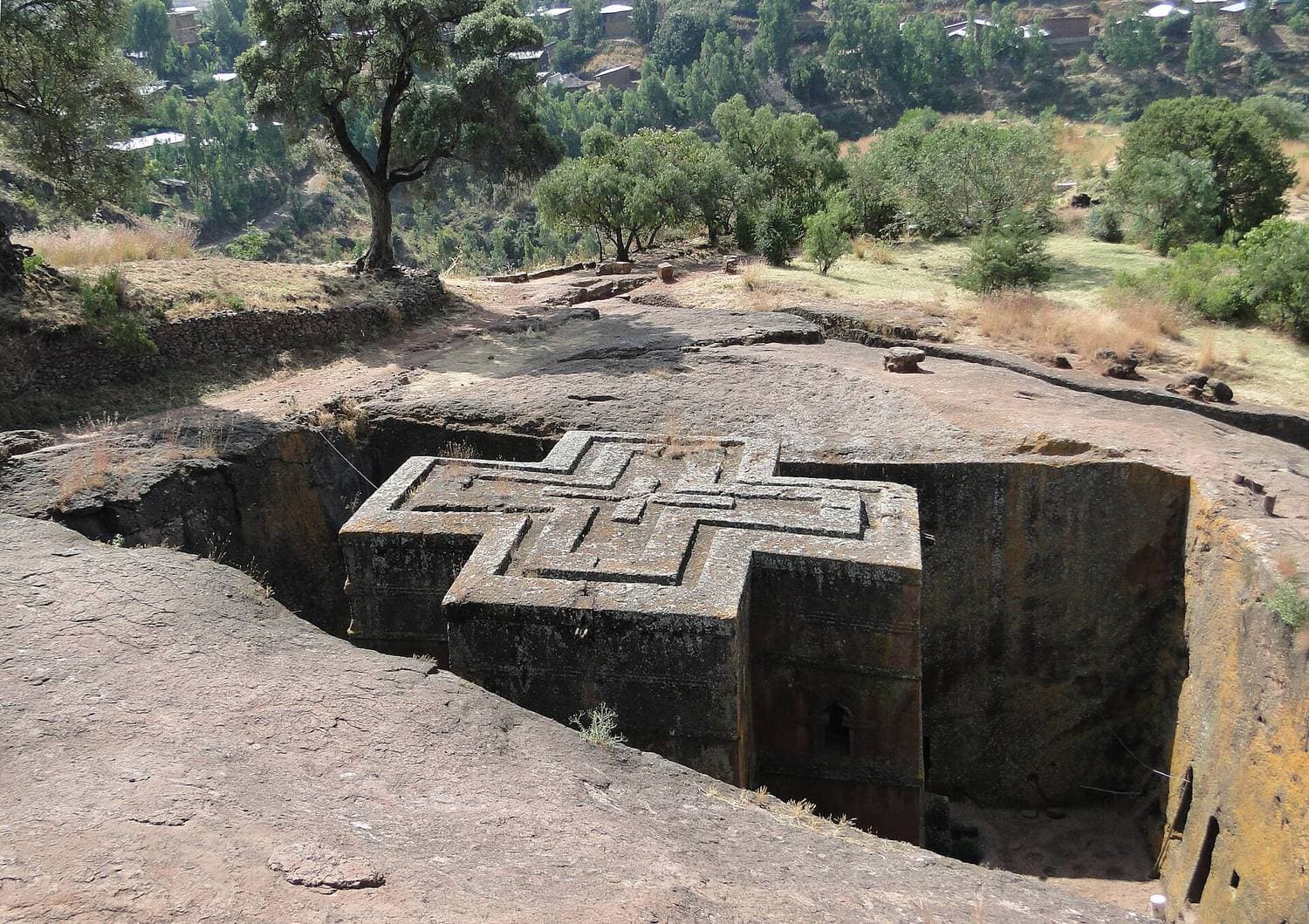
EthiopiaPhoto: Bernard Gagnon / Wikimedia Commons (CC BY-SA 3.0)

Ethiopia

Country · ET · ETB · Africa/Addis_Ababa

This information may change. Always check the official source.Last verified: August 2026 by

Hold the e-visa before you board. The FCDO says apply online; Ethiopian Airlines publishes a visa-on-arrival guideline. The airline check-in desk is the checkpoint that decides.

  • A visa is required for tourism. Apply online, before you travel, at evisa.gov.et, which is the government platform.
  • The FCDO tells British travellers to get the visa online before arrival and does not present visa on arrival as a route.
  • Ethiopian Airlines requires a health declaration form completed before departure, on the Ethiopian Public Health Institute's portal at e-thtp.ephi.gov.et.
  • A certificate is required if you are arriving from a country on the transmission risk list.
  • You may carry no more than 3,000 birr in or out of Ethiopia. That is a legal maximum, not a guideline.
More details

The visa

  • A visa is required for tourism. Apply online, before you travel, at evisa.gov.et, which is the government platform.
  • The standard tourist visa is 30 days, single entry, and can be extended by 30 or 90 days from inside the country before it expires.
  • The passport must be machine readable and valid at least 6 months after the day you arrive.

Visa on arrival, honestly

  • The FCDO tells British travellers to get the visa online before arrival and does not present visa on arrival as a route.
  • Ethiopian Airlines publishes an Immigration and Citizenship Services guideline for a visa on arrival service at Addis Ababa, so the service exists.
  • The two are not in conflict so much as aimed at different people. A visa on arrival is granted to a published list; the airline is what stands between you and the aircraft, and a check-in agent who is unsure will refuse boarding.
  • So hold the e-visa. It costs a small fee and removes the argument.

The health declaration

  • Ethiopian Airlines requires a health declaration form completed before departure, on the Ethiopian Public Health Institute's portal at e-thtp.ephi.gov.et.
  • This is separate from the visa and is easy to miss because it is announced by the airline rather than by immigration.

Yellow fever

  • A certificate is required if you are arriving from a country on the transmission risk list.

Cash at the border

  • You may carry no more than 3,000 birr in or out of Ethiopia. That is a legal maximum, not a guideline.
  • Up to USD 10,000 or equivalent in foreign currency may be brought in; above that you declare it on arrival.
  • Taking more than USD 10,000 out requires either a bank document certifying you bought the currency, or the customs declaration you made on entry. Even with the paperwork, confiscation, fines or imprisonment remain possible above the limit.
  • Arriving overland, the declaration threshold drops to USD 500.
Sources (3)

Altitude, malaria and cholera

The capital is high enough to make you ill on day one, malaria is rising, cholera is present in parts, and evacuation cover is essential.

  • Addis Ababa is about 2,500 m above sea level, and Canada's travel health advice raises high-altitude illness for it.
  • It usually shows up as a headache, breathlessness and poor sleep on the first night, and it is easily mistaken for jet lag.
  • An increase in malaria cases is being reported across Ethiopia.
  • Cholera is a risk in parts of the country, though most travellers are at very low risk. Safe food and water precautions are the defence.
  • Facilities outside Addis Ababa are very limited.
More details

Altitude

  • Addis Ababa is about 2,500 m above sea level, and Canada's travel health advice raises high-altitude illness for it.
  • It usually shows up as a headache, breathlessness and poor sleep on the first night, and it is easily mistaken for jet lag.
  • Rest, water and no alcohol on day one. If it gets worse rather than better, that is not acclimatisation.

Malaria

  • An increase in malaria cases is being reported across Ethiopia.
  • Risk varies by altitude, region and season, and antimalarials may be recommended depending on your itinerary. Addis itself is high enough to be low risk; the lowlands are not.
  • Talk to a travel clinic about six weeks ahead, and treat any fever within a year of returning as malaria until proven otherwise.

Water-borne illness

  • Cholera is a risk in parts of the country, though most travellers are at very low risk. Safe food and water precautions are the defence.
  • Typhoid is present, also through food and water.
  • Do not drink the tap water.

Medical care

  • Facilities outside Addis Ababa are very limited.
  • Insurance must cover local treatment and medical evacuation. Evacuation from a regional town is the scenario to insure for.
  • Bring enough of your own medication for the whole trip, in original containers with a copy of the prescriptions, in hand luggage.
Sources (2)

Addis Ababa

Long-term averages for Addis Ababa: the mean daily high, the mean overnight low and the mean monthly rainfall across 30 years of ERA5 reanalysis data (1995–2024).

DayNight
510152025°C0500mmJanFebMarAprMayJunJulAugSepOctNovDecJanuary: Day 22.3 °C, Night 8.8 °C, Rain 13 mm. February: Day 23.6 °C, Night 9.8 °C, Rain 17 mm. March: Day 23.7 °C, Night 11.2 °C, Rain 67 mm. April: Day 23.4 °C, Night 11.6 °C, Rain 130 mm. May: Day 23.1 °C, Night 11.4 °C, Rain 160 mm. June: Day 21.6 °C, Night 10.9 °C, Rain 237 mm. July: Day 20 °C, Night 11.2 °C, Rain 367 mm. August: Day 19.9 °C, Night 11.1 °C, Rain 381 mm. September: Day 20.2 °C, Night 10.3 °C, Rain 255 mm. October: Day 20.9 °C, Night 8.7 °C, Rain 48 mm. November: Day 21.6 °C, Night 8.3 °C, Rain 9 mm. December: Day 21.7 °C, Night 8 °C, Rain 5 mm
Show the monthly table
Addis Ababa
MonthDay (°C)Night (°C)Rain (mm)
January22.38.813
February23.69.817
March23.711.267
April23.411.6130
May23.111.4160
June21.610.9237
July20.011.2367
August19.911.1381
September20.210.3255
October20.98.748
November21.68.39
December21.78.05
Sources (1)

Two networks, and a state that can switch them off

Ethio telecom and Safaricom Ethiopia both operate, Ethio telecom publishes a plan for international visitors, and the authorities can close the networks without notice.

  • Ethio telecom is the state operator and has by far the wider coverage.
  • Safaricom Ethiopia entered the market as the second operator and is competitive in the cities.
  • The authorities may close down networks with no notice, which the FCDO states plainly. It has happened for exams, for security operations and during unrest, and it has lasted weeks in some regions.
  • This is the reason to download offline maps, tickets and documents before you fly, rather than the usual reason.
  • Bring your passport to register a SIM.
More details

The networks

  • Ethio telecom is the state operator and has by far the wider coverage.
  • Safaricom Ethiopia entered the market as the second operator and is competitive in the cities.
  • Ethio telecom publishes an International Visitors Plan, a tariff aimed specifically at arriving foreigners, which is the thing to ask for at the airport counter.

The shutdowns

  • The authorities may close down networks with no notice, which the FCDO states plainly. It has happened for exams, for security operations and during unrest, and it has lasted weeks in some regions.
  • This is the reason to download offline maps, tickets and documents before you fly, rather than the usual reason.
  • A foreign roaming eSIM does not help. A network shutdown takes the network down, not your subscription.

Practical

  • Bring your passport to register a SIM.
  • Wi-Fi in hotels is common in Addis and slow. Treat mobile data as the primary connection and the hotel as the backup, not the other way round.
Sources (2)

A different calendar, a different clock, and two kilos of coffee

Ethiopia keeps its own calendar and counts hours from dawn, and you may take out two kilograms of coffee without a permit.

  • Two kilograms per passenger. Ethiopian Airlines states that anyone leaving Ethiopia may take out no more than 2 kg of coffee products unless the Ethiopian Coffee and Tea Authority issues a special authorisation.
  • Ethiopia uses its own calendar, seven to eight years behind the Gregorian one, with thirteen months: twelve of thirty days and a short thirteenth.
  • The traditional Ethiopian clock counts from dawn, so 1 o'clock is roughly 07:00 by the international clock and 7 o'clock is roughly 13:00.
  • 230 V, 50 Hz, sockets type , and . Continental round two-pin and British three-pin both appear.
  • Amharic is the working language of the federal government, written in the Ge'ez script, which is not an alphabet you can guess at.
More details

The coffee limit

  • Two kilograms per passenger. Ethiopian Airlines states that anyone leaving Ethiopia may take out no more than 2 kg of coffee products unless the Ethiopian Coffee and Tea Authority issues a special authorisation.
  • This is the country coffee came from and the shops know it. Buy accordingly, and put it where customs can see it rather than buried in a case.
  • Plastic barrels and drums are forbidden as packing material for personal effects shipped to Addis, which is a niche rule with a real fine behind it.

The calendar

  • Ethiopia uses its own calendar, seven to eight years behind the Gregorian one, with thirteen months: twelve of thirty days and a short thirteenth.
  • Ethiopian New Year, Enkutatash, falls in September.
  • Dates on local paperwork may not be the date you expect. Confirm which calendar a domestic ticket or a permit is written in.

The clock

  • The traditional Ethiopian clock counts from dawn, so 1 o'clock is roughly 07:00 by the international clock and 7 o'clock is roughly 13:00.
  • Ask "Ethiopian time or European time?" when someone gives you a meeting time. Everyone is used to the question.

Power

  • 230 V, 50 Hz, sockets type , and . Continental round two-pin and British three-pin both appear.
  • Power cuts are frequent. A battery pack is not optional here.

Language

  • Amharic is the working language of the federal government, written in the Ge'ez script, which is not an alphabet you can guess at.
  • English is the medium of secondary and higher education and is widely spoken in Addis and in tourism.
Sources (3)

Cash, and a currency that may not cross the border

Cards barely work outside a few Addis hotels, ATMs run dry, the black market is a criminal offence, and 3,000 birr is the most you may carry across the border.

  • You may not enter or leave Ethiopia with more than 3,000 birr. In practice that is enough for a taxi and a meal, so plan to arrive with foreign cash and change it here.
  • Changing money on the black market is illegal and carries heavy penalties. The rate you are offered on the street is a criminal offence with a discount attached.
  • Credit cards are not widely accepted, except at large hotels, travel agencies and a handful of shops and restaurants in Addis Ababa.
  • ATMs are very limited outside urban areas and can run out of cash without notice.
  • Above USD 10,000 you need either a bank certificate for the currency purchase or the entry declaration form.
More details

The birr

  • You may not enter or leave Ethiopia with more than 3,000 birr. In practice that is enough for a taxi and a meal, so plan to arrive with foreign cash and change it here.
  • Changing money on the black market is illegal and carries heavy penalties. The rate you are offered on the street is a criminal offence with a discount attached.

Cards, barely

  • Credit cards are not widely accepted, except at large hotels, travel agencies and a handful of shops and restaurants in Addis Ababa.
  • Outside the capital, assume cash.

ATMs

  • ATMs are very limited outside urban areas and can run out of cash without notice.
  • Carry hard currency as a backstop. Canada's advice is explicit: make sure you have access to hard-currency cash in case of emergency.
  • Draw cash in Addis before flying domestic. A regional town on a Sunday is not where you want to discover the machine is empty.

Taking money out

  • Above USD 10,000 you need either a bank certificate for the currency purchase or the entry declaration form.
  • Even with the documents, the excess can be confiscated. Regulations here change without notice, which the advisories say in as many words.
Sources (2)

Airport guides for Ethiopia1

One page per airport: the routes into town, what they cost and the trap particular to that arrival.

See all 1 airports

The connection trap: your bag leaves the system at Addis

Ethiopian Airlines states that passengers connecting to a domestic flight must clear customs and collect their baggage at Addis, even when it is checked through.

  • Passengers continuing to an Ethiopian domestic destination must go through customs and clear their baggage at Addis Ababa - Ethiopian Airlines says so on its own travel update page - despite the bags being through-checked.
  • Bole is about 6 km from the centre, which is unusually close for a hub airport.
  • Addis has a light rail system and Canada advises against using the railways as limited, slow, overcrowded and unreliable. It does not serve the airport.
  • Addis Ababa sits about 2,500 m above sea level. That is high enough for altitude illness, and high enough that a night flight followed by a hard day will feel worse than you expect.
More details
The rule that ruins connections
  • Passengers continuing to an Ethiopian domestic destination must go through customs and clear their baggage at Addis Ababa - Ethiopian Airlines says so on its own travel update page - despite the bags being through-checked.
  • So a 90 minute connection to Lalibela, Gondar or Bahir Dar is not 90 minutes. It is immigration, baggage reclaim, customs, re-check and domestic security.
  • Budget three hours for a domestic connection at Bole, and more at a busy hour.
  • This also means you need your visa even if you thought you were transiting, because you are entering the country to collect the bag.
Getting into the city
  • Bole is about 6 km from the centre, which is unusually close for a hub airport.
  • The FCDO's advice is to use only buses or taxis from the airport that have been organised by your hotel or travel company. That is stronger than the usual "book ahead" line and it is worth following on a first arrival.
  • If you are taking a taxi anyway, choose a yellow one or an app-based one over the blue and white ones.
  • Global Affairs Canada rates taxis in Ethiopia as generally unsafe, and advises against hailing on the street, sharing with strangers, or letting a driver pick up others on the way.
  • Ride-hailing apps operate in Addis and are the practical version of "app-based taxi".
Rail
  • Addis has a light rail system and Canada advises against using the railways as limited, slow, overcrowded and unreliable. It does not serve the airport.
The altitude
  • Addis Ababa sits about 2,500 m above sea level. That is high enough for altitude illness, and high enough that a night flight followed by a hard day will feel worse than you expect.
  • Take the first day slowly, drink water and go easy on alcohol. If your trip continues to the Simiens, this is your acclimatisation day and it is a gift.
Sources (3)

The advisories, and Addis after dark

Governments advise against travel to several regions and Canada against non-essential travel countrywide. In Addis itself, mugging is rising and the distraction methods are specific.

  • Global Affairs Canada advises against non-essential travel to Ethiopia as a whole, with further regional advisories on top.
  • Mugging is on the rise, including knifepoint robberies and victims being choked unconscious.
  • Thieves work with a distraction: begging, spitting on you, spilling food or a drink, feigning illness, then jostling and pickpocketing.
  • Photography is illegal near military zones, of military personnel, near the Presidential Palace, and anywhere a sign prohibits it.
  • Do not drive after dark outside Addis Ababa. Unlit vehicles and livestock on the road are the reason.
More details

Read the advisories first

  • Global Affairs Canada advises against non-essential travel to Ethiopia as a whole, with further regional advisories on top.
  • The FCDO advises against all travel to parts of Ethiopia, and against all but essential travel to other parts. Tigray, Amhara and parts of Oromia are the regions in question.
  • A state of emergency has been in effect in the Amhara region, allowing restrictions on movement and assembly. Kidnapping for ransom has affected foreigners there.
  • Check the regional detail on the day you book and again before you fly. This is one of the few countries in this guide where that is not a formality.

Addis Ababa

  • Mugging is on the rise, including knifepoint robberies and victims being choked unconscious.
  • The areas named are Bole Medhanealem, Bole Atlas, Meskel Square, Yeka Hills and Entoto. Bole is where most visitors stay.
  • Do not walk alone in those areas after dark.

The distractions

  • Thieves work with a distraction: begging, spitting on you, spilling food or a drink, feigning illness, then jostling and pickpocketing.
  • If someone spills something on you, hold your bag first and deal with the mess second.

Photography and drones

  • Photography is illegal near military zones, of military personnel, near the Presidential Palace, and anywhere a sign prohibits it.
  • Drones need permission from both the Ethiopian Civil Aviation Authority and the Information Network and Security Agency.

Roads

  • Do not drive after dark outside Addis Ababa. Unlit vehicles and livestock on the road are the reason.
Sources (2)

911 for police and emergencies, 907 for an ambulance in Addis Ababa.

  • 907 is an Addis Ababa number. Outside the capital, your hotel or tour operator is the first call, and that is not a shortcut but the actual system.
  • Keep your embassy's number saved offline, because the networks can be closed with no notice and a saved number in a cloud contacts list is not a saved number.
  • Have a written note of your accommodation's address in Amharic. A driver who cannot read your phone can read that.
More details

The numbers

Emergency numbers in Ethiopia
ServiceNumber
Police and emergency911
Ambulance, Addis Ababa907

Before you need them

  • 907 is an Addis Ababa number. Outside the capital, your hotel or tour operator is the first call, and that is not a shortcut but the actual system.
  • Keep your embassy's number saved offline, because the networks can be closed with no notice and a saved number in a cloud contacts list is not a saved number.
  • Have a written note of your accommodation's address in Amharic. A driver who cannot read your phone can read that.
Sources (2)