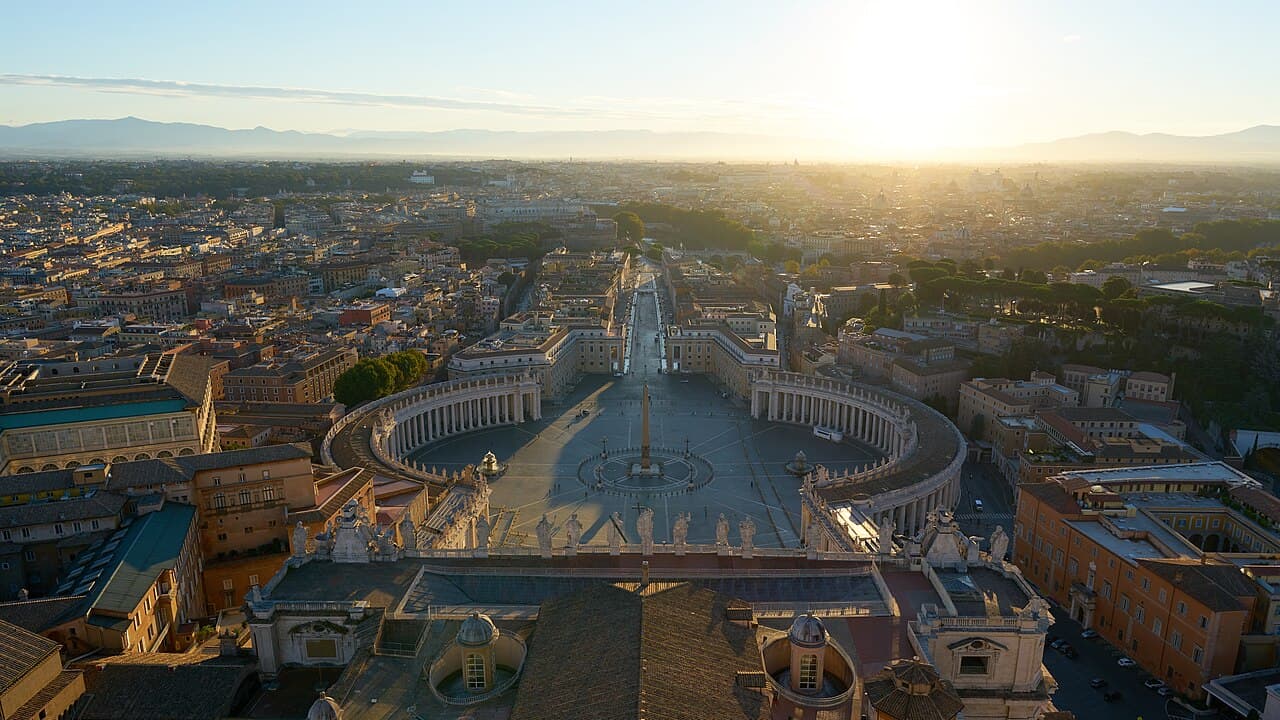
Vatican CityPhoto: Radek Kucharski from Warsaw, Poland / Wikimedia Commons (CC BY 2.0)

Vatican City

Country · VA · EUR · Europe/Rome

This information may change. Always check the official source.Last verified: August 2026 by

There is no border and no passport check - if you can be in Italy, you can walk into the Vatican.

  • There are no border controls between Italy and Vatican City.
  • You walk across St Peter's Square from Rome and you have changed country. Nobody looks at anything.
  • Security screening at St Peter's Basilica and the Museums is airport-style, with bag scanning. Expect a queue.
  • The dress code is enforced at the entrance - see the everyday section. People are turned away daily.
  • The Vatican Museums are ticketed and should be booked online well in advance - the walk-up queue can run for hours.
More details

You just walk in

  • There are no border controls between Italy and Vatican City.
  • You walk across St Peter's Square from Rome and you have changed country. Nobody looks at anything.
  • Whatever admits you to Italy admits you here. There is no Vatican visa and no separate allowance.
  • Days here are days in Italy for your Schengen 90/180.
  • Vatican City is not in the EU or Schengen as a matter of law, and it makes no practical difference to a visitor.

What is actually checked

The controls here are about behaviour, not nationality.

  • Security screening at St Peter's Basilica and the Museums is airport-style, with bag scanning. Expect a queue.
  • The dress code is enforced at the entrance - see the everyday section. People are turned away daily.
  • Large bags, tripods and knives are refused at the basilica and there is limited cloakroom space.

The Museums

  • The Vatican Museums are ticketed and should be booked online well in advance - the walk-up queue can run for hours.
  • St Peter's Basilica itself is free and has its own separate, faster-moving security queue.
  • They are different entrances on opposite sides of the walls. People routinely queue for the wrong one.
Sources (2)

The Vatican is outside the EU customs territory, but its tax-free shops are for permit holders, not for tourists.

  • There is no customs border to cross. The Vatican has no controls of its own, and everyone arrives through Italy, so Italian and EU customs rules are what applied to you on the way in.
  • The tax-free shops are not open to visitors. The Annona supermarket and the department store are restricted to Vatican employees, residents and holders of a special card, and the queues you see are staff, not tourists.
  • The Vatican Pharmacy is the exception most travellers can use. It sells medicines not licensed in Italy and works on prescriptions, and you can enter it with your passport through the Sant'Anna gate.
More details
  • There is no customs border to cross. The Vatican has no controls of its own, and everyone arrives through Italy, so Italian and EU customs rules are what applied to you on the way in.
  • The tax-free shops are not open to visitors. The Annona supermarket and the department store are restricted to Vatican employees, residents and holders of a special card, and the queues you see are staff, not tourists.
  • The Vatican Pharmacy is the exception most travellers can use. It sells medicines not licensed in Italy and works on prescriptions, and you can enter it with your passport through the Sant'Anna gate.
  • Buying there and carrying goods into Italy is legally an import, because the Vatican is outside the EU customs territory even though nobody checks.
  • The euro is legal tender under an agreement with the EU, and Vatican-minted coins are collectors' items rather than something you will be handed as change.
Sources (1)

Vatican City

Long-term averages for Vatican City: the mean daily high, the mean overnight low and the mean monthly rainfall across 30 years of ERA5 reanalysis data (1995–2024).

DayNight
0102030°C0200mmJanFebMarAprMayJunJulAugSepOctNovDecJanuary: Day 12 °C, Night 4 °C, Rain 72 mm. February: Day 13 °C, Night 4 °C, Rain 76 mm. March: Day 15 °C, Night 6 °C, Rain 82 mm. April: Day 18 °C, Night 9 °C, Rain 76 mm. May: Day 23 °C, Night 13 °C, Rain 63 mm. June: Day 28 °C, Night 17 °C, Rain 36 mm. July: Day 31 °C, Night 20 °C, Rain 23 mm. August: Day 31 °C, Night 20 °C, Rain 28 mm. September: Day 26 °C, Night 17 °C, Rain 88 mm. October: Day 21 °C, Night 13 °C, Rain 106 mm. November: Day 16 °C, Night 9 °C, Rain 141 mm. December: Day 13 °C, Night 5 °C, Rain 104 mm
Show the monthly table
Vatican City
MonthDay (°C)Night (°C)Rain (mm)
January12472
February13476
March15682
April18976
May231363
June281736
July312023
August312028
September261788
October2113106
November169141
December135104

When to visit

Vatican City's weather is Rome's weather over half a square kilometre of open stone. April to May and September to October are the months in the band; the Wednesday audience is the other half of the timing question.

The numbers here are Rome's, because the country is less than half a square kilometre inside it. July and August average 31 C by day, and April to May and September to October - 18-26 C - are the months this page picks, the standard two-shoulder Roman answer.

More details

Rome's climate, with none of Rome's shade

The numbers here are Rome's, because the country is less than half a square kilometre inside it. July and August average 31 C by day, and April to May and September to October - 18-26 C - are the months this page picks, the standard two-shoulder Roman answer.

What makes the Vatican a harder August than the rest of Rome is the ground plan. St Peter's Square is open stone with a colonnade round the edge and nothing in the middle; the museum queue forms along a wall on the Viale Vaticano. The rest of Rome has narrow streets, awnings and trees. A 31 C afternoon spent standing in the square is not the same 31 C as a 31 C afternoon in Trastevere, and the dress code - shoulders and knees covered inside the basilica and the museums - is not negotiable on account of the heat.

The wet end of the year is autumn: November takes 141 mm and October 106, against 23 mm in July.

Wednesday is a date, not a coincidence

The other half of timing a visit here has nothing to do with weather. The Papal Audience is held every Wednesday, except when the Pope has other commitments, in St Peter's Square or in the Paul VI Hall, and free tickets are requested through the Prefecture of the Papal Household.

Which of the two venues is used varies, and the square holds many times what the hall does. Either way a Wednesday morning is the busiest the site gets in a normal week, and the basilica's own access is affected by it. If you want the basilica quiet, pick another weekday; if you want the audience, Wednesday is the only day it exists.

Sources (2)

Data in Vatican City

You are on Italian networks the whole time, so EU roaming applies and an Italy eSIM is the thing to buy.

  • Vatican City is 0.44 square kilometres inside Rome, and you walk in past a line on the pavement. Your phone stays on the Italian network it was already using.
  • An Italy plan is the correct product for the whole trip, St Peter's included.
  • The Vatican Museums are dense stone and very crowded, and a signal that works outside can be poor in the galleries. Download your tickets and any audio guide before going in rather than relying on a live connection at the turnstile.
  • An eSIM is live before you land and skips the shop entirely, which on a short trip is the whole argument for it.
More details

It is Rome's network

  • Vatican City is 0.44 square kilometres inside Rome, and you walk in past a line on the pavement. Your phone stays on the Italian network it was already using.
  • Italy is in the EU, so roam-like-at-home applies: an EU or EEA SIM works at your domestic rates, on your domestic allowance.
  • There is no Vatican SIM to buy and no reason to look for one. Vatican City has its own telephone service for the institution, not a consumer mobile network for visitors.
  • UK plans are a separate question. Several UK networks reintroduced European roaming charges after Brexit, so check yours rather than assuming.

If you need a travel eSIM, buy Italy

  • An Italy plan is the correct product for the whole trip, St Peter's included.
  • Buy it for the length of your Rome stay, not for the afternoon inside the walls.

Inside the walls

  • The Vatican Museums are dense stone and very crowded, and a signal that works outside can be poor in the galleries. Download your tickets and any audio guide before going in rather than relying on a live connection at the turnstile.
  • Queue-time and ticketing all happen on your phone, which is the practical reason to arrive with working data rather than hunting for wi-fi.

eSIM

  • An eSIM is live before you land and skips the shop entirely, which on a short trip is the whole argument for it.
  • Check your phone takes one. Most flagship phones since 2019 do; most budget models do not.

Practical points

  • Keep your home number reachable for two-factor codes. If you swap in a local SIM as your only card, bank apps that text a code to your home number stop working at the worst possible moment. A dual-SIM phone, or an eSIM alongside your home SIM, solves it.
  • Wi-fi is widespread in cafes, hotels and stations.
Sources (2)

The Vatican is wired to the Italian standard: Type and Schuko sockets at 230 V.

  • Type is the three-in-line Italian socket with the earth in the middle; the common bipasso version also takes a Europlug.
  • A Schuko plug fits the modern hybrid outlets and not the older narrow ones.
  • British, American and Australian plugs need an adapter.
  • 230 V, so only American 120 V-only equipment needs a converter.
  • There is nowhere to buy an adapter inside the walls, so this is a Rome problem solved before you arrive.
More details

Sockets in Vatican City are Type , and at 230 V, 50 Hz - the Italian arrangement, since the supply and the fittings come from Rome.

  • Type is the three-in-line Italian socket with the earth in the middle; the common bipasso version also takes a Europlug.
  • A Schuko plug fits the modern hybrid outlets and not the older narrow ones.
  • British, American and Australian plugs need an adapter.
  • 230 V, so only American 120 V-only equipment needs a converter.
  • There is nowhere to buy an adapter inside the walls, so this is a Rome problem solved before you arrive.
  • The Vatican generates some of its own power from the roof of the Nervi hall, but the sockets are ordinary Italian ones on the Roman grid.
Sources (1)

Visiting Vatican City: the rules that are enforced

The dress code turns people away every day, and it applies to men as well as women.

  • Shoulders must be covered. No vest tops, no strappy dresses, no bare shoulders.
  • Knees must be covered. No shorts, no short skirts - this applies to men too, and men in shorts are turned away from St Peter's constantly in July.
  • Silence is required and is enforced by guards who say "Silenzio" out loud, repeatedly.
  • Photography is prohibited in the Sistine Chapel specifically - permitted in most of the rest of the Museums.
  • Language: Italian in practice, Latin officially. Staff speak English.
More details

The dress code

This is the thing that actually stops people getting in, and it is enforced at the door by staff who do this all day.

  • Shoulders must be covered. No vest tops, no strappy dresses, no bare shoulders.
  • Knees must be covered. No shorts, no short skirts - this applies to men too, and men in shorts are turned away from St Peter's constantly in July.
  • No hats inside the basilica.
  • A scarf or a light shawl in your bag solves it and street vendors outside sell them at a markup to people who arrive unprepared.
  • The same rules apply at the Museums and at the Sistine Chapel.

The Sistine Chapel

  • Silence is required and is enforced by guards who say "Silenzio" out loud, repeatedly.
  • Photography is prohibited in the Sistine Chapel specifically - permitted in most of the rest of the Museums.
  • It is at the end of a long one-way route through the Museums; budget two to three hours to reach it.

Practical

  • Language: Italian in practice, Latin officially. Staff speak English.
  • 230 V, 50 Hz, sockets type , and - as in Italy.
  • The country is 0.44 km2 with a population of a few hundred. There is no accommodation, no public transport and no ordinary shops - which is why this guide is shorter than the others, and why the Italy page covers the rest.
  • Wednesday mornings are the Papal Audience and the square fills; Sunday noon is the Angelus. Both are free and both make everything else slower.
Sources (2)

The euro, coins that never reach circulation, and a post office people genuinely queue for.

  • Vatican City uses the euro under a monetary agreement with the EU, and mints its own coins.
  • Vatican euro coins are minted in tiny numbers and are collectors' items - you will never receive one as change.
  • The Vatican post office is a working postal service with its own stamps, and posting a card from it is a genuine tradition.
  • Post it in the Vatican's own yellow boxes, not Italian ones - a Vatican stamp in an Italian box goes nowhere.
  • The Museums have a fixed admission; book online to skip the queue and pay a small booking fee.
More details

The currency

  • Vatican City uses the euro under a monetary agreement with the EU, and mints its own coins.
  • Vatican euro coins are minted in tiny numbers and are collectors' items - you will never receive one as change.
  • Cards work in the Museums and the shops.

The post office

  • The Vatican post office is a working postal service with its own stamps, and posting a card from it is a genuine tradition.
  • Post it in the Vatican's own yellow boxes, not Italian ones - a Vatican stamp in an Italian box goes nowhere.
  • It has a reputation for being faster than the Italian post, which is a low bar and, by most accounts, true.

Prices

  • The Museums have a fixed admission; book online to skip the queue and pay a small booking fee.
  • Everything else nearby is Roman tourist pricing. Walk five minutes into Prati for a normal-priced lunch.
Sources (2)

You are arriving in Rome; Fiumicino and Ciampino are the airports and the Vatican is a metro ride from either.

  • Fiumicino (FCO) is Rome's main airport - the Leonardo Express reaches Termini in 32 minutes.
  • Ciampino (CIA) is the low-cost airport - the Ciampino Airlink combines a bus and train to Termini for about EUR 2.70.
  • Metro line A to Ottaviano is the standard route - about 15 minutes, and a short walk to the Museums entrance.
  • Cipro is the other useful stop, slightly closer to the Museums.
  • The Vatican is walkable from much of central Rome, across the Tiber from Castel Sant'Angelo.
More details
You are arriving in Rome

Vatican City has no airport, no railway station for passengers and no port. Every arrival is a Rome arrival.

  • Fiumicino (FCO) is Rome's main airport - the Leonardo Express reaches Termini in 32 minutes.
  • Ciampino (CIA) is the low-cost airport - the Ciampino Airlink combines a bus and train to Termini for about EUR 2.70.
  • Both have their own pages here.
From Termini to the Vatican
  • Metro line A to Ottaviano is the standard route - about 15 minutes, and a short walk to the Museums entrance.
  • Cipro is the other useful stop, slightly closer to the Museums.
  • For St Peter's Square itself, Ottaviano and then a walk down Via Ottaviano is the simplest approach.
  • Bus 40 and 64 from Termini run to Largo Argentina and towards the Vatican, and are notorious pickpocket routes - see the safety note.
On foot
  • The Vatican is walkable from much of central Rome, across the Tiber from Castel Sant'Angelo.
  • The approach along Via della Conciliazione is the one to take at least once.
Sources (2)

There is no driving in Vatican City for visitors: no public parking, and Rome's traffic zones surround it.

  • There is no visitor parking. The car parks inside are for residents and staff, and St Peter's Square is pedestrian.
  • Rome's ZTL zones surround the approach, and a hire car photographed entering one collects a fine weeks later through the rental company.
  • The nearest practical parking is Gianicolo or a station car park, and both mean a walk or a bus.
  • Italian rules apply outside the walls, including the 0.5 g/l alcohol limit and toll motorways to reach Rome.
  • The metro Line A to Ottaviano is how nearly everyone arrives, and it is a five-minute walk from there.
More details

Not somewhere you drive. The entire state is 0.44 km2 and closed to visiting traffic.

  • There is no visitor parking. The car parks inside are for residents and staff, and St Peter's Square is pedestrian.
  • Rome's ZTL zones surround the approach, and a hire car photographed entering one collects a fine weeks later through the rental company.
  • The nearest practical parking is Gianicolo or a station car park, and both mean a walk or a bus.
  • Italian rules apply outside the walls, including the 0.5 g/l alcohol limit and toll motorways to reach Rome.
  • The metro Line A to Ottaviano is how nearly everyone arrives, and it is a five-minute walk from there.
Sources (1)

The Vatican itself is one of the safest places in Europe; the queues outside it are among the most worked.

  • St Peter's Square, the Museums queue and the metro to Ottaviano are heavily worked by pickpockets. This is one of the most reliable spots in Europe for it.
  • Bus 64 from Termini has a long-standing reputation and is worth avoiding with valuables.
  • People selling "skip the line" tickets outside the Museums are numerous and mostly legitimate tour resellers charging a large markup.
  • Some are not legitimate at all.
  • The Vatican itself is extremely secure with airport-style screening and a large gendarmerie presence.
More details

The queue is the risk

  • St Peter's Square, the Museums queue and the metro to Ottaviano are heavily worked by pickpockets. This is one of the most reliable spots in Europe for it.
  • Bus 64 from Termini has a long-standing reputation and is worth avoiding with valuables.
  • Keep bags closed and in front of you, and be alert exactly when you are distracted - looking up, taking a photograph, being jostled in a queue.

Ticket touts

  • People selling "skip the line" tickets outside the Museums are numerous and mostly legitimate tour resellers charging a large markup.
  • Some are not legitimate at all.
  • Book on the official Vatican Museums site before you travel and none of this applies to you.
  • Nobody official approaches you in the street to sell a ticket.

Inside

  • The Vatican itself is extremely secure with airport-style screening and a large gendarmerie presence.
  • Crowds are the practical hazard - the basilica and the Sistine Chapel get very dense, and it is hot in summer.
  • There is limited shade in St Peter's Square and the summer queue is fully exposed. Water and a hat matter more than they sound.
Sources (2)

Use the Italian numbers - 112 works, and in practice you are in Rome.

  • 112 works from any phone, free, with no credit and no SIM, and operators handle English.
  • Report a theft to the police and get a written record. No insurer will pay a claim without one, and obtaining it later from another country is close to impossible.
  • A lost passport means the police first, then your embassy.
  • Save 112 in your phone now, and write your accommodation's address somewhere that does not depend on a charged battery.
  • No country has an embassy inside Vatican City - there is no room for one in half a square kilometre. Every embassy to the Holy See sits in Rome, on Italian soil, and so does the embassy you would actually need.
More details

The numbers

Emergency numbers in Vatican City
ServiceNumber
All emergencies112
Police (Italy)113
Ambulance (Italy)118
Fire (Italy)115
  • 112 works from any phone, free, with no credit and no SIM, and operators handle English.

If you need help

  • Report a theft to the police and get a written record. No insurer will pay a claim without one, and obtaining it later from another country is close to impossible.
  • A lost passport means the police first, then your embassy.
  • Your embassy cannot pay your bills or get you out of jail, but it can issue emergency travel documents, contact your family and provide lists of local lawyers and doctors.

Before you need them

  • Save 112 in your phone now, and write your accommodation's address somewhere that does not depend on a charged battery.

  • No country has an embassy inside Vatican City - there is no room for one in half a square kilometre. Every embassy to the Holy See sits in Rome, on Italian soil, and so does the embassy you would actually need.

  • In practice you are in Rome and the Italian services respond.

  • Inside the walls, the Vatican Gendarmerie and the Swiss Guard handle security - approach the nearest officer, who will call whatever is needed.

  • Ambassadors to the Holy See are accredited separately from those to Italy, and are not who you contact if you lose a passport - your embassy to Italy in Rome is.

Sources (2)