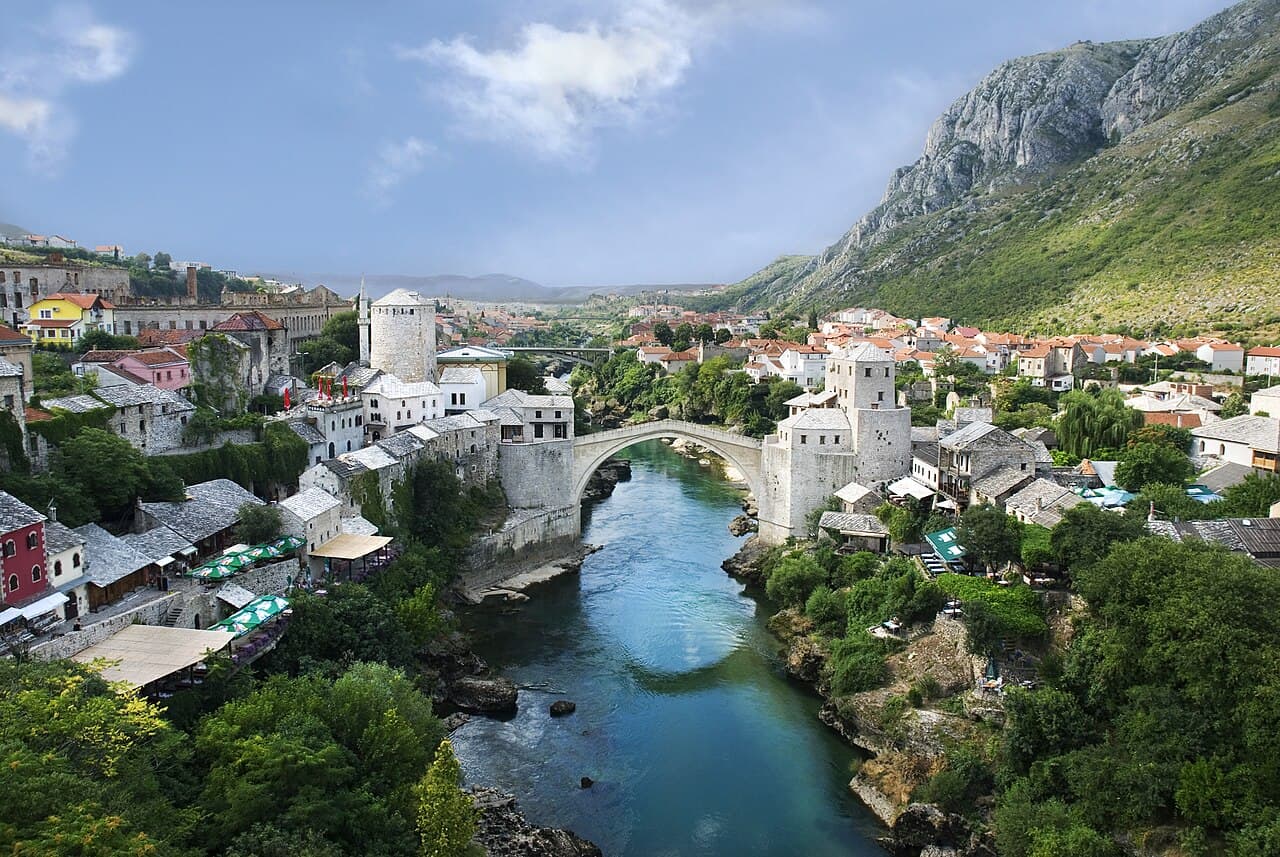
Bosnia and HerzegovinaPhoto: Ramirez / Wikimedia Commons (CC BY-SA 4.0)

Bosnia and Herzegovina

Country · BA · BAM · Europe/Sarajevo

This information may change. Always check the official source.Last verified: August 2026 by

Bosnia keeps its own 90/180 clock, and the Neum corridor means a drive down the Croatian coast crosses its border twice.

  • Bosnia and Herzegovina is outside the Schengen area and outside the EU. Its 90 days in 180 are counted separately.
  • Days spent here do not consume your Schengen allowance - which makes the region genuinely useful if you are close to your 90-day Schengen limit and want to stay in Europe.
  • Bosnia has about 20 km of Adriatic coast at Neum, which cuts Croatia's coastline in two.
  • Driving from Split to Dubrovnik crosses it - out of Croatia and Schengen, into Bosnia, then back again.
  • Register with the police within 72 hours, which is the FCDO's figure and more slack than the 24 hours often quoted. Hotels do it automatically and issue a slip; private apartments may not.
More details

The allowance is not your Schengen one

  • Bosnia and Herzegovina is outside the Schengen area and outside the EU. Its 90 days in 180 are counted separately.
  • Days spent here do not consume your Schengen allowance - which makes the region genuinely useful if you are close to your 90-day Schengen limit and want to stay in Europe.
  • Your passport is stamped on entry and exit. This country is outside EES, so the stamps are the record and you should keep the passport pages readable.
  • Crossing back into the EU re-enters Schengen and is an external border: expect the EES biometric check, and a longer queue than the drive suggests.

The Neum corridor

  • Bosnia has about 20 km of Adriatic coast at Neum, which cuts Croatia's coastline in two.
  • Driving from Split to Dubrovnik crosses it - out of Croatia and Schengen, into Bosnia, then back again.
  • Croatia's Peljesac bridge now bypasses it entirely, opened in 2022, and most through traffic uses the bridge.
  • If you do drive through Neum, you need your passport, and since Croatia joined Schengen the crossings are external EU borders in both directions.
  • Check your car hire agreement. Many Croatian rental contracts restrict or surcharge taking the vehicle into Bosnia, and a green card may be required.

Registration

  • Register with the police within 72 hours, which is the FCDO's figure and more slack than the 24 hours often quoted. Hotels do it automatically and issue a slip; private apartments may not.
Sources (2)

Bosnia is outside the EU customs union, and the Neum corridor means a Croatian coastal drive crosses two customs borders each way.

  • Every border with Croatia, Serbia and Montenegro is a customs border, with the usual regional allowance of a carton of cigarettes and a small quantity of spirits per adult.
  • The Neum corridor cuts the Croatian coast in two. Driving from Split to Dubrovnik on the old road means leaving and re-entering the EU twice; the Peljesac Bridge exists to avoid exactly that.
  • Cash above the declarable threshold must be reported in both directions, and the exit check is the one that catches people carrying a property deposit.
  • Croatia is in the EU and Schengen, so the crossing is an external EU border with full customs and passport controls.
More details
  • Every border with Croatia, Serbia and Montenegro is a customs border, with the usual regional allowance of a carton of cigarettes and a small quantity of spirits per adult.
  • The Neum corridor cuts the Croatian coast in two. Driving from Split to Dubrovnik on the old road means leaving and re-entering the EU twice; the Peljesac Bridge exists to avoid exactly that.
  • Cash above the declarable threshold must be reported in both directions, and the exit check is the one that catches people carrying a property deposit.
  • Croatia is in the EU and Schengen, so the crossing is an external EU border with full customs and passport controls.
  • Bringing meat, cheese and other animal products into the EU from Bosnia is prohibited for personal use, even in small quantities - the smoked ham in the back seat is the classic seizure.
Sources (1)

No EHIC; insurance is essential, and the best hospitals are in Sarajevo.

  • The EHIC and GHIC do not apply. Travel insurance is essential, including repatriation.
  • Some countries hold bilateral healthcare agreements with Bosnia; they cover less than an EHIC.
  • Sarajevo has the main hospitals; elsewhere facilities are basic.
  • Tap water is safe in Sarajevo and the main towns.
  • Pharmacies (apoteka) are well stocked.
More details

Cover

  • The EHIC and GHIC do not apply. Travel insurance is essential, including repatriation.
  • Some countries hold bilateral healthcare agreements with Bosnia; they cover less than an EHIC.
  • Sarajevo has the main hospitals; elsewhere facilities are basic.

Everyday health

  • Tap water is safe in Sarajevo and the main towns.
  • Pharmacies (apoteka) are well stocked.
  • Ticks are present in forests - the usual precautions.
  • Air quality in Sarajevo is very poor in winter, when the valley traps smog. If you are asthmatic, this is a real consideration for a December to February visit.
Sources (2)

Sarajevo

Long-term averages for Sarajevo: the mean daily high, the mean overnight low and the mean monthly rainfall across 30 years of ERA5 reanalysis data (1995–2024).

DayNight
-551525°C0200mmJanFebMarAprMayJunJulAugSepOctNovDecJanuary: Day 5 °C, Night -4 °C, Rain 86 mm. February: Day 6 °C, Night -3 °C, Rain 89 mm. March: Day 10 °C, Night 0 °C, Rain 88 mm. April: Day 15 °C, Night 5 °C, Rain 99 mm. May: Day 20 °C, Night 9 °C, Rain 111 mm. June: Day 24 °C, Night 13 °C, Rain 104 mm. July: Day 26 °C, Night 15 °C, Rain 89 mm. August: Day 26 °C, Night 15 °C, Rain 75 mm. September: Day 21 °C, Night 11 °C, Rain 89 mm. October: Day 17 °C, Night 7 °C, Rain 84 mm. November: Day 11 °C, Night 3 °C, Rain 108 mm. December: Day 6 °C, Night -2 °C, Rain 107 mm
Show the monthly table
Sarajevo
MonthDay (°C)Night (°C)Rain (mm)
January5-486
February6-389
March10088
April15599
May209111
June2413104
July261589
August261575
September211189
October17784
November113108
December6-2107

Mostar

Long-term averages for Mostar: the mean daily high, the mean overnight low and the mean monthly rainfall across 30 years of ERA5 reanalysis data (1995–2024).

DayNight
0102030°C0500mmJanFebMarAprMayJunJulAugSepOctNovDecJanuary: Day 9 °C, Night 0 °C, Rain 168 mm. February: Day 10 °C, Night 1 °C, Rain 156 mm. March: Day 13 °C, Night 3 °C, Rain 150 mm. April: Day 18 °C, Night 7 °C, Rain 150 mm. May: Day 22 °C, Night 12 °C, Rain 131 mm. June: Day 27 °C, Night 16 °C, Rain 77 mm. July: Day 30 °C, Night 18 °C, Rain 41 mm. August: Day 31 °C, Night 18 °C, Rain 60 mm. September: Day 25 °C, Night 14 °C, Rain 160 mm. October: Day 20 °C, Night 10 °C, Rain 180 mm. November: Day 14 °C, Night 6 °C, Rain 253 mm. December: Day 10 °C, Night 2 °C, Rain 217 mm
Show the monthly table
Mostar
MonthDay (°C)Night (°C)Rain (mm)
January90168
February101156
March133150
April187150
May2212131
June271677
July301841
August311860
September2514160
October2010180
November146253
December102217
Sources (1)

Cheap, and Mostar empties completely once the day-trip buses leave.

  • Mostar is a day trip for most visitors - coaches from Dubrovnik and Split arrive mid-morning and leave mid-afternoon.
  • Staying the night is the whole point. The bridge without the crowds, at dusk, is a different place.
  • Bascarsija is the old Ottoman quarter and is where most visitors stay.
  • Prices are low by European standards.
  • Registration within 72 hours - see the entry section; hotels handle it.
More details

Mostar after five o'clock

  • Mostar is a day trip for most visitors - coaches from Dubrovnik and Split arrive mid-morning and leave mid-afternoon.
  • Staying the night is the whole point. The bridge without the crowds, at dusk, is a different place.
  • Accommodation is cheap and the old town is small.

Sarajevo

  • Bascarsija is the old Ottoman quarter and is where most visitors stay.
  • Prices are low by European standards.
  • Winter is cold and foggy, and the 1984 Olympic mountains are half an hour away.

Practicalities

  • Registration within 72 hours - see the entry section; hotels handle it.
  • Cash is still needed outside the cities.
Sources (1)

EU roaming does NOT apply here - Bosnia and Herzegovina is outside the EU, so a European SIM roams at foreign rates unless your operator includes the Western Balkans.

  • Bosnia and Herzegovina is outside the EU, so roam-like-at-home does not apply. A European SIM roams at whatever your operator charges for a non-EU country, which can be brutal.
  • BH Telecom - https://www.bhtelecom.ba/
  • An eSIM is live before you land and skips the shop entirely, which on a short trip is the whole argument for it.
  • Keep your home number reachable for two-factor codes. If you swap in a local SIM as your only card, bank apps that text a code to your home number stop working at the worst possible moment. A dual-SIM phone, or an eSIM alongside your home SIM, solves it.
More details

Your EU plan does not cover you here

This is the trap, and it is the reverse of everywhere else in this part of Europe.

  • Bosnia and Herzegovina is outside the EU, so roam-like-at-home does not apply. A European SIM roams at whatever your operator charges for a non-EU country, which can be brutal.
  • Some EU operators now include the Western Balkans in their roaming zones - a regional agreement has pushed prices down - but it is opt-in by operator, not automatic. Check yours before you land.
  • Turn off data roaming on arrival until you have checked.

Local prepaid SIM

eSIM

  • An eSIM is live before you land and skips the shop entirely, which on a short trip is the whole argument for it.
  • Check your phone takes one. Most flagship phones since 2019 do; most budget models do not.

Practical points

  • Keep your home number reachable for two-factor codes. If you swap in a local SIM as your only card, bank apps that text a code to your home number stop working at the worst possible moment. A dual-SIM phone, or an eSIM alongside your home SIM, solves it.
  • Wi-fi is widespread in cafes, hotels and stations.
Sources (3)

Bosnian sockets are Type Schuko at 230 V, matching the whole western Balkans.

  • A Europlug fits every socket in the country.
  • Croatia, Serbia, Montenegro and Slovenia all match, so a Balkans road trip needs one adapter at most.
  • British, American and Australian plugs need an adapter.
  • Older housing has unearthed sockets that look identical to the earthed ones from the front.
  • 230 V, so only American 120 V-only appliances need a converter.
More details

Sockets in Bosnia and Herzegovina are Type and at 230 V, 50 Hz - the round Schuko outlet.

  • A Europlug fits every socket in the country.
  • Croatia, Serbia, Montenegro and Slovenia all match, so a Balkans road trip needs one adapter at most.
  • British, American and Australian plugs need an adapter.
  • Older housing has unearthed sockets that look identical to the earthed ones from the front.
  • 230 V, so only American 120 V-only appliances need a converter.
  • British, American and Australian plugs all need the same adapter, and one universal unit covers the whole Balkan route.
  • Mountain guesthouses in Bosnia often run one circuit for a whole floor, so a hair dryer and a kettle together trip it.
Sources (1)

Type sockets, three peoples and two alphabets, and coffee that is a ceremony rather than a drink.

  • 230 V, 50 Hz, sockets type and .
  • Bosnian, Croatian and Serbian are mutually intelligible and officially distinct; Latin and Cyrillic are both used, with Cyrillic dominant in Republika Srpska.
  • Bosnian coffee is served in a dzezva with a copper tray, rahat lokum and a glass of water, and is meant to take an hour.
  • It is not Turkish coffee and saying so is a small mistake with a long history behind it.
  • Take your shoes off indoors.
More details

Power and language

  • 230 V, 50 Hz, sockets type and .
  • Bosnian, Croatian and Serbian are mutually intelligible and officially distinct; Latin and Cyrillic are both used, with Cyrillic dominant in Republika Srpska.
  • English is widely spoken by younger people.
  • "Dobar dan" is hello, "hvala" is thank you.

Coffee

  • Bosnian coffee is served in a dzezva with a copper tray, rahat lokum and a glass of water, and is meant to take an hour.
  • It is not Turkish coffee and saying so is a small mistake with a long history behind it.

Manners

  • Take your shoes off indoors.
  • Mosques welcome visitors outside prayer times - cover shoulders and knees, remove shoes, and women should cover their hair. Scarves are usually provided.
  • The war is discussed openly and personally. Listen; do not offer a verdict.
Sources (1)

The convertible mark is pegged to the euro at a fixed rate, so prices convert predictably - but pay in marks, not euros.

  • The currency is the convertible mark (BAM, or KM locally).
  • It is pegged to the euro at a fixed rate - the peg dates from the Deutschmark it was designed to replace - so prices convert predictably.
  • Always refuse the machine's offer to charge you in your own currency. Dynamic currency conversion at an ATM or a card terminal costs several per cent, every time, and the offer is worded to sound helpful. Choose the local currency and let your own bank convert.
  • Use bank ATMs rather than the independent machines in tourist areas, which add their own fee on top.
  • Rounding up is normal, 10 per cent for good restaurant service.
More details

The convertible mark

  • The currency is the convertible mark (BAM, or KM locally).
  • It is pegged to the euro at a fixed rate - the peg dates from the Deutschmark it was designed to replace - so prices convert predictably.
  • Euro cash is often accepted in tourist areas at a rate that favours the seller. Pay in marks.
  • Cards work in cities, less so in villages.

ATMs

  • Always refuse the machine's offer to charge you in your own currency. Dynamic currency conversion at an ATM or a card terminal costs several per cent, every time, and the offer is worded to sound helpful. Choose the local currency and let your own bank convert.
  • Use bank ATMs rather than the independent machines in tourist areas, which add their own fee on top.
  • Beware the standalone Euronet machines in tourist areas across the region. They add a large fee and push dynamic currency conversion hard. Use a bank's own machine.

Tipping

  • Rounding up is normal, 10 per cent for good restaurant service.
Sources (2)

Everyday prices

Typical prices in convertible mark (BAM), averaged across the country by Numbeo and read on 19 August 2026. Tick Convert prices above the table to see every amount in your own currency.

Everyday prices
ItemTypical price
Inexpensive restaurant meal13 BAM
Dinner for two, mid-range, three courses60 BAM
Cappuccino2.91 BAM
Local draught beer, 0.5 l4.00 BAM
Bottled water, 0.33 l2.21 BAM
Public transport, one-way ticket2.20 BAM
Taxi, starting fare2.50 BAM
Petrol, 1 litre2.70 BAM
Cigarettes, pack of 20 (Marlboro)6.50 BAM
Average net monthly salary1,440 BAM

These are country-wide averages, not a price list: tourist districts, airports and islands sit well above them, and small towns below. The salary line is there for proportion - it is what people living here actually earn.

Sources (1)

Airport guides for Bosnia and Herzegovina3

One page per airport: the routes into town, what they cost and the trap particular to that arrival.

See all 3 airports

Sarajevo airport is close to town and the tram is the cheap way in; taxis should be agreed in advance.

  • The airport is about 6 km from the old town - a short trip by the standards of this site.
  • Trolleybus 103 and local buses run nearby, and the tram network reaches Ilidza, from where the city is a straight run east.
  • Taxis are the practical choice with luggage. Agree the fare before setting off, or use the official rank.
  • Tuzla is the Wizz Air airport and is a long way from Sarajevo - about three hours by road. Check which airport your flight uses.
  • Mostar has limited seasonal service.
More details
Sarajevo (SJJ)
  • The airport is about 6 km from the old town - a short trip by the standards of this site.
  • Trolleybus 103 and local buses run nearby, and the tram network reaches Ilidza, from where the city is a straight run east.
  • Taxis are the practical choice with luggage. Agree the fare before setting off, or use the official rank.
  • Sarajevo Taxi and similar apps work and remove the negotiation.
  • The airport closes in heavy fog - it sits in a valley and winter diversions to Mostar or Belgrade happen.
Mostar, Banja Luka, Tuzla
  • Tuzla is the Wizz Air airport and is a long way from Sarajevo - about three hours by road. Check which airport your flight uses.
  • Mostar has limited seasonal service.
  • Dubrovnik and Split in Croatia are common arrival points for Mostar and the Herzegovina south.
Sources (2)

Buses do everything; the Sarajevo to Mostar train is slow, cheap and one of the best rides in Europe.

  • Sarajevo to Mostar takes about two hours through the Neretva canyon and is one of the most scenic rail journeys in Europe.
  • It is cheap and infrequent - a couple of services a day.
  • Everything else is a bus, and the network is comprehensive.
  • Sarajevo has two bus stations - one in the Federation, one in East Sarajevo (Republika Srpska) - and they serve different destinations. Check which one your ticket uses; this catches people.
  • Roads are winding and slow. Distances on a map understate journey times badly here.
More details

The Mostar train

  • Sarajevo to Mostar takes about two hours through the Neretva canyon and is one of the most scenic rail journeys in Europe.
  • It is cheap and infrequent - a couple of services a day.
  • Sit on the right leaving Sarajevo.

Buses

  • Everything else is a bus, and the network is comprehensive.
  • Sarajevo has two bus stations - one in the Federation, one in East Sarajevo (Republika Srpska) - and they serve different destinations. Check which one your ticket uses; this catches people.

Driving

  • Roads are winding and slow. Distances on a map understate journey times badly here.
  • Fuel stations are sparse in the mountains.
  • Winter equipment is compulsory from 1 November to 15 April.
Sources (2)

Bosnian motorways charge at booths, the mountain roads are slow, and off-road driving carries a mine risk in some areas.

  • Do not drive or park off marked roads in areas still being cleared of mines from the 1990s. The hazard is real, marked where known, and the reason nobody parks on the verge outside towns.
  • The A1 motorway is tolled at booths; most of the country is served by two-lane roads through the mountains at 40 to 60 km/h.
  • A green card is required for a foreign-registered car.
  • The alcohol limit is 0.3 g/l, and zero for anyone under 21 or holding a licence less than three years.
  • Winter equipment is compulsory from 1 November to 15 April, and the routes over Vlasic and to Sarajevo close in heavy snow.
More details

Toll booths on the short motorway network, and rules about where not to go that are unlike anywhere else in Europe.

  • Do not drive or park off marked roads in areas still being cleared of mines from the 1990s. The hazard is real, marked where known, and the reason nobody parks on the verge outside towns.
  • The A1 motorway is tolled at booths; most of the country is served by two-lane roads through the mountains at 40 to 60 km/h.
  • A green card is required for a foreign-registered car.
  • The alcohol limit is 0.3 g/l, and zero for anyone under 21 or holding a licence less than three years.
  • Winter equipment is compulsory from 1 November to 15 April, and the routes over Vlasic and to Sarajevo close in heavy snow.
Sources (1)

Landmines from the 1990s war are still in the ground - stay on hard surfaces and marked paths, and this is not a historical footnote.

  • Mines and unexploded ordnance from the 1992-95 war remain in the ground across parts of the country.
  • Clearance is ongoing and incomplete. Bosnia is among the most mine-affected countries in Europe.
  • Violent crime against visitors is rare.
  • The country's constitutional arrangement is contested and periodically tense. It does not affect visitors.
  • Mountain roads are demanding and fog is a serious hazard in the valleys.
More details

Landmines

This is the one genuinely serious safety point in this guide, and it is thirty years old and still current.

  • Mines and unexploded ordnance from the 1992-95 war remain in the ground across parts of the country.
  • Clearance is ongoing and incomplete. Bosnia is among the most mine-affected countries in Europe.
  • Stay on hard surfaces, marked paths and areas in regular use. Do not walk into abandoned villages, overgrown fields, forest edges or ruined buildings.
  • Marking is inconsistent. Some areas carry red-and-white tape or skull signs; some contaminated ground carries nothing at all.
  • Do not touch any munition you see. Report it and move away by the route you came.
  • This does not make Bosnia dangerous to visit. Cities, roads, trails in regular use and tourist sites are safe. It makes wandering off them a genuinely bad idea, in a way that is not true anywhere else in Europe.

Crime

  • Violent crime against visitors is rare.
  • Pickpocketing in Sarajevo's old town is the usual level.
  • Stray dogs are common in Sarajevo and can be aggressive in packs at night.

Politics

  • The country's constitutional arrangement is contested and periodically tense. It does not affect visitors.
  • The 1990s are living memory and personal. Follow your host's lead on the subject.

Roads and weather

  • Mountain roads are demanding and fog is a serious hazard in the valleys.
  • Winter equipment is compulsory from 1 November to 15 April.
Sources (2)

122 police, 123 fire, 124 ambulance - 112 works but the local numbers are more reliable.

  • 112 works from any phone, free, with no credit and no SIM, and operators handle English.
  • Report a theft to the police and get a written record. No insurer will pay a claim without one, and obtaining it later from another country is close to impossible.
  • A lost passport means the police first, then your embassy.
  • Save 112 in your phone now, and write your accommodation's address somewhere that does not depend on a charged battery.
  • Not every country keeps an embassy in Bosnia and Herzegovina. Several cover it from a neighbouring capital - check yours before you need to know.
More details

The numbers

Emergency numbers in Bosnia and Herzegovina
ServiceNumber
Police122
Fire123
Ambulance124
European emergency112
  • 112 works from any phone, free, with no credit and no SIM, and operators handle English.

If you need help

  • Report a theft to the police and get a written record. No insurer will pay a claim without one, and obtaining it later from another country is close to impossible.
  • A lost passport means the police first, then your embassy.
  • Your embassy cannot pay your bills or get you out of jail, but it can issue emergency travel documents, contact your family and provide lists of local lawyers and doctors.

Before you need them

  • Save 112 in your phone now, and write your accommodation's address somewhere that does not depend on a charged battery.

  • Not every country keeps an embassy in Bosnia and Herzegovina. Several cover it from a neighbouring capital - check yours before you need to know.

  • Use the three-digit numbers. 112 works but coverage of it is less consistent here than the national numbers.

  • To report suspected ordnance, call the police on 122 and do not approach it.

Sources (3)